Showing posts with label Nature. Show all posts

Saturday, September 13, 2025

Incident at Hawk's Hill

"Benjamin MacDonald was following a mouse."

So begins an unusual tale set in 1870 on a small farm 20 miles from Winnipeg. Ben is six years old and very small for his age. He's an odd lad who likes to follow animals around and emulate their behaviour, preferring their company to that of his own family. 

His father thinks there's something wrong with him, while his mother feels he just needs a little more time to grow out of it. When neighbours see him clucking like a chicken and eating grass like a lamb, there's bound to be talk.

One day while out on the prairie he encounters a badger and follows it on all fours, micmicking its grunting and chattering. He is enthralled when he sees it eating a mouse, and moves close enough to offer it some baby mice from an abandoned nest. At length the badger tolerates him.

Later his family is visited by a crude trapper who proudly exhibits a dead badger that he's trapped. Ben's father worries about the safety of his young family, for he knows that badgers can be dangerous and he has already lost two horses due legs broken from stepping into badger holes. Though he doesn't like the trapper, he lets himself be goaded into skinning the badger. This results in a confrontation between Ben and his father that ends badly.

The stage is now set for the most engaging part of the novel. Ben is out on the prairie when a storm hits, and he ends up taking shelter in the den of the badger that he previously met. When he doesn't return home his family is frantic, and the story veers back and forth over a period of weeks between them and life in the badger den. This part is admirably done.

An author's note states: "The story which follows is a slightly fictionalized version of an incident which actually occurred at the time and place noted."  

The book includes eight scratchboard images by John Schoenherr. A 1975 Disney movie,The Boy Who Talked to Badgers, is very loosely based on the book. 


Saturday, June 4, 2016

The Mushroom Hunters

On the Trail of an Underground America

The bland title and cover don't do this book justice. Instead, pay attention to the subtitle, then imagine picking mushrooms with Hunter S. Thompson. Yes, guns are involved.

According to the author, mushroom hunting for profit is so secretive it shares "certain similarities with drug smuggling."

That's because there's a lot of money to be made. Some pickers go armed, and the harvesting is often done illegally in restricted areas, or in backwoods America where "your average passing motorist with a flat tire would hesitate to knock on any of the doors."

Characters

The author tags along with a couple of expert foragers who are quirky but likeable. One is a former sous-chef who supplies wild produce directly to restaurants in New York and on the West Coast. Since pickers want cash he makes frequent trips to banks, but without the slightest concern over his appearance. When setting up a new account on a buying trip to Montana, he looks homeless or deranged -- unshaven, dishevelled, hands black with dirt. "Hard work was his mantra."

The other person is a former logger and commercial fisherman who's been diagnosed with Parkinson's and is awaiting a new set of teeth. He's served in the military, spent time in drug rehab, had two dozen concussions, and drives a car called the Blue Pig. He manages without a phone, bank account, or (after three divorces) a wife. He does not use maps or GPS, yet has never gotten lost. He smokes pot through a mushroom, and once earned $6000 in two days picking matsutake.

The supporting cast is large enough to populate a novel, and includes chefs, restauranteurs, mycological geeks, meth-heads, and hardworking immigrants whose "lives had been full of tumult and misfortune." One of them says, "I don't pick for money, I pick for survival."

Mushrooms

Inherently mysterious, they take strange shapes that can be deadly, delicious, or hallucinogenic. Evolutionarily (says the author) they're closer to animals than plants, which perhaps explains common names like oyster, lobster, hedgehog, hawkwing, shaggy mane, bear's head, man-on-horseback, chicken-of-the-woods.

The adventurous author goes truffling in Oregon, picks hedgehogs in Washington, hunts for black trumpets and yellow chantarelles in northern California, and sets himself the goal of picking 100 pounds of morels in a single day in the Yukon.

Food

How about squid-ink pasta, oxtail ragu, stinging nettle soup, eider-poached oysters, Pinot-Noir-braised pork belly, and "pickled quail eggs, bone marrow, and green juniper berries."

My favourite: seven-minute duck eggs with goat-shit oil and wild purslane.

Quotes


Dried porcini have an earthiness that is quite frankly mind-blowing to the newcomer. Put your nose in a bag of dried porcini and inhale -- and be prepared to suck in the woods and the duff and the very dirt where the mushrooms live. It's a big aroma: toasty, terrestrial, rugged.

I could hear the muffled voices of two men, then the sharp ringing of at least thirty rounds of automatic gunfire unloaded into the woods mere yards from my car.

Zimmerman ran his hands through the chantarelles and chortled like a pirate sifting his pile of golden booty.


Illustrations

There aren't any, so here are three of my own.

To the left is a morel growing in Yoho National Park in BC at an altitude of 2000m. I remember picking these guys as a kid growing up on the prairies. The other two are from the Annapolis Valley at the opposite end of the country: hen-of-the-woods (not to be confused with chicken-of-the-woods) fruiting at the base of an oak tree, and a chaga mushroom (looking like a lump of burnt wood) picked by a friend of my wife. It grows on birch trees and can be used to make a medicinal "tea."


Wednesday, September 17, 2014

Merging

Contemplations on Farming and Ecology
from Horseback


Bondrup-Nielsen got his first horse at the age of 11. He was living in Denmark then, and was taught to ride by a woman whose barn was cleaner than her home. At 13 he came to Canada and now, several horses later, lives in rural Nova Scotia at the north end of the Annapolis Valley.

It's the perfect setting for a day-long ride.

There are orchards and vineyards and fields of vegetables, patches of forest and salt marsh, dykes and tidal rivers, sandy beaches and crumbling cliffs, and a sizeable basalt ridge that separates Annapolis Valley from Fundy's cobbled shore.

He visits them all and, endlessly curious, muses about nature, farming, riding, and the idiosyncrasies of his horse, Bucephalus. He recalls the excitement of a simulated fox hunt, and remembers that horses in the past wore wooden clogs while working on the dykelands.

Being mounted contributes an extra set of eyes for spotting wildlife and also provides a useful metaphor. A good rider becomes one with a horse, each responding to the other's subtle changes of body position. "To me the relationship with a horse is one of symbiosis. Should it not be so with all relationships?"

That's not the case with large-scale industrial farming, whose practices are damaging soil that took thousands of years to create. Irrigation, pesticides, chemical fertilizers, the destruction of farmland for development (after which it can never be restored), the buying practices of large grocery chains -- all are contributing to the problem.

Our infatuation with economies of scale brings forth this observation from the author:


The most depressing picture I know of is not one of giant smoke stacks pumping out pollution, of extensive clearcutting in the Amazon basin or of urban sprawl, but rather a photograph of a small shorebird, a stilt, trying desperately to incubate an egg much larger than itself.


Yet the tone throughout is genial, not hectoring, and the book itself is a beautiful artifact with thick creamy pages, original pencil drawings, and a textured handprinted dust jacket.

There's interesting trivia -- earthworms are not native to North America, mammary glands are modified sweat glands, oxygen in 3 out of 4 breaths comes from oceans.

And unusual characters -- a Hungarian hussar, a farmer with brass knuckles in his pocket, an orchardist who controls the grass beneath trees by rolling around on it.

And, best of all, examples of successful strategies used by Valley farmers -- going organic, adding value (eg turning apples into cider), bypassing large grocery chains to sell directly to consumers at local markets. "Eat local" is a frequently heard rallying cry.

The disconnect between an urbanized population on the one hand, and nature and agriculture on the other, was underlined at the book launch last week when a teacher in the audience related an anecdote: a student on learning that milk comes from udders vowed never to drink it again.

Soil is irreplaceable. Farmers too.

Think about it.

Author's website

         Back cover                    Without the dust jacket

Friday, October 7, 2011

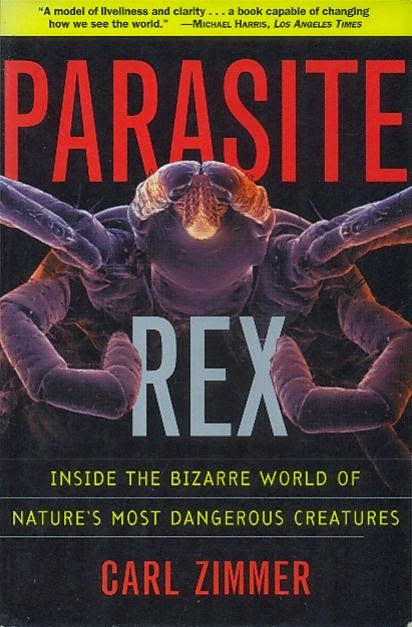
Parasite Rex

Inside the Bizarre World of Nature's Most Dangerous Creatures

It's a disturbing fact that the body of any creature, including our own, is potential habitat. We are a house and the mice want in. Or as the prologue puts it: "a vein is a river."

The life cycle of a parasite can be ingenious, complex, and gruesome, and the book provides some startling examples. Among the 16 pages of b&w photos you'll find one of a crustacean that has devoured the tongue of a fish and taken its place. But what makes this book remarkable is that it goes beyond such sensational examples and addresses broader issues.

Parasites, it seems, have been practising their trade since the dawn of life, and any ecosystem without them is likely to be unhealthy. Parasites may even have been responsible for the development of sex and language.

Then there are social parasites, like the cuckoo. Ultimately we ourselves may be seen as parasites -- with the planet our host.

Behaviour Modification

One of the truly shocking aspects of parasitism is the ability of some organisms to alter the behaviour of their host. Toxoplasma causes rats to be less wary of cats, the parasite’s final host.

Ants that have ingested lancet flukes leave their sisters and spend the night at the top of a blade of grass, the better to be consumed by a grazing mammal.

Sacculina, a parasitic barnacle, penetrates a crab’s leg joint, sends out "roots" through the crab’s entire body, and emerges as a sac on its ventral surface. The crab loses its ability to reproduce, becoming "genetically speaking, a zombie: one of the undead serving a master."


...parasites such as Sacculina...control their hosts, becoming in effect their new brain, and turning them into new creatures. It is as if the host itself is simply a puppet, and the parasite is the hand inside.


Makes one think of Heinlein’s Puppet Masters, and the movie Alien, doesn’t it? The author mentions them too.

Carl Zimmer

I enjoyed Parasite Rex so much that I immediately went out and bought two more of Zimmer’s books. Check out his website, which contains numerous articles he has written, as well as Chapter 1 from this book.

You can also find a link to his blog on Discover’s website, and there a link to a a photo gallery of scientific tattoos, the basis for a cool book coming out this fall called Science Ink.

Zimmer has had a tapeworm named after him.

A Few More Quotes


It’s time to put the parasite alongside the lion.

Castration is a strategy that any number of parasites have hit on independently...

Parasites have been a dominant force, perhaps the dominant force, in the evolution of life.

There are more human intestinal worms than humans.

Monday, May 9, 2011

The Golden Spruce

A True Story of Myth, Madness and Greed

Winner of the Governor General’s award for non-fiction in 2005 for its combination of fine writing, gripping story, and fascinating detail.

The setting is the BC rainforest and the Queen Charlotte Islands, where trees "like Tolkien's Ents" can be found.

The backstory includes the troubled history of the warlike Haida, whose totem poles were at one time cut down and used for pilings; the hair-raising dangers of logging as experienced by chokermen, whistlepunks, donkey punchers, and high-riggers; and the deadly waters of Hecate Strait (between the BC mainland and the Queen Charlottes) with its overfalls, blind rollers, clapitos, and katabatic winds.

But in the end what makes this book so compelling are its elements of Shakespearian tragedy. The people and events will stay with you for a long time to come.

The Greed

The forest industry in BC has clearcut an unimaginable amount of rainforest and left behind “traumatized landscapes.” Worst of all is the removal of old growth trees that have lived for centuries and whose harvest resembles “terrestrial whaling.” BC, the author notes, “has been described as a banana republic, only with bigger bananas.”

The Myth

One tree on the Queen Charlotttes was utterly unique, a Sitka spruce with golden needles. An "arboreal unicorn" is how the author refers to it, while another person said, “This was not just a physical tree of unusual beauty, it was in fact a unique symbol of the islands and ourselves. It was a mythic tree.” According to the Haida, the tree had once been a human being. MacMillan Bloedel had abstained from harvesting it.

The Madness

A gifted and formidable woodsman working in the logging industry became disillusioned with the devastation it was causing. After suffering a religious experience, he cut down the sixteen-storey Golden Spruce to publicize his concerns. He called it a freak, MacBlo’s "pet tree." He wrote, “We tend to focus on the individual trees like the Golden Spruce while the rest of the forests are being slaughtered.”

He refused to travel by public transport to the Queen Charlottes for his trial because he feared that he would be murdered. Instead he set out by kayak and was never seen again. Many people, including former colleagues and Haida elders, believe he is still alive. His former wife called him “indestructible.”

The Author

John Vaillant is also the author of another fascinating book, The Tiger: A True Story of Vengeance and Survival.

Thursday, February 24, 2011

A Sound Like Water Dripping

In Search of the Boreal Owl

Youthful idealism motivated the author to tackle the boreal owl as a research project while attending the University of Guelph. At the time little was known about the species, including whether or not it even nested in Ontario.

Undeterred, he set out for Kapuskasing in late winter equipped with camping gear, climbing irons, and a recording of a Tengmalm's owl (a European version of the boreal). Thanks to his determination and resourcefulness he not only confirmed that the owl was indeed nesting in the province, but also gathered much useful information about the species.

The following year he continued his research in northern Alberta, and travelled to Sweden in the book's final chapter to compare notes with a fellow biologist studying the Tengmalm's owl. A few of his experiences:

One moonless night while returning to camp he walked smack into a moose.

Boreal owls are quite small, and so unwary he was able to catch one with his bare hands.

He got a personal demonstration of an owl's striking power (their prey is usually killed outright) when an attack left him with a splitting headache and bloody talon marks across his face.

One of the best anecdotes in the book explains how a snake was cowed by its intended meal, a fearless white lab mouse.

While you'll learn a lot about owls and nature and wildlife biologists, what really makes this book so readable is its human side. You'll meet the guys at a logging camp, and a married couple running an owl rehabilitation centre, and a fellow student the author fell in love with. You'll admire his resourcefulness when he makes an owl-trap out of an aluminum lawn chair, and uses a mechanical clock to record the comings and goings at a nest, and fixes up an old cabin by installing windows, door, and a pole floor.

This is a quintessentially Canadian book, infused with honesty, enthusiasm, and a genuine love of nature. It contains 23 b&w photos and a beautiful line drawing by one of the author's friends (whom you'll also meet in the book). The title comes from the Montagnais name for the boreal owl: the water-dripping bird.

Monday, October 18, 2010

The Tiger

A True Story of Vengeance and Survival

We tend to associate tigers with jungle settings, but the Siberian subspecies lives in the subarctic and has no difficulty surviving minus 40 degree temperatures. It's the largest big cat in the world, but unlike its Bengal cousin does not have a reputation as a man-eater. Yet in 1997 a male killed and devoured two men in Primorski Krai, a region in the Russian Far East.

John Vaillant's book recounts these events, and the subsequent tracking down and killing of the tiger. It's a sensational topic, but the author's handling of it is sensitive and wide-ranging. His portrait of life in Primorski Krai, and of the ghastly effects of perestroika, is empathetic without being sentimental.

Particularly moving is his sketch of the first man to be killed. He was poacher, yes, but he was also a person who had not been ground under by the harsh realities of life in post-Soviet Russia. Whether or not he was a victim of bad luck, or caused his own demise by interferring with the tiger in some way, perhaps by pilfering some of its kill, remains unknown.

What is astonishing is the vindictive manner in which the tiger acted, seeking out this man's cabin, vandalizing everything he had touched, and then waiting for his return. There can be no question that the tiger was targetting him.

Vaillant's approach to this extraordinary tale is similar to that of Sebastian Junger in The Perfect Storm. Indeed, Siberian tigers are so fierce and implacable they seem like a force of nature. Vaillant likens an attack to having a piano dropped on you from a two-storey window. The difference is that tigers act with intent. They are endowed with ferocious cunning, a hypnotic gaze, an earth-shaking roar, and an almost supernatural ability to move invisibly through the forest.

As of December 2009, only 400 remain in the Russian Far East. Some of the proceeds of this book go toward their protection.

Go HERE to watch the author speaking about The Tiger. He won a G-G for a previous book, The Golden Spruce.