Showing posts with label Travel. Show all posts

Friday, November 30, 2018

The Jungle and the Damned

Published in 1952, explorer/adventurer Hassoldt Davis describes an expedition in French Guiana backed by France, UNESCO, the Explorers' Club, the New York Botanical Club, and others.

The book is divided into three sections roughly equal in length. "The Damned" comes first, and describes the infamous penal colony of Devil's Island, where Alfred Dreyfus was imprisoned, and which was popularized by a book and film called Papillon.

The remaining two sections describe the ascent by canoe of the Maroni River, which forms the border between French Guiana and Suriname. The expedition's goal was to reach the Tumuc-Humacs, a mountain range near the border with Brazil where El Dorado was once thought to be located.

The book includes a map, 16 pages of black-and-white photos, and a useful introduction by Lawrence Millman, who says that Davis had "a passion for the bizarre and the grotesque, a passion that was to become one of his trademarks."

Davis mentions lepers and vampire bats, pirhanas (whom they frequently ate "to their suprise"), a vomiting contest, a test of manhood involving wasps one-and-a-half inches long, the singing of anacondas and an encounter with one that was 27 feet long.

Although the expedition did not quite reach the Tumuc-Humacs, it succeeded in its secondary goal of producing a film that was later released by Warner Brothers as Jungle Terror.

The book sent me scampering to Wikipedia where I learned that French Guiana, once a colony, is now a part of France and the European Union, and the location of a French and European spaceport. The Euro is its official currency.

Hemingway

There are some obvious parallels between Davis and Hemingway. Both were heavy-drinking Americans who thirsted after risky adventure.

There are also some parallels between this book and The Green Hills of Africa. Both are written in the first person and set within a few degrees of the equator, though on different continents. Both men were accompanied by their second wives, and both marriages later came to an end. Davis drank cognac, Hemingway whiskey and German beer. 

Unsurprisingly, they knew each other. However -- as Millman points out -- Hemingway "went to great lengths to prove that he was a war hero," while Davis actually was one. During WWII he fought with the Free French army in Africa and Europe, and was awarded the Legion of Honour and twice the Croix de guerre.

The cover shows a detail from "Tropical Forest" by Henri Rousseau.

Monday, February 29, 2016

Full Tilt

Ireland to India with a Bicycle

Dervla Murphy's first book describes a journey undertaken in 1963. It took her six months to travel 3000 miles with an "average cycling day" of 70-80 miles.

The subtitle, however, is somewhat misleading, as the portion between Ireland and Teheran is covered in an 18-page introduction. The rest of the story is told in diary format with the first two chapters covering Iran and the final one India.

Thus the bulk of the book is devoted to Afghanistan and Pakistan, and is full of praise for the wild beauty of the mountains and the instinctive honesty and generosity of the people she met. It is refreshing to read such a positive view of these two countries, but one cannot help wondering how well those characteristics have survived over the last 50 years. 

The book has three maps but no photos. The cover shows a pass in the mountains between Kabul and Bamiyan in Afghanistan.

Personal Safety

She carried a .25 calibre pistol with her and had to use it three times, the first when she was attacked by wolves in what is now Croatia, the second just before she reached Iran, when she used it to scare off a would-be rapist.

In Iran she used the gun for the final time to chase off three elderly men with shovels when they tried to seize her bicycle. Shortly afterwards she foiled another rape attempt (a police officer this time) with a kick to the balls. Occasionally she had stones thrown at her by kids, also in Iran.

Her only serious injury happened on a crowded bus in Afghanistan -- a rifle butt to the ribs delivered accidentally by an angry tribesman trying to get at the driver because of a sudden increase in fare. A week later she was stung by a scorpion the size of a mouse.

Due to the extreme differences in temperature, travel through Pakistan was physically the most challenging portion of the journey. It was there that she suffered heat stroke as well as dysentery.

The only thefts she experienced were minor ones and occurred in Iran and India.

Afghanistan

She travelled from Herat to Kandahar, Kabul, and Jalalabad, with side trips to the Hindu Kush. She praises the splendour of the mountains and compares the Ghorband Valley (with its "neat vineyards," and orchards of "apricot, peach, almond, apple, and cherry") to the Garden of Eden. 

In Bamiyan she saw a 180-foot statue of Buddha carved into a cliff face (since destroyed by the Taliban), as well as the ruins of the "city of sighs" sacked by Genghis Khan in 1222.

Afghanistan was the only country "where not one single man of any type has made the slightest attempt 'to get off' with me." Men may be "hot-tempered and uncontrollably ferocious when roused, but once a dispute is settled without loss of honour on either side" they embrace each other and "sing a duet."

"The other day in a tea-house I made a casual remark to a total stranger about the postal rates here and he immediately offered to pay all my stamp bills -- a man with no shoes to his feet! This is typical."

Pakistan

She travelled the famed Khyber Pass to Pakistan, and continued on through Peshawar, Rawalpindi, and Lahore, with excursions into the Himalayas and the Karakoram Mountains.

She visited the Swat, Indus, and Kaghan Valleys, and saw ibex, the pugmarks of leopards, and butterflies the size of British robins. When travelling by horseback along precipices she became "so trustful that I positively enjoyed looking down to see nothing whatever between me and the torrent, 1500 feet below." 

She dined on goat meat and stewed clover, and drank salted tea and a local wine called Punial Water. Afterwards she cleaned her teeth with walnut bark, which she found better than ordinary toothpaste.

She saw a thrilling polo match where "blood was soon streaming from over half the twelve players' heads and hands and backs" yet "no tempers were lost." Meanwhile a band "played non-stop."

She was repeatedly "astonished by the hospitality and kindness of everyone in this part of the world." Starving peasants were willing to share their last egg with her yet reluctant to accept money.

Wheels within Wheels

Full Tilt ends abruptly in India, but -- as mentioned in her 1979 autobiography, Wheels within Wheels -- she then worked for six months without pay at a Tibetan refugee camp. She also describes how Full Tilt came to be published and felt it "less a personal triumph than the fulfilment of an obligation to my parents."

She began secretly planning her trip to India at the age of ten when she received an atlas and a bicycle as birthday presents. When her father died, she felt smothered by the task of caring for her demanding invalid mother. It was not until 1962 when her mother died that Dervla was free to make the trip that she had been planning for more than half her life.

Saturday, January 31, 2015

Ghost Train to the Eastern Star

On the Tracks of the 
Great Railway Bazaar

“Writing about travel,” says Theroux, is “the nearest I will come to autobiography.” This book seems more personal than others because it reprises the 1973 journey that first brought him fame, The Great Railway Bazaar.

Back then he didn't mention the “domestic turmoil” the trip had caused, but in 2004 he “relived much of the pain.” Railway Bazaar, he tells us now, was written “in an agony of suffering.”

Other personal details include a gouty knee, double cataract surgery, his mother's verdict on his first book (“trash”). He reports the criticism of his former students in Singapore “who said, in so many words, what a horse's ass I had been,” and “rubbished” him “for having been a poor teacher.”

He provides updates on two of the more memorable characters from Bazaar. Molesworth, who later complained that Theroux had not used his real name, and Mr. Bernard, who read about himself with much pleasure and whose hotel profited from being mentioned in the book. Theroux is fondly remembered by Mr. Bernard's son: “We talk about you all the time. We have a copy of your book. You were up there in room eleven.” Theroux adds:


Nothing like this had ever happened to me among my own family.  Was this a motivation, the embrace of strangers, in my becoming a traveller? ... Without daring to anticipate such an event, it was the sort of reunion I had hoped for when I set out to repeat my trip.


Fame

Author photos from the two books
In 1973 Theroux was a minor novelist. In 2004 he's an established author who's asked to give talks in Istanbul, Ankara, Ashbagat, and Singapore.

His works are everywhere: Russian translations in Moscow bookstores, bootleg copies in Phnom Penh, and a guidebook that dismisses his views as “caustic.”

On the train he notices a fellow traveller reading Mosquito Coast, and in India chats with Prince Charles about the premiere of the movie based on it. His Singapore novel, Saint Jack, and the movie based on it, are finally available there.

Literature

One of the great pleasures of Theroux's travel books is how literary-minded they are. He always serves up a wide variety of quotes and references. A nice example: Thoreau's mention of ice from Walden pond ending up in India.

He hobnobs with other writers: Orhan Pamuk and Elif Shaka in Turkey, Haruki Murakami and Pico Iyer in Japan. Their conversations are delightful, their literary gossip fascinating especially when the subject is other travel writers. Jan Morris is esteemed, Chatwin “a boaster,” and Hunter Thompson “one of the most timid travellers I've ever known.”

In Sri Lanka he visits Arthur Clarke, “so frail, so vague, his mind drifting,” his appearance “like the sort of alien he had described in his prose fantasies.” He also visits the bungalow where Leonard Woolf lived, and glimpses the small island where Paul Bowles wrote his Tangier novel, The Spider's House.

War

American foreign policy dictates some route changes. In 1973 he visited Iran, Afghanistan, and Pakistan, but in 2004 he swings around them via Turkmenistan and Uzbekistan. 

In 1973 the Vietnam war was still raging, which prevented him from reaching northern Vietnam and Cambodia. Now he is able to visit Hanoi and Angkor Wat, and talks to former soldiers from both sides. Two Viet Cong vets, now construction workers, share a joint with him.

He quotes an alarming statistic from British historian J.M. Roberts: “a heavier tonnage of bombs dropped on North Vietnam than on Germany and Japan together in the entire Second World War.” In Japan, Murakami supplies this alarming fact: “the firebombing of Tokyo...killed more people than the atom bombs.”

Food

Stuffed grape leaves in Turkey and “an eggplant dish so delicious its name is a catchphrase, imam bayildi, 'the imam fainted'”

Spinach pies in Turkmenistan and pigeon eggs in Uzbekistan

...amok, one of Cambodia's delicious national dishes, the snakehead [fish] simmered in coconut milk with spices”

Vietnamese eel soup (recipe included) and “snake wine (each bottle with a coiled cobra pickled inside)”

“Woodka” and “pissing dumplings” and bags of smoked omul in Russia

Architecture

Thanks to the Internet and Google Earth, there has never been a better time to be an armchair traveller. I was particularly keen to check out the following places:

Chatrapathi Sivaji Terminus in Mumbai
“one of the grandest railway stations in the world”
 
Kuala Lumpur Railway Station
“a marvel of good design...any American city would have been proud to have such a station”

Palace of Congresses in Bucharest
“an impressively ugly and gigantic example of megalomaniacal architecture”

Shimoly Station in Tashkent
“one of the largest railway stations I saw on my entire trip, possibly the grandest, lovely even”

Todai-ji Temple in Japan
“this 18th century structure was the single most imposing building I saw in the whole of Japan”

Vladivostok Railway Station
“a weirdly pretentious example of Russian railway design”

Cities & Countries

Ashbagat 
“a city without benches, the subtle message being: keep walking”

Cambodia 
"I was not prepared for people so poor to look so beautiful...even as beggars they had dignity”

Georgia 
a “wolfish landscape”

India
“...the paradox, that India's poor were her wealth”

Istanbul 
“one of the most...hospitable cities in the world”

Myanmar 
“...perhaps the only country I passed through where I met nothing but generosity and kindness. And the Burmese were the most ill-treated, worst governed, belittled, and persecuted of any people I met...”

Saigon 
“one big bazaar of ruthless capitalism”

Singapore
“good manners are suspect” and blaming "a national vice”

Tokyo 
“more machine than city”

Turkmenistan 
“an emptiness of lizards and a landscape like cat litter“

Vietnam 
“travel in Vietnam for an American was a lesson in humility”

Vladivostok 
“one of the Siberian centers of skinhead gang activity”

Caveat

 “Travellers are always inventing the country they're travelling through.”

Maps


Monday, January 20, 2014

Travels in Siberia

The five journeys described here took place over a period of 16 years, with a third of the book devoted to a 2001 road trip from St. Petersburg to Vladivostok. Bankrolled by a $22,000 advance from The New Yorker magazine, the author bought a van and hired a couple of tough and resourceful Russians as guides. It took them just over five weeks to complete the trip.

Of the other trips to Siberia, the first was to Ulan Ude and Lake Baikal in 1993 and the next in 1999 to Chukotka just across the Bering Strait from Alaska.

The third took place in the winter of 2005 when the core of the journey was by rail from Irkutsk to Ulan Ude via the Trans-Siberian, then by BAM from Severobaikalsk to Yakutsk.

The final visit was in 2009 to Novosibirsk and Akademgorodok.

When asked what kind of style he wrote in, the author's understated reply was "factual." This is true up to a point, for he writes in a quiet and easy-going manner with a multitude of closely-observed details, but the book is also leavened with humour and the author is not afraid to show himself in an unflattering light. He also weaves a vast amount of historical and literary information into the text, but so expertly that it's never dry or overwhelming.

The Road Trip

Before crossing the Urals they encountered a wedding party that was blocking traffic in both directions. They coughed up ten rubles for the newlyweds, refused the offer of vodka, and managed to cajole their way through. One of the guides, Volodya, observed that he had once been forced by a wedding party to drink for an entire afternoon, and had heard of others who had been detained for days.

They paid $200 to cross a roadless stretch in a private boxcar. Soon after they encountered a gauntlet of watermelon sellers, who after a while became so numerous that free watermelons were being thrust through the vehicle's windows.

Names of villages they passed through: Puddle, Free, Noisy, Smokes, Jellies, Luxury, Merry Cliff, Devil Bread, Unhappyville.

Quotes


...the remarkable ability possessed by all Russians, even the sweetest and gentlest, to make their faces rock hard instantly...

"Some people here in Russia refer to the events of the last ten years as the Third World War," he explained. "They say that Russia lost the war, and you Americans won. And if you just look around you anywhere in Russia, except in the biggest cities, it's obvious that this country lost a war."

Russians have long been proud to claim that by absorbing the worst the Mongols could do they saved Western Europe, and maybe civilization, from destruction.

My attempt to join the Great Patriotic War conversation was met with silence. America lost four hundred thousand people in the war, a frightening number; but Russia’s dead numbered about twenty million. To many Russians, America’s participation in the war was that of a bystander who holds the combatants' coats and steps in at the end to finish off the loser.


Misc

The Russia word for Siberia is Sibir’ with the final syllable pronounced like a shiver: brrr.

The most popular American in Russia appears to be Sylvester Stallone, and the the most popular recent English-language writer is Farley Mowat. "Everyone there seems to know Ne Kri Volki."

Pushkin eating cherries out of a cap before fighting a duel.

The charming practice of Aeroflot to name its jetliners after writers.

Saturday, August 10, 2013

American Notes

In 1842 Dickens arrived in America starry-eyed with admiration for the young, vigorous, and self-made republic, no doubt seeing in it a reflection of himself. At the same time America was no less admiring of an author who at 30 years of age was already an international celebrity.

Dickens got the sort of reception that the Beatles did more than a century later. Indeed, with his long hair, he would not have looked out of place alongside the Fab Four, as can be seen in the portrait below, which was painted in Boston at the beginning of the tour. It gives one a fresh appreciation for the writer who had already produced at such a young age Pickwick Papers, Oliver Twist, Nicholas Nickleby, Old Curiosity Shop, and Barnaby Rudge.

Despite getting off to an excellent start, the tour soon went sour. Dickens was pummelled in the press for urging the need for international copyright, beleaguered by legions of curious fans, and finally worn out by months of travel.

He met people from all strata of society, from its most elite (including the President) to its most wretched. He saw much to admire but also much to despise: filth, boorishness, hypocrisy, swinish table manners, and more.

Filled with loathing, he returned to England and produced a travel book with the ungainly title of American Notes for General Circulation.

It is not much read today, one reason being the endless inspections of public institutions, which make for rather dull reading. Yet at the same time there are many fine passages that sparkle with his trademark wit, exaggeration, and keen eye for detail.

His journey was retraced recently in a BBC TV series called Dickens in America. Hosted by actress Miriam Margolyes, it comes on three disks and clocks in at five hours.

Great Expectorations

At first Dickens struggles to maintain the stance of an impartial observer, but it does not take long for his bottled rage to escape. He portrays Americans as humourless idlers and "leaden people." Meals are eaten with "no conversation, no laughter, no cheerfulness, no sociality, except in spitting." People thrust knives and forks down their throats or suck them meditatively. Hot corn bread is "almost as good for the digestion as a pin cushion," while sherry cobbler and mint julep are to be avoided "by those who wish to preserve contented minds."

The press is "a monster of depravity," politicians "legislators of coarse threats, of words and blows such as coalheavers deal upon each other." The Mississippi is a "foul stream," the town of Cairo a "detestable morass." Roads are bad, hotel bedrooms "conducive to early rising," and overheated stoves a "detested enemy."

Running like a theme through the book is his disgust for "salivatory phenomenon." Washington is "the head-quarters of tobacco-tinctured saliva" with "the universal disregard for the spittoon" existing even in the Senate and House of Representatives, where the carpets "are squirted and dabbled upon." Gentlemen in the President’s mansion "bestowed their favours…abundantly on the carpet." The driver of a mail-coach "chews and sprays," while sleepers on a canal boat "expectorate in dreams."


I was surprised to observe that even steady old chewers of great experience are not always good marksmen, which has rather inclined me to doubt that general proficiency with the rifle, of which we have heard so much in England. Several gentlemen called upon me who, in the course of conversation, frequently missed the spittoon at five paces, and one (but he was certainly short-sighted) mistook the closed sash for the open window, at three.


The book closes with a denunciation of slavery and examples of extreme cruelty and brazen violence. Slave-owners are the "miserable aristocracy spawned of a false republic."

A Touch of Pickwick

Non-fiction, yes, but details are captured with the eye of a novelist, some indelibly so. Onboard the Cunard steamship RMS Britannia, "every plank has its groan, every nail its shriek." A stove is a "red-hot demon" and a train has a "mad dragon of an engine." A young girl has a "loquacious chin," while a man's beard is "shaved down to blue dots." Pigs have backs like "the lids of old horsehair trunks," while prisoners in striped uniforms resemble "faded tigers."

Even better, Dickens does not restrain his comic genius, and at such moments it's almost as if Pickwick, not Dickens, is on tour. The horizon seems drunk when crossing the Atlantic, and the motion of the ship makes beds "a practical joke." Stage-coaches sink up to their windows in mire, and passengers are either "flung together in a heap at the bottom" or have their heads crushed against the roof.

And here is an example of the sort of rudeness that infuriated him:


Being rather early, those men and boys who happened to have nothing particular to do, and were curious in foreigners, came (according to custom) round the carriage in which I sat; let down all the windows; thrust in their heads and shoulders; hooked themselves on conveniently by their elbows; and fell to comparing notes on the subject of my personal appearance, with as much indifference as if I were a stuffed figure.

I never gained so much uncompromising information with reference to my own nose and eyes, and various impressions wrought by my mouth and chin on different minds, and how my head looks when it is viewed from behind, as on these occasions.

Some gentlemen were only satisfied by exercising their sense of touch; and the boys (who are surprisingly precocious in America) were seldom satisfied, even by that, but would return to the charge over and over again. Many a budding president has walked into my room with his cap on his head and his hands in his pockets, and stared at me for two whole hours: occasionally refreshing himself with a tweak of his nose, or a draught from the water jug; or by walking to the windows and inviting other boys in the street below, to come up and do likewise: crying, "Here he is!" "Come on!" "Bring all your brothers!"


American Connection

The trip to America was Dickens's first major setback as an adult, and may have wounded him as deeply as his childhood experience in a blacking factory. Is there a connection between his need for adulation and his almost demonic energy, traceable perhaps to his negligent mother? His visits to jails, insane asylums, and other public institutions, though admirable, seem at times almost pathological, as though satisfying a morbid need to see how low he himself might have sunk had he not written his way out of penury.

In any event, he returned from America deeply shaken. He vented his disappointment in American Notes and the American passages of the novel that came next, Martin Chuzzlewit. The latter, however, was the first of his novels to suffer a decline in popularity as it was being published, and led to him switching publishers. It was as though his American experiences were still casting a shadow across his life.

Twenty-five years later he made a second trip to America and conducted a very successful reading tour. This time he was favourably impressed and promised to include in all future editions of American Notes and Martin Chuzzlewit a postscript recording the changing of his views.

But the reading tour took its toll. A gouty swollen foot made it difficult to walk, and he needed assistance taking the stage in New York for his final readings. He returned to England exhausted, yet almost immediately began preparations for another round of readings in England. He survived one more year.

Canadian Connection

In 1842 the RMS Britannia made a brief stopover in Halifax, and Dickens recorded a few observations at the end of Chapter II.

Later, after visiting Niagara Falls, which was one of the few sights that lived up to its billing, he continued north to Toronto, Montreal and Quebec City. About half of Chapter XV is devoted to this portion of his tour. Canada, he wrote, was a "sound and wholesome state," which would hold "a foremost place in my remembrance."

After his death in 1870, one of his shiftless sons wangled an appointment to the North West Mounted Police. Frank Dickens served in Canada for 12 years, beginning in 1874 and ending in 1886. After his discharge, he hoped to revive his declining fortunes with a lecture tour in the US, but on the day of his first scheduled appearance he died of a heart attack at the age of 42.

The Canadian Dictionary of Biography has this to say of him:


Francis Dickens made a definite, if negative, impact on the Canadian west. He was partly responsible for the serious deterioration in relations between the NWMP and the Blackfoot in the 1880s. His misadventures also contributed to the strong prejudice against English officers that existed in the mounted police in the late 19th century.

Monday, April 18, 2011

The Ukimwi Road

From Kenya to Zimbabwe

The word "intrepid" scarcely seems adequate to describe Dervla Murphy. In 1992 she set out on a four-month, 3000-mile, bicycle trip through East Africa -- alone, and at the age of 60.

Early on she is challenged by an African pastor to speak out about AIDS (ukimwi in Swahili). "There's no medicine for this plague, only information to stop it," he says, and his words are borne out by people who believe the disease is caused by alcohol, or witchcraft, or American biological experiments. Condom use is widely disdained, one reason being the belief that only inferior ones are sent to Africa, another that they are part of a Western plot to slow African population growth.

AIDS thus becomes the book's leitmotif, and Dervla reports on the devastation she glimpses and the tangled ethical and moral issues it has stirred up. She also voices some pet peeves -- the IMF, the World Bank, and "UN free-loaders." At one point an FAO Land Cruiser whizzes past her, "vividly illustrating the reality of Western 'aid' to Africa. Hundreds of such vehicles, normally carrying only one or two expatriates, zoom around rural areas; but the locals, to whom transport would be a boon, knew better than to expect a lift."

Yet the book is not shrill or single-minded, and contains the usual elements of good travel writing -- description, anecdote, conversation, historical context, economic status report, observation both sympathetic and caustic -- as well as her own somewhat eccentric behaviour. She tipples Nile beer in Uganda, Tusker in Kenya and Tanzania, and Carlsberg in Malawi. She registers herself as a Russian astronaut at a police station, and alters a date on her vaccination booklet to facilitate a border crossing.

Throughout her travels she is repeatedly cautioned by concerned Africans about her safety, yet the only violence she witnesses are two episodes of brutal government repression in Kenya. True, she is harassed by belligerent louts, jeering children, and uncooperative officials, yet such acts are overshadowed by many instances of friendliness and generosity, people who go out of the way to help her when she has a flat, gets lost, falls sick.

Kenya (2 chapters)

From Nairobi she heads west to the port of Kisumu on Lake Victoria, then continues on to Uganda. While in Kenya she observes that "a half-century of White settlement created a racial chasm," and mentions the legacy of paternalism exemplified in the writings of Karen Blixen and Elspeth Huxley.

Uganda (4 chapters)

She "salutes the Nile" at Jinja, visits friends in Entebbe, and tours the Sese Islands in Lake Victoria. She spends time in Kampala, then heads west to Fort Portal and skirts the Ruwenzoris.

Tanzania (2 chapters)

After a stop in Bukoba, she takes the ferry to Mwanza at the southern end of Lake Victoria. The road is so corrugated that she departs from it at Old Shinyanga and (in my favourite part of the book) heads overland to Dodoma -- on a footpath! She camps out four nights in succession after being reassured that leopards and hyenas are rare in the area. After this detour she returns to the road system and continues on to Iringa and Mbeya in the beautiful southern highlands.

She blames much of "Tanzania’s drab and uniform poverty" on Nyerere's disastrous ujamaa policy.

Malawi and Zambia (3 chapters)

Faced with visa limitations in Malawi during a time of upheaval, she departs from her planned route and takes a rough mountain road which turns out to be one of the highlights of the trip. She delights in Malawian charm, and in Zambia declares, "The good news, in Zambia, is the Zambians – warm-hearted, open-minded, high-spirited against all the odds."

After a stay in Lusaka, she crosses the Zambesi into Zimbabwe where she is immediately felled by malaria and the book ends in Karoi (where the family of Alexandra Fuller once farmed, as described in Don’t Let’s Go to the Dogs Tonight). When she recovers she heads back to Nairobi by public transport, a journey that regrettably she does not describe, for part of it was on the Tanzam railway from Lusaka to Dar, which I very much would have enjoyed reading.

Dark Star Safari

Paul Theroux replicated part of this route about 10 years later, as recounted in Dark Star Safari. He was about the same age as Dervla at the time of her trip, and though he didn’t travel by bike he was as intrepid as her in his own way, and equally scathing about aid workers. Moreover, as a young man he lived and taught in Malawi and Uganda, and still retains a grasp of Swahili. It’s interesting to compare the two books.

Links

Dervla's Website
CBC "Writers & Co." interview (podcast)

Sunday, June 6, 2010

The Lost City of Z

A Tale of Deadly Obsession in the Amazon

Percy Fawcett was an English explorer who became obsessed with finding El Dorado in the Amazon forest. He led several expeditions in search of it, each time emerging virtually unscathed while those around him sickened and died, their minds deranged, their bodies oozing pus and maggots. Piranhas, vampire bats, malaria, xenophobic tribes armed with 6-foot poisonous arrows -- these were just a few of the dangers involved.

Thanks to an iron constitution, ruthless determination, and suicidal bravery, Fawcett became one of the most famous explorers of the early 20th century. He seemed absolutely invincible -- until 1925 when he shocked the world by vanishing without a trace. Party after party set out in search of him, but many of them also disappeared, which only deepened the mystery. As time wore on, cults sprang up worshipping Fawcett.

More recently New Yorker author David Grann joined the ranks of the obsessed and set off to solve the mystery. The result is this compulsively readable book, which cleverly (and somewhat disingenuously) dovetails Grann's own journey with the final Fawcett expedition.

At the end he delivers a surprising conclusion. Fawcett wasn't so crazy after all. Recent findings by anthropologists such as Anna Roosevelt and Michael Hecklenberger seem to indicate that advanced civilizations did exist in the Amazon. One site has been dubbed the "Stonehenge of the Amazon."

Literary Echoes

The Lost World - Conan Doyle knew Fawcett and is believed to have used him as a model for one of the characters.

Indiana Jones and the Seven Veils - Who better to find Fawcett than Indy?

A Handful of Dust - Fawcett's fate likely inspired the ending of this Evelyn Waugh novel.

Gringos - An end-of-the-world cult called the Magical Nucleus reminded me of a similar cult in this Charles Portis novel set in the Yucatan.

The Lost City of Zzz...

Brad Pitt is not starring in the upcoming movie.

What sounds better? The lost city of Zee (Grann), or the lost city of Zed (Fawcett)?

There are interesting similarities between the lost expeditions of Fawcett and Franklin.

David Grann's website
Simon & Schuster book trailer

Saturday, September 12, 2009

The Road to Oxiana

In 1933 an Englishman named Robert Byron began a pilgrimmage to Persia, or what is now called Iran.

His main interest was Islamic architecture, and one of his goals was to reach the ancient river of Oxus (now called the Amu), which at the time marked the boundary between Afghanistan and the former USSR.

His description of this journey has been called the first modern travel book for its unique combination of humour, erudition, and splendid writing. His influence on Bruce Chatwin is immediately obvious.

One of my favourite passages, which even my schoolboy French was able to comprehend, takes place in Damascus:


“Guide, Monsieur?”

Silence.

“Qu’est-ce vous désirez, Monsieur?”

Silence.

“D’où venez-vous, Monsieur?”

Silence.

“Où allez-vous, Monsieur?”

Silence.

“Vous avez des affaires ici, Monsieur?”

“Non.”

“Vous avez des affaires à Baghdad, Monsieur?”

“Non.”

“Vous avez des affaires à Téhéran, Monsieur?”

“Non.”

“Alors, qu’est-ce que vous faites, Monsieur?”

“Je fais un voyage en Syrie.”

“Vous êtes un officier naval, Monsieur?”

“Non.”

“Alors, qu’est-ce que vous êtes, Monsieur?”

“Je suis homme.”

“Quoi?”

“HOMME.”

“Je comprends. Touriste.”


It's a silly passage, but a good example of Byron's irrepressible wit, which runs throughout the book.

Sadly, the places he visited (Iran under Reza Shah, Afghanistan with Russia menacing the border) are no less volatile today. When he learns a rumour is circulating that he works for the Secret Service, he remarks prophetically, "Next time I do this kind of journey, I shall take lessons in spying beforehand. Since one has to put up with the disadvantages of the profession anyhow, one might as well reap some of its advantages, if there are any."

Back in England he spoke out loudly against the policy of appeasement, and in 1941 agreed to work for British Intelligence. The ship he set out on to return to the Middle East was torpedoed before it arrived. He was only 36.

The edition of The Road to Oxiana pictured above contains excellent introductions by Rory Stewart and Paul Fussell, as well as maps and several B&W photos of the buildings that Byron sought out.

If you enjoy travel writing, read this book.

Thursday, April 9, 2009

Silverland

A Winter Journey Beyond the Urals

"A typical old Irish Leftie" is how Dervla Murphy was once described.

A grandmother in her 70s, she embarks upon her second journey through Siberia. She travels alone, speaks no Russian, and stashes money in her vagina.

This trip seems a little grimmer than the first one. The openness and generosity of many people are counterbalanced by the rudeness and xenophobia of many others. The word "Nyet!" is heard far too often, and there are sad examples of poverty, alcoholism, bureaucratic tangles, and "pollution on a truly sinister scale." Towards the end of the book she is robbed at gunpoint.

Murphy is an engaging, well-read, and plain-speaking traveller. She suffers the occasional hangover, provides apt historical asides, and collects interesting observations from others, such as support for the US invasion of Iraq, the reason for gigantism in Soviet architecture, and the opinion that Russia is "too big for democracy".

For me, two lines sum up the book:


I met no one who could honestly express optimism about Russia's future.

Siberia's uninhabited vastness mesmerizes me; as I write these words I long to return.


Details

1. Silverland is a companion volume to Through Siberia by Accident, which recounts the author's abortive attempt to bicycle through the Russian Far East in 2002. She returned in 2004, drawn by Siberian hospitality and such natural wonders as Lake Baikal (a "Hallowed Sea").

2. She travels almost entirely by train -- from Cologne to Moscow with an awkward interruption in Belarus, then over the Urals with stops in Severobaikalsk, Tynda, Komsomolsk-na-Amure, and Vanino. Her return journey takes her through Khabarovsk, Ulan-Ude, and Rostov-on-Don, with a final week in St. Petersburg.

3. She airs some personal views. Bicycle helmets are "wimpish," the IMF has caused "despair and death on three continents," and crematories release dioxins into the air and mercury vapour from dental fillings. She recommends a "woodland" burial -- no coffin, just a winding-sheet of wool or cotton.

4. The book contains a map, bibliography, and four pages (eight sides) of B&W photos.

More Quotes


electric "butter-lamps"

tea sweetened with blackcurrent jam

the sordid engine room of the capitalist ship

that notorious Soviet mix, zealotry and incompetence

a society dazzled by but not fully comprehending the workings of capitalism


Wednesday, January 28, 2009

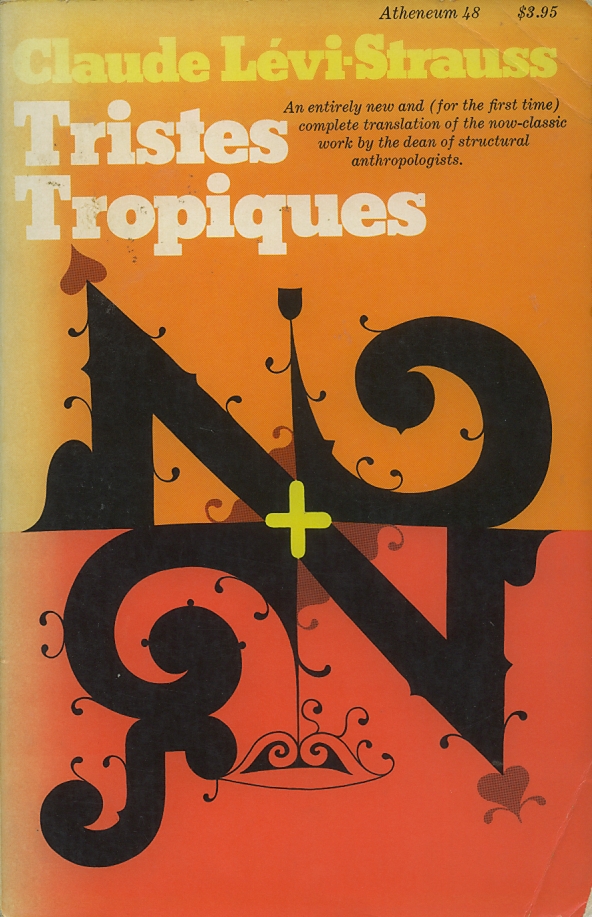
Tristes Tropiques

Part memoir, part travelogue, and part anthropological essay, this is Levi-Strauss's most personal book.

He mentions his debt to Rousseau, his attachment to Marxism, and his rejection of Existentialism. He devotes six pages to describing a sunset, summarizes a play he'd written based on one by Corneille, and describes his escape from France during WW2 (which played out in my mind like a scene from Raiders of the Lost Ark).

The writing is often erudite and abstruse, yet enlivened by arresting phrases (the "nostalgic cannibalism of history"); arresting ideas ("the primary function of written communication is to facilitate slavery"); and arresting images (the moon "an anguished lantern drifting across the sky," cultivated fields like "geographical musings by Paul Kee," and "date merchants with their produce piled up in sticky mounds of pulp and stones suggesting the excreta of some dinosaur").

The bulk of the book, and the most accessible part, describes the time spent by the author among the Bororo and the Nambikwara in South America. Here are poisoned arrows and penis sheaths (foreskin required), brazil nuts big enough to kill if they struck an unlucky head, parasitic fish able to swim up a stream of urine, and an astonishing 4-hour opera performed by a man in a trance.

The book communicates the dizzying intoxication of anthropology, especially in its narcissistic examination of primitive cultures (though it made me wonder to what extent anthropologists themselves, by their prying and poking, contribute to the wreckage of such societies).

Levis-Strauss, himself brooding on the role of anthropology, points out that it is a discipline that only Western society has produced. The anthropologist "is incomprehensible except as an attempt at redemption; he is the symbol of atonement."

Sunday, February 24, 2008

Through Siberia by Accident

Dervla Murphy is a beer-swilling cigar-smoking travel writer with more than 20 books to her credit. She is also an eccentric Irish granny who prefers travelling by bike. She does not own a car, microwave, washing machine, computer, TV, or central heating.

The misfortunes she has suffered during her travels are many:

Afghanistan – broken ribs, scorpion bite
Albania – three attempted robberies
Cameroon – “triple tooth abscess”
Ethiopia – dislocated knee, robbed by bandits
India – heat stroke, mumps, brucellosis (brucellosis!)
Laos – torn tendon in right foot
Madagascar – gout, more broken ribs, Hep A
Nairobi-London flight – life threatening clot in leg
Pakistan - amoebic dysentery
Rumania – robbed by police, concussion, fractured coccyx, broken foot
South Africa – tick bite fever, shattered left arm
Zimbabwe - malaria

In 2002 she crossed the Russian Federation by the Baikal-Amur Mainline, her intention being to cycle through a portion of Siberia. In this she was prevented by a couple of injuries that occurred before her starting point was reached. Instead she continued to travel by train and boat in the Baikal and Sakha areas.

She extols the friendliness of Siberians, and falls under the spell of Lake Baikal and the Lena River. Her observations are intelligent, well-informed, and contain none of the usual whining often found in travel writing. She complains about toilet facilities only once. She is gutsy, pragmatic and open-minded.

My sole complaint is her continual fussing over pets. No incident is too trivial to report on:


As I drank, the pup farted – potent farts which at first provoked only laughter and comically expressed disgust. Then, as they increased in volume and frequency, filling the cabin with asphyxiating fumes, the consensus was that he should be exiled. Tears gathered in the little boy’s eyes. But I had finished my beer, and thawed, and was returning to the platform where the pup could sit on my lap because Baikal’s wind would disperse his wind. When I had found the most sheltered corner he gazed up at my face with a puzzled expression. No doubt I smelt wrong, foreign. Soon he struggled to be free, loudly relieved his bowels behind a milk churn and thereafter farted no more.


Murphy undertook this trip in 2002, when she was in her early 70s. A few years later she returned and completed it, the results being published as Silverland: A Winter Journey Beyond the Urals.

Tuesday, December 11, 2007

Riding the Iron Rooster

By Train Through China

Paul Theroux loves trains. His first great success was The Great Railway Bazaar, which described a journey by train from London to Japan, returning via the Trans-Siberian railway. Riding the Iron Rooster takes place in the mid-1980s, more than 10 years later, and describes a year spent in China travelling by train.

The book begins with a charming epigraph: "A peasant must stand a long time on a hillside with his mouth open before a roast duck flies in." But the charm is superficial. China is an ancient, hungry, overpopulated country. In some places people are still living in caves. Theroux explains:


The Chinese had moved mountains, diverted rivers, wiped out the animals, eliminated the wilderness; they had subdued nature and had it screaming for mercy. If there were enough of you it was really very easy to dig up a whole continent and plant cabbages. They had built a wall that was the only man-made object on earth that could be seen from the moon. Whole provinces had been turned into vegetable gardens, and a hill wasn't a hill--it was a way of growing rice vertically.


Theroux, able to converse in Chinese, crisscrosses the country by rail and examines everything with a microscopic eye. He reports on the Chinese penchant for spitting, the use of cormorants for fishing, an erotic novel that has been banned for five centuries. "The Chinese laugh," he tells us, "is seldom a response to something funny." A sign in a train reads: "Guests must not perform urination in sink basin." The death penalty consists of "a bullet in the back of the neck."

The food is an adventure in itself: sheep vein, snake soup, yak slices, cow tendon, caterpillar fungus, chicken foot stew, rotten eggs wrapped in seaweed, grilled bear's paw, stewed moose nose, stir-fried camel's foot, monkey-leg mushrooms, pig's trotters in gelatin.

He is particularly interested in Mao's legacy. What he discovers is that the Great Helmsman is in a kind of disgrace. The museum in his home town is closed. The Cultural Revolution is widely admitted to have been a mistake.

The book concludes on a positive note with a visit to Tibet. "Lhasa was the one place in China I eagerly entered, and enjoyed being in, and was reluctant to leave." Part of this is due Tibet being "a place for which China had no solution."

Theroux is an impeccable writer -- 480 pages and not a word out of place -- and he always has something interesting to say: a pithy observation, a telling description, an historical aside.

It should be added, however, that the book is more than 20 years old, and its portrait of China may be seriously out-of-date. It is also worth noting another Chinese proverb (one that Theroux himself is fond of quoting):

"We can always fool a foreigner."