Tuesday, March 31, 2009

The Rat

It takes considerable skill to pull off such a fantastic and convoluted work as this, but Grass is equal to the task. The book is far richer than any brief summary can indicate.

Narrative duties are shared by the author and a rat, while another character, Oskar Matzerath, pipes up now and then to suggest how the novel should proceed. There are several plotlines that twist, double back on themselves, and branch out in truly amazing directions.

Really Big Spoilers

1. The narrator gets a rat for Xmas. It speaks to him in dreams and explains how rats survived the Flood and what really happened at Hamelin. Eventually rats cause WW3 by infiltrating the computers of Eastern and Western powers. The only human to survive is the narrator, who is orbiting the earth in a space capsule. Meanwhile the rats prosper, though their fur has turned green. Eventually a new species of rat appears -- with blue eyes, blond hair, and a penchant for marching in columns.

2. The narrator convinces Oskar to make a film about the plight of dying forests. Oscar is a successful producer whose company, Post Futurum, "pre-enacts" future scenes -- "prevision" or "clairvoyant film" it's called at one point. While visiting Gdansk to celebrate his grandmother's 107th birthday, WW3 takes place. His withered remains and those of his grandmother are treated by the rats as relics.

3. The narrator's partner, Damroka, and four female shipmates (all of whom were romantically involved with the narrator in the past) embark on a scientific journey to count jellyfish in the Baltic Sea. A talking flounder directs them to the submerged city of Vineta, but just as they reach it they are incinerated by an atomic blast.

4. Fairy tale characters take up the plight of the dying forests. They travel to Bonn to appeal to the Grimm Brothers who head up the Ministry of Medium-Term Forest Damage. Rumpelstilkskin drives a car that runs on witch piss. Other characters include Little Red Cap, who pops in and out of a wolf's zippered belly, and Snow White and her sex-crazed dwarfs. They take the Chancellor prisoner in a fairy tale fashion, but eventually are crushed (literally) by the military.

5. A painter named Lothar Malskat successfully completes a magnificent art forgery in a Lubeck cathedral. The narrator compares him to two "political forgers," Konrad Adenauer and Walter Ulbricht, leaders of the postwar Germanies. Grass writes:


That was the era of winking, of appearances, of whitewashing. In the decade of innocent lambs and clean bills of health, of murderers holding public office and Christian hypocrites, no one wanted to know too much, regardless of what happened.


6. Oskar returns from Gdansk to celebrate his 60th birthday. The party is attended by the narrator and Damroka.

Notes

Reading this, I imagined a resemblance between Grass and another famous writer. The avuncular mustaches, the similar war records (each captured by the other's army and held as a POW), a taste for the fantastic, the use of recurring characters, and the importance of WW2 as a central theme, especially in their most famous works, Slaughterhouse-5 and The Tin Drum. Both grappled with political and moral issues. Both were graphic artists.

Oskar Matzerath is the protagonist of Grass's first novel, The Tin Drum.

Damroka and the talking flounder are characters who first appeared in The Flounder (the only other novel by Grass that I've read). So too a woman named Ilsebill, after whom the boat in this book is named.

Lothar Malskat is not a fictional character.

The cover image is a fine pen-and-ink drawing by the author.

Gunter Grass won the Nobel Prize for literature in 1999.

Other Ratworthy Books

Doctor Rat by William Kotzwinkle - During a lab revolt, an insane rat becomes an apologist for animal testing.

The Papers of Andrew Melmoth by Hugh Sykes Davies - A scientist disappears into the sewers where he has been studying rats.

King Rat by China Mieville - A young man in London discovers he's part rat.

Daybreak 2250 AD by Andre Norton - One of her earliest and best YA books. After a nuclear war, rats have mutated into creatures that walk on their hind legs, wear loin-cloths, and wage war on humans.

Rats: Observations on the History and Habitat of the City's Most Unwanted Inhabitants by Robert Wilson - A personal investigation into the life of the modern rat.

Saturday, March 7, 2009

The Cyberiad

Tales for the Cybernetic Age

In this collection of whimsical nonlinear tales, vanity gets a pair of friendly rivals into a number of ridiculous predicaments, often at the expense of a good shellacking.

Trurl and Klapaucius are "constructors," but everything they build has unforeseen effects or does not work properly. Some of their contraptions are:
-an electrobard
-a kingdom in a box
-a probability amplifier for summoning up dragons
-a machine that can create anything beginning with the letter n.

While not all the tales are equally good, the language throughout is imaginative and fun. There are photon schooners, ion crumpets, antimatter sabres, and three Voltaic brothers. There is also a Battery Age and an Empire of the Cold Welders. Someone wears a semi-permeable cummerbund. Another is "innocent as a brand new fuse."

As the stories progress it becomes apparent that Trurl and Klapaucius are robots, and gradually a serious, if not bitter, undertone creeps in. In the penultimate story a philosopher describes the utter failure of robotkind's godlike powers to bring peace and happiness to the universe.

The last tale in the book (and the only one that does not include Trurl and Klapaucius) concerns a princess who spurns "every suitor who seeks her radioactive hand." She will marry no one but a human. Infatuated, a neighbouring prince dons a disguise that is "flaccid, drooping, doughy." His description of human customs is hilarious.

Misc

The Cyberiad was first published in 1967. This edition was translated by Michael Kandel, and illustrated with delightful line drawings by Daniel Mroz. There is no introduction or afterword, which could have illuminated some of the challenges in translating Lem's prose, which contains many made-up words.

The book's subtitle might easily have been Don Quixote in Space, for the tales take place in an "age of electric errantry." Indeed, Lem uses the same word as Cervantes when he describes these adventures as "sallies."

The author, a famous and prolific Polish writer of SF, passed away in 2006. His work has been compared to that Kafka, Vonnegut, and Douglas Adams.

Official website

Sunday, February 22, 2009

Don Quixote

Considered the first modern novel, and one of the greatest works of world literature, Don Quixote has been translated into English many times. This version by Samuel Putnam appeared in 1949.

The book, whose full title is The Ingenious Gentleman Don Quixote De La Mancha consists of two parts that were published separately in 1605 and 1615. Together they take up more than 1000 pages in the Putnam translation.

One of the book's most remarkable aspects is the freshness of the language. It does not sound like a work that is 400 years old.

The Story

Don Quixote, approaching 50 years of age and guilty of reading too many books of chivalry, takes it into his head to go on the road as a knight-errant. He cobbles together a suit of armor, including a helmet with a pasteboard visor, and sets out on a bony nag named Rocinante.

His self-appointed task is to right wrongs, defend honour, and proclaim the beauty of a farm girl he's never met. Upon her he bestows a grand-sounding name, Dulcinea del Toboso.

Accompanying him is a fat peasant named Sancho Panza, who is simple and loyal, happiest when his stomach is full. He rides out on an ass, spouting proverbs and malapropisms, sustained by the hope of receiving an earldom or the governorship of an island.

As a result of his delusions, Don Quixote is repeatedly thrashed, pummelled, and humiliated. He mistakes windmills for giants, an inn for a castle, and a brass pot for a helmet. Yet despite such mishaps his faith in himself never wavers, and he has a convenient explanation for his misfortunes. They are the work of an evil enchanter.

Part I contains a number of famous scenes (the windmills, the slaying of wineskins, the attack on a flock of sheep) and is said to be the more popular of the two books. Putnam’s preference, however, is for Part II, which he considers a more accomplished work.

Part I is weighed down by several tales of romantic intrigue. There is "The Captive's Tale" and "The Story of the One Who Was Too Curious for His Own Good," as well as some improbable love affairs that displace Don Quixote and Sancho Panza for large portions of Part I.

In Part II there are still a number of romantic interludes, but none are as intrusive or cloying as those in Part I.

As evidence of the novel's modernity, I present the following excerpt in which Don Quixote tells Sancho Panza of a balm that can restore health despite the severest injury. The scene is eerily similar to the famous encounter with the Black Knight in Monty Python and the Holy Grail. Don Quixote says:


…whenever in any battle you see my body cut in two—as very often happens—all that is necessary is for you to take the part that lies on the ground, before the blood has congealed, and fit it very neatly and with great nicety upon the other part that remains in the saddle, taking care to adjust it evenly and exactly. Then you will give me but a couple swallows of the balm of which I have told you, and you will see me sounder than an apple in no time at all.


Narrative Structure

In Part I the narrator tells us the book has been written in Arabic by a Moor named Cid Hamete Benengeli. The narrator has only a fragment in his possession, but in Chapter IX discovers the complete work in a Toledo marketplace, and hires a Moor to translate it.

In Part II the narrator frequently interrupts the tale with comments about the fictional author and translator. It is a delightful irony that most readers will be reading a real and not a phony translation.

A metafictional layer is added when the characters begin talking about Part I, whose success has made Don Quixote and Sancho Panza famous. Other characters are aware of their exploits, and several shortcomings in Book I are discussed.

A further complication is the existence of a spurious Part II, which was published one year before Cervantes’ Part II. In the latter, Don Quixote learns that the rival version has him visiting Sargossa to take part in a tournament, and this causes him to deliberately bypass it.

If Don Quixote is the first modern novel, it is also the first post-modern novel.

Miguel de Cervantes

Not much is known about his early life, other than that his childhood was itinerant and impoverished. As an adult he spent time in Italy before entering military service. He took part in the Battle of Lepanto, where he was shot in the chest and lost the use of his left hand.

When he recovered, he resumed active duty only to be captured by pirates and held as a slave for a number of years in Algiers. He was finally ransomed by his family after several abortive escape attempts. These events are reflected in the Captive’s Tale.

Even after his return to Spain, Cervantes’ life continued to be somewhat precarious. He wrote plays, became a purchasing agent for the Spanish Armada, and was imprisoned more than once.

He died in the year following the publication of Book II of Don Quixote – 23 April 1616 – the same date as Shakespeare’s death.

So popular was Don Quixote that it had a significant impact on the Spanish language.

Sunday, February 15, 2009

The Even More Complete Chess Addict

This 1993 book is a revised and expanded version of The Complete Chess Addict, which appeared in 1987. It's a collection of chess anecdotes written in a breezy style, and includes eight pages of black-and-white photos, a bibliography, and an index.

The largest section in the book is taken up with a survey of famous chess players, grouped under these headings: The Royals, The Holy, The Sinners, The Musicians, The Artists, The Writers, The Entertainers, The Sportsmen, The Thinkers, The Politicians, The Soldiers, The Aristocrats, The Businessmen, The Rest.

Subsequent sections are:

The Greatest: the 64 strongest players, the 64 greatest games, etc.

The Frightful: worst games and performances at tournaments, including a game in which a player lost three pieces in 1-1/2 moves.

The Unorthodox: fantasy chess variations. Reverso is one example, in which the opening positions of knights and bishops are reversed. "All opening theory goes out the window. Try it against your club theoretician and watch him flounder!"

The Unacceptable: bad behaviour at the board, including games that turned violent.

The Awesome mentions a number of records, including:
- longest announced mate - 45 moves
- longest series of mutual captures - 13
- longest sequence of successive checks - 43
- longest sequence of moves without a capture - 100

The Bizarre: chess-playing animals, strange openings, and other oddities (eg Bobby Fischer and Barbra Streisand were classmates in Brooklyn).

Desert Island Chess: puzzles and problems.

The final two sections are the most dated, but still fun to read: The Future describes up-and-coming possible greats, and The End? talks about the influence of computer chess programs.

In all, 369 pages of trivia that range from the magnificent to the loony. A very entertaining read.

Monday, February 2, 2009

Terminal Beach

As he walked slowly through the deserted streets, he seemed to see the image of a different village superimposed over this one, where any shadowy doorway might contain a man-eater.

But these roofs were not thatched, and it was not a Mannlicher that he held in his hands.

The blistered concrete walls matched the colour of the sand that was sweeping in from the desert, and the rigidly assembled structures with their stencilled alphanumerics suggested this had once been a military installation.

Sunday, February 1, 2009

Invisible Cities

Another unusual and bewitching work from the ever-imaginative Italo Calvino -- though novel may not be the correct term for this collection of sketches.

The narrator, Marco Polo, is describing to Kublai Khan the cities he has visited in his travels. There are 55 in all, described in spare but evocative prose.

My favourite is the city of Armilla, which consists only of plumbing. No houses, only a forest of water pipes rising in the air. Occasionally one glimpses a woman bathing in a tub or showering in midair.

But most sketches are far less visual than this, focusing instead on mysterious behaviour and odd routines. Sophronia, for example, is composed of two half-cities, one permanent, one temporary. The former is an amusement park of roller coasters and ferris wheels. The latter is made of stone and marble; every year it is dismantled and transported to vacant lots in the amusement park.

There is no plot to unify these tales, and the reader, like Kublai Khan, struggles to extract meaning from them. Wide and exotic his kingdom may be, yet how can such cities be real? Are they different views of the same city, Marco Polo's Venice perhaps? Can they be likened to squares on a chessboard, or an atlas of cities not yet discovered?

Further complications are the names of the cities (all feminine) and the order in which they appear. The 55 cities are composed of eleven groups:

Cities and memory
Cities and desire
Cities and signs
Thin cities
Trading cities
Cities and eyes
Cities and names
Cities and the dead
Cities and the sky
Continuous cities
Hidden cities


Within each group there are five cities, numbered thusly:

Cities and memory 1
Cities and memory 2
Cities and memory 3
Cities and memory 4
Cities and memory 5


These sketches are scattered throughout the book in nine numbered sections. The middle sections (2-8) contain five fables each, while the first and last sections contain ten each. The order of the first section seems arbitrary:

1
Cities and memory 1
Cities and memory 2
Cities and desire 1
Cities and memory 3
Cities and desire 2
Cities and signs 1
Cities and memories 4
Cities and desire 3
Cities and signs 2
Thin cities 1


But a glance at the second section reveals the secret:

2
Cities and memory 5
Cities and desire 4
Cities and signs 3
Thin cities 2
Trading cities 1


The numerical pattern is repeated through the remaining sections, save the last, whose order is now predetermined:

9
Cities and the dead 5
Cities and the sky 4
Continuous cities 3
Hidden cities 2
Cities and the sky 5
Continuous cities 4
Hidden cities 3
Continuous cities 5
Hidden cities 4
Hidden cities 5


The significance of the book's mathematical structure is murky. Either it is done purely for effect (unlikely), or it is invested with a meaning I've not been able to decipher (likely).

Eventually I found myself imagining the book as a deck of cards, the kind used for divination, partly because of the elusive meaning of the tales, and partly because the eleven city groups reminded me of suits.

Were I to read this book again, I might forsake the order of the sketches as they appear in the book, and read them group by group in correct numerical sequence.


Wednesday, January 28, 2009

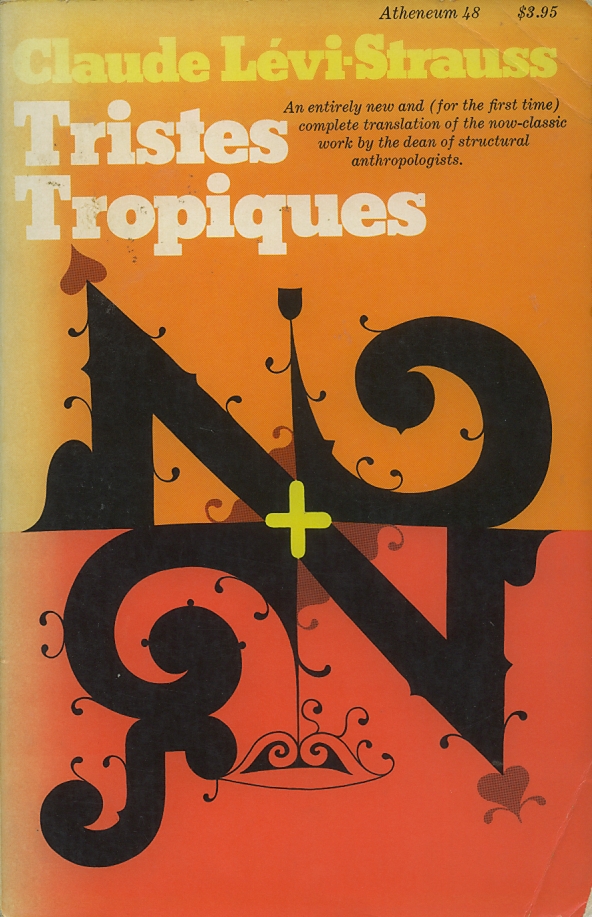
Tristes Tropiques

Part memoir, part travelogue, and part anthropological essay, this is Levi-Strauss's most personal book.

He mentions his debt to Rousseau, his attachment to Marxism, and his rejection of Existentialism. He devotes six pages to describing a sunset, summarizes a play he'd written based on one by Corneille, and describes his escape from France during WW2 (which played out in my mind like a scene from Raiders of the Lost Ark).

The writing is often erudite and abstruse, yet enlivened by arresting phrases (the "nostalgic cannibalism of history"); arresting ideas ("the primary function of written communication is to facilitate slavery"); and arresting images (the moon "an anguished lantern drifting across the sky," cultivated fields like "geographical musings by Paul Kee," and "date merchants with their produce piled up in sticky mounds of pulp and stones suggesting the excreta of some dinosaur").

The bulk of the book, and the most accessible part, describes the time spent by the author among the Bororo and the Nambikwara in South America. Here are poisoned arrows and penis sheaths (foreskin required), brazil nuts big enough to kill if they struck an unlucky head, parasitic fish able to swim up a stream of urine, and an astonishing 4-hour opera performed by a man in a trance.

The book communicates the dizzying intoxication of anthropology, especially in its narcissistic examination of primitive cultures (though it made me wonder to what extent anthropologists themselves, by their prying and poking, contribute to the wreckage of such societies).

Levis-Strauss, himself brooding on the role of anthropology, points out that it is a discipline that only Western society has produced. The anthropologist "is incomprehensible except as an attempt at redemption; he is the symbol of atonement."

Tuesday, January 20, 2009

Descartes' Secret Notebook

A True Tale of Mathematics, Mysticism, and the Quest to Understand the Universe

Descartes continues to fascinate us not just because he was a titan. He lived in a strange and unruly age, and led the sort of life one would not expect of a philosopher. He was a gentleman soldier and intellectual tourist whose life continues to provide a rich field of speculation for writers three centuries after his death.

The raison d'etre of this new biography is a secret notebook found after Descartes' death. It was written in code because (argues the author) it contained information that Descartes felt would endanger his life should the Inquisition get wind of it.

Leibniz apparently cracked the code but kept the secret to himself. (He was preoccupied by a feud with Newton over calculus.) Not until 1987 was the code deciphered and made public. Descartes had discovered a formula regarding geometric figures that is a property of space itself, and a foundation for the science of topology. A century after his death this formula was rediscovered by the Swiss mathematician Euler.

Descartes' Secret Notebook is smoothly and gracefully written, and its author, Amir Aczel, who is himself a mathematician, concisely explains some of the esoteric aspects of Descartes' work. Best of all are the final three chapters, which describe events after Descartes' death, including the involvement of Leibniz.

Existentialism

Descartes was a Catholic and took great pains not to run afoul of the Church, as Galileo had. Aczel quotes him as writing, "Fear of God is the beginning of wisdom." How ironic then that another Frenchman, 300 years later, would take a very different view. Sartre, an atheist, writes in Nausea, mocking Descartes:


I am, I exist, I think, therefore I am; I am because I think, why do I think? I don't want to think any more, I am because I think that I don't want to be, I think that I...because...ugh! I flee.


Both men lived through times of great upheaval in Europe -- Descartes the Thirty Years War and Sartre WW2, during which he spent nine months as a POW.

Tuesday, January 13, 2009

The Erasers

Nine murders have taken place in nine days, all at exactly the same time. Special agent Wallas is sent to investigate the most recent death. He's new at the job and it's a confusing case. He spends a lot of time walking the streets and getting lost. He stops in at several shops to buy an eraser.

Soon the reader is as confused as Wallas. It's difficult to know what's real and what's imagined. Even the identity of certain characters, who are often described in terms of the coats they wear, becomes blurred. The writing is packed with banal detail, often in the form of numbers and measurements, as though this is the only way to pin down what's demonstrably real:


...on a bed of toast, spread with margarine, is arranged a broad filet of herring with silvery-blue skin; to the right, five quarters of tomato, to the left, three slices of hard-boiled egg; set on top, at specific points, three black olives.


Finally Wallas, who is on job probation, begins to doubt himself. At the post office he receives a "pneumatic message" that appears to be incriminating. It seems that he physically resembles the alleged murderer and has the same type of gun that was used in the shooting. When he returns to the scene of the crime, he ends up killing the man whose death he was sent to investigate.

Characters

Roy-Dauzet - Minister of the Interior, who, distrusting his own police force, sends Wallas to take charge of the investigation.

Commissioner Laurent - the local police chief.

Daniel Dupont - a professor who receives a superficial gunshot wound.

Albert Dupont - a wood exporter mistakenly identified in the newspaper as the original victim, later killed in an auto accident.

Dr. Juard - a gynecologist who issues a fake death certificate to protect Daniel Dupont's life.

Marchat - a wood exporter in collusion with Juard and Daniel Dupont who comes to believe that he is the next victim.

Garinati - bungles the murder of Daniel Dupont.

Jean Bonaventure - Garinati's boss, aka Bona.

Fabius - the best sleuth in Europe, adept at disguises, Wallas's immediate superior.

Madame Dupont - Daniel Dupont's estranged wife, from whom Wallas purchases an eraser.

Jean - Daniel Dupont's illegitimate son, who may or may not exist.

Anna Smite - Daniel Dupont's half-deaf housekeeper who thinks Juard killed Dupont.

Juliette Dexter, Emilie Lebermann, and Madame Jean - post office employees.

Andre WS - the addressee of the "pneumatic message," described by post employees as resembling Wallas; the message's sender is indicated by a set of initials, J.B.

Madame Bax - a watcher at a window.

Nameless drunk - keeps turning up at the Cafe des Allies, where Wallas is lodging, to ask meaningless riddles.

Nouveau Roman

The Erasers was first published in 1953 as Les Gommes. At its most superficial, it could be read as a humourless parody of a detective novel, a recursive tale that keeps doubling back on itself. At a deeper level, it's a statement about the nature of reality.

The author, Alain Robbe-Grillet, was a leading figure in the nouveau roman movement. The translation is by Richard Howard.

Thursday, December 18, 2008

Untitled

They left the brisk secretarial facade of the outer office and moved into a netherworld of dark passages, dripping walls, and mossy cells.

They stepped over cables held to the floor with gaffer tape, and moved past gnomish figures hunched before consoles, their faces glowing like radioactive craters.

Two technicians were dumping spiders into a cobweb machine, while a dwarf on a wheeled ladder crammed items onto shelves already overflowing with oddities: sweat bottles and fog juice, jugs of rubber ears, boxes of sneezing powder, motorized rats.

A parade of signs offered unhelpful comments: Telecine, Continuity, Vegetation, Laughter.

Finally the passage they were following opened into into an enormous cavern. Above them the ceiling was hidden by a network of steel catwalks and racks of blazing lights.

In the distance a chip of blue sky was suspended overhead like a spacecraft in orbit.