And warlike! He had not realized how bellicose they were.
Now, whenever he saw a column trudging along, he imagined them as tiny Greek soldiers, marching off to overthrow a neighbouring city-state.
Their exoskeletons provided ready-made helmets and cuirasses. Their swords were mandibles and stings, their spears sprays of formic acid.
They were brave, merciless, without fear. Every battle was a Thermopylae. Their legions were everywhere. Perhaps even in space, and not as a science experiment aboard the Space Shuttle, but as stowaways on Mir.
He imagined ant scientists launching their own rockets and sending ant astronauts into space. They'd be wearing white spacesuits with transparent bubbles around their heads. They wouldn't have to worry about cosmic rays.
When humans finally reached Mars, they'd find anthills there.
Tuesday, February 16, 2010
Little Dorrit
![]() |
| Duke Classics ebook |
In Book I (“Poverty”), Mr. Dorrit is confined to Marshalsea, the same debtor's prison that Dickens' father had been incarcerated in. He and his daughter, Little Dorrit (born in prison), are visited by Arthur Clennam, whose generosity includes discreet financial assistance.
In Book II (“Wealth”) Mr. Dorrit enjoys unexpected riches, while other people are suddenly ruined, including Clennam, who ends up in Mr. Dorrit's former room in Marshalsea. Now it is Little Dorrit who comes visiting.
Theme
Little Dorrit is about imprisonment. The book opens in Marseilles -- first in a jail, then behind walls where some travellers have been quarantined. The story moves on to London – first to a decrepit house where Arthur's mother has been confined to a wheelchair for years, then to the Marshalsea prison.
These visible forms of imprisonment are matched by self-imposed barriers. When Mr. Dorrit is set free, he remains trapped by his own pride and vanity. Arthur Clennam has been a prisoner in the family business for 20 years. Miss Wade is a “self-tormentor,” caged by her own bitterness and resentment. The Circumlocution Office is a bureaucratic fortress with the power to enslave the unwary in its labyrinthine coils.
Marriage can be a prison too. Mrs. Clennam's sterile morality divides her from her husband and sends him into exile, while the Merdles and the Sparklers are bound together in arid unions based entirely on money and appearances. Mrs. Flintwinch is so bullied by her husband that her life becomes a nightmare. All are marriages of convenience.
Memorable Characters
Mostly they are villains. Chief among them is an arrogrant cartoon Frenchman named Blandois, who overflows with extravagant speech and gestures. He snaps his fingers at everyone and cries out “Holy blue!” at the drop of a hat. Somehow Dickens manages to make him sinister and comic at the same time.
Gowan is a careless fellow who excels at nothing except his own self-interest. His nonchalant and patronizing comments are superb, especially when he cloaks his disparaging remarks in words of praise.
Mrs. General is the companion that Mr. Dorrit hires for his two daughters while they are touring Europe. Her idea of genteel breeding is never to show an interest in anything unpleasant. To be genteel is to have an impervious, highly polished surface, and Dickens has great fun when he refers to her efforts at “varnishing” the two young ladies.
My favourite character is the collection agent Mr. Pancks, who is compared to a steam-tug, constantly puffing and snorting and towing away other people:
Mr. Pancks, who was always in a hurry, and who referred to a little dirty notebook which he kept beside him (perhaps containing the names of the defaulters he meant to look up by way of dessert), took in his victuals as if he were coaling; with a good deal of noise, and a good deal of dropping about, and a puff and a snort occasionally, as if he were nearly ready to steam away. |
Gripes
Little Dorrit and Arthur Clennam are the least interesting characters in the book. Little Dorrit is selfless to the point of sainthood (which suggests a title change, Little Doormat), while the bland Clennam is more of a plot device than a character, linking up the Clennams, the Dorrits, the Meagles, and others. Though he spent 20 years in China, he shows no evidence of it, returning without souvenirs, anecdotes, or mannerisms.
Another problem is the age difference between hero and heroine. Little Dorrit is 22, yet petite enough to be mistaken for a child. Clennam, who is 40, frets about his age and often addresses her as "My dear child." Their first embrace is described as that of a father embracing a daughter. Since this is a prelude to a sexual relationship, the whole thing strikes me as rather creepy.
(There is an interesting sidelight to this in Dickens's own life. He met Ellen Ternan in 1857, the year he completed Little Dorrit. He was 45, she 18. Soon afterward, he left his wife and conducted a lengthy affair with Ternan. While he didn't meet her early enough for their relationship to influence the book, it's an odd coincidence, almost as though he were imagining, and perhaps justifying, a future involvement with a woman young enough to be his daughter.)
Then there are the usual things that modern readers tend to roll their eyes at -- an unexpected legacy, an overwrought death scene, a secret twin, and an improbably melodramatic event. The latter, which is intended to mirror the financial collapse brought about by Merdle's swindles, is the sudden disintegration of Mrs. Clennam's house. Dickens sets it up beforehand in various ways, but it's no more convincing than the spontaneous combustion of Krook in Bleak House.
And wait a minute, how does the paralyzed Mrs. Clennam survive the collapse of her house? Well, just before the house falls apart she miraculously regains the use of her limbs, leaping to her feet and rushing out to Marshalsea prison. But seriously, having been wheelchair-bound for years, it's unlikely she would have made it to the door, let alone down the stairs.
Finally, I mentioned earlier that the narrative is easy to follow. That's true, except for the denouement, when Dickens launches into a lengthy explanation of the book's backstory. It's so convoluted that the Penguin edition I read includes a precis of it in the appendix.
Canadian Connection
For several years Dickens managed a house for "fallen" women called Urania Cottage. One of the young women was Rhena Pollard, a headstrong girl with dark hair and dark eyes. She seems to have been the model for Tattycoram (an orphan taken on as a maid by the Meagleses). Pollard eventually came to Canada, where she married and settled down to a respectable life in Ontario.
Tattycoram is also the subject of a novel of the same name by Canadian author Audrey Thomas. Thomas has been nominated twice for the GG.
Mrs. Merdle's son, Edmund Sparkler, was born in "St. John's, New Brunswick."
Links
After reading the book I watched the recent and most excellent BBC production of Little Dorrit. It was interesting to see how the book was shaped for the screen I urge you to see it. You can find out more at the following sites:
BBC
Jane Austen's World
Here's a review of Jenny Hartley's Charles Dickens and the House of Fallen Women. The book discusses the role of Dickens in running Urania Cottage.
I also discovered that there is a Dickens World in England. Wouldn't that be fun to visit!
Monday, February 1, 2010
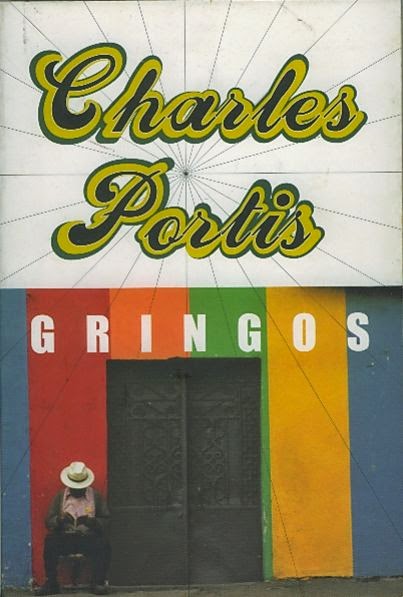
Gringos
Imagine Indiana Jones down on his luck, living in a hotel room in the Yucatan peninsula. No longer dealing in stolen Mayan artifacts, he's scratching out a living as a scavenger and bounty hunter.
That's Jimmy Burns, a generous easy-going guy with many eccentric and largely ungrateful friends.
There's Doc Landin, a maverick archeologist who wants to make one last trip into the jungle so he can be buried with an Olmec figurine in his mouth.
There's Rudy Kurle, a follower of von Daniken, who believes that "space dwarfs" civilized the Mayans.
There's Refugio Bautista Osorio, who runs a trading post and salvage yard, and counts "his wealth in fifty-five gallon drums."
Burns makes a delivery to a dysfunctional archeological dig, travels into the jungle when Rudy goes missing, and encounters a band of hippies who are awaiting the end of the world at the "Inaccessible City of Dawn."
The book is peppered throughout with archeological lore, Spanish words and phrases, and convincing details of life in Mexico. It has more of an edge than his other books, which makes a fine counterpoint to the wryly comic observations.
There is one misstep, though, and that's in a sudden burst of violence near the end. It's totally unnecessary. My only other complaint is that Gringos is Portis's fifth and last novel.
The others are Norwood, True Grit, Dog of the South, and Masters of Atlantis.
Unofficial Charles Portis Website
Charles Portis Appreciation Society
Labels:
Charles Portis,
Novels
Tuesday, January 26, 2010
The Palm-Wine Drinkard
The Palm-Wine Drinkard and His Dead Palm-Wine Tapster in the Deads' Town
The subtitle provides an accurate glimpse into this strange book, which describes an epic quest with mythic elements drawn from Yoruba folk tales.
The hero's name is "Father of gods who could do anything in this world." One day he sets out "to find out whereabouts was my tapster who had died." Thus begins a surreal journey through an African underworld.
Some of his adventures:
He rescues a beautiful woman from a "complete gentleman" with rented body parts.
After he marries her, the woman gives birth to a fully grown child from her thumb.
He turns himself into a canoe, which his wife paddles across a river.
They sell their "death" and lend out their "fear."
They are captured by a giant who tosses them into a bag.
When they finally arrive at the Deads' Town, the tapster gives them a magical egg. They return to the land of the living when the hero changes himself into a pebble and throws himself across a river. At home they put an end to a famine.
The journey is so phantasmagoric that the imperfect English becomes a key element. If the language were brushed up, the book would not be the same. Here's a typical passage:
Critical Analysis
Margaret Laurence notes that the book "has been compared to Orpheus in the underworld, to Bunyan's Pilgrim's Progress, to Dante, to the journey of Odyseus."
Gerald Moore says that all of the author's "heroes or heroines follow out one variant or another of the cycle of the heroic monomyth, Departure -- Initiation -- Return."
Chinua Achebe (in the first Equiano Memorial Lecture) calls Tutuola "the most moralistic of all Nigerian writers." The Palm-Wine Drinkard describes the consequences of inverting work and play, and though the events are grotesque and surreal, there are always boundaries to a monster's power. Thus:
References
Margaret Laurence, "A Twofold Forest," in Long Drums and Cannons.
Gerald Moore, "Amos Tutuola: A Modern Visionary," in Seven African Writers.
Chinua Achebe, "Work and Play in Tutola's The Palm-Wine Drinkard," in Okike: An African Journal of New Writing, No. 14.
The subtitle provides an accurate glimpse into this strange book, which describes an epic quest with mythic elements drawn from Yoruba folk tales.
The hero's name is "Father of gods who could do anything in this world." One day he sets out "to find out whereabouts was my tapster who had died." Thus begins a surreal journey through an African underworld.
Some of his adventures:
He rescues a beautiful woman from a "complete gentleman" with rented body parts.
After he marries her, the woman gives birth to a fully grown child from her thumb.
He turns himself into a canoe, which his wife paddles across a river.
They sell their "death" and lend out their "fear."
They are captured by a giant who tosses them into a bag.
When they finally arrive at the Deads' Town, the tapster gives them a magical egg. They return to the land of the living when the hero changes himself into a pebble and throws himself across a river. At home they put an end to a famine.
The journey is so phantasmagoric that the imperfect English becomes a key element. If the language were brushed up, the book would not be the same. Here's a typical passage:
His fingernails were long to about two feet, his head was bigger than his body ten times. He had a large mouth which was full of long teeth, these teeth were about one foot long and as thick as a cow's horns, his body was almost covered with black long hair like a horse's tail hair. He was very dirty. |
Critical Analysis
Margaret Laurence notes that the book "has been compared to Orpheus in the underworld, to Bunyan's Pilgrim's Progress, to Dante, to the journey of Odyseus."
Gerald Moore says that all of the author's "heroes or heroines follow out one variant or another of the cycle of the heroic monomyth, Departure -- Initiation -- Return."
Chinua Achebe (in the first Equiano Memorial Lecture) calls Tutuola "the most moralistic of all Nigerian writers." The Palm-Wine Drinkard describes the consequences of inverting work and play, and though the events are grotesque and surreal, there are always boundaries to a monster's power. Thus:
...anarchy is held at bay and a traveller who who perseveres can progress from one completed task to the domain of another and in the end achieve the creative, moral purpose in the extra-ordinary but by no means arbitrary universe of Tutuola's story. |
References
Margaret Laurence, "A Twofold Forest," in Long Drums and Cannons.
Gerald Moore, "Amos Tutuola: A Modern Visionary," in Seven African Writers.
Chinua Achebe, "Work and Play in Tutola's The Palm-Wine Drinkard," in Okike: An African Journal of New Writing, No. 14.
Tuesday, January 19, 2010
The Lyre of Orpheus
This is the concluding novel in the Cornish trilogy.
Leapfrogging the middle book are several characters from The Rebel Angels, the most important being Simon Darcourt, and Arthur and Maria Cornish. The latter bankroll an unfinished opera by E.T.A. Hoffmann -- Arthur of Britain, or the Magnanimous Cuckold -- and soon find the Arthurian legend reflected in their own lives.
Darcourt is the narrative glue that unites two plot lines. He writes the opera's libretto, and solves certain mysteries surrounding Francis Cornish (Arthur's uncle and the central figure in the middle book, What's Bred in the Bone).
A pair of characters new to the trilogy are doctoral student Hulda Schnakenburg, who is completing the music, and the composer-in-residence, Gunilla Dahl-Soot. Once their work is done and Darcourt's libretto completed, the opera company is assembled and preparations made for opening night.
Throughout it all Davies' comic touch is as sure as ever, especially in portraying the foibles and peccadilloes of actors, students, and professors. However, the portrayal of Arthurian archetypes is not entirely convincing, and the book gets a bit windy in spots, though Davies' prose is never less than urbane, his erudition never forced or heavy-handed.
With no engaging villain (as with Parlabane in Angels), Dahl-Soot is a welcome eccentric, as are Maria's mother (she gives another Tarot reading) and uncle Yerko (he puts together a claque for opening night). There is an especially fine scene involving drunken academics, but the real treat of the novel is the exhilarating account of opening night.
Names
One of the things I admire about Davies is his wonderful use of names. In Lyre he has to populate an entire opera company, a formidable task in itself. Some favourites:
Ogden Whistlecraft - poet
Mervyn Gwilt - lawyer
Dulcy Ringgold - costume designer
Gwen Larking - stage manager
Nutcombe Puckler - "Sir Dagonet"
Clara Intrepidi - "Morgan Le Fay"
Oliver Twentyman - "Merlin"
Ulick Carman - herald
Eden Wigglesworth - attendant
Dicky Plaunt - head carpenter
Otto Klafsky - concert-master
Claude Applegarth - New York critic
A minor character named Wally Crottel makes a brief appearance. His name harkens back to a monologue on excrement in Angels -- "the crotels of a hare." As the name suggests, he's a bit of a shit.
Quotes
"Lies keep the teeth white."
"You don't smell bad, for a man."
"A horse is always a sure card in an opera."
"...we shall add a little salt to the dreary porridge of our lives."
"That's what I like about you Canadians," said the doctor; "you are so ready to admit fault."
"Is there something ambiguous about Knockers?" said Hollier. "I'm sorry. I'm not very well up on the latest indecencies."
NY Times review
Labels:
Novels,
Robertson Davies
Thursday, December 3, 2009
Of Mice and Men
This one's a country mouse driven by a little old lady on dialup
This one is an optical fellow, he needs glasses
This one's our patented oncomouse, he went to Harvard
This wee cowering beastie has the best laid plans
This one saved a lion, this one scared an elephant
This one ran up a clock, this one's a rat in disguise
Wednesday, December 2, 2009
The Rebel Angels
What a shitty book!
Professor Ozias Froats examines human excrement by the bucketful.
Clement Hollier is interested in Medieval Filth Therapy.
Maria Theotoky's mother uses horse dung to refurbish old violins.
John Parlabane bequeaths his arsehole to the university.
Urquhart MacVarish likes having ribbon shoved up his bum.
And here are a few pungent thoughts from the Reverend Simon Darcourt, after visiting Ozy's lab:
But The Rebel Angels is not just a satire of university life, it is also a morality play. The title refers to angels tossed out of heaven, not all of them "sore-headed egotists like Lucifer. Instead they gave mankind another push up the ladder, they came to earth and taught tongues, and healing and laws and hygiene..."
The profs at the College of St. John and the Holy Ghost are rebel angels, flawed but well-intentioned. They are also medievalists, either by training (Hollier, Darcourt, McVarish, Parlabane and Maria) or in spirit (Froats). Maria's mother is a gypsy who's practically living in the Middle Ages; she gives tarot readings and knows how to cast a curse and prepare a love philtre.
Parlabane is the villain of the piece, "as slippery-tongued, as entertaining, and sometimes as frightening as the Devil himself." He is also one of Davies's most engaging creations.
The urbane prose is a pleasure to read, and the humour has a superb Rabelaisian flavour.
The Rebel Angels is the first book in the Cornish Trilogy. The second is What's Bred in the Bone, the third The Lyre of Oprheus.
Professor Ozias Froats examines human excrement by the bucketful.
Clement Hollier is interested in Medieval Filth Therapy.
Maria Theotoky's mother uses horse dung to refurbish old violins.
John Parlabane bequeaths his arsehole to the university.
Urquhart MacVarish likes having ribbon shoved up his bum.
And here are a few pungent thoughts from the Reverend Simon Darcourt, after visiting Ozy's lab:
I walked on toward Ploughwright, thinking about faeces. What a lot we had found out about the prehistoric past from the study of fossilized dung of long-vanished animals. A miraculous thing, really; a recovery of the past from what was carelessly rejected. And in the Middle Ages, how concerned people who lived close to the world of nature were with faeces of animals. And what a variety of names they had for them: the Crotels of a Hare, the Friants of a Boar, the Spraints of an Otter, the Werderobe of a Badger, the Waggying of a Fox, the Fumets of a Deer. Surely there might be some words for the material so near to the heart of Ozy Froats better than shit? What about the Problems of a President, the Backward Passes of a Footballer, the Deferrals of a Dean, the Odd Volumes of a Librarian, the Footnotes of a Ph.D., the Low Grades of a Freshman, the Anxieties of an Untenured Professer? |
But The Rebel Angels is not just a satire of university life, it is also a morality play. The title refers to angels tossed out of heaven, not all of them "sore-headed egotists like Lucifer. Instead they gave mankind another push up the ladder, they came to earth and taught tongues, and healing and laws and hygiene..."
The profs at the College of St. John and the Holy Ghost are rebel angels, flawed but well-intentioned. They are also medievalists, either by training (Hollier, Darcourt, McVarish, Parlabane and Maria) or in spirit (Froats). Maria's mother is a gypsy who's practically living in the Middle Ages; she gives tarot readings and knows how to cast a curse and prepare a love philtre.
Parlabane is the villain of the piece, "as slippery-tongued, as entertaining, and sometimes as frightening as the Devil himself." He is also one of Davies's most engaging creations.
The urbane prose is a pleasure to read, and the humour has a superb Rabelaisian flavour.
"Roberta, have I ever shown you my penis-bone?" Professor Burns, a zoologist, did not turn a hair. "Have you truly got one? I know they used to be common, but it's ages since I saw one." Urky detached an object with a gold handle from his watch-chain and handed it to her. "Eighteenth century; very fine." "Oh, what a beauty. Look, Professor Lamotte, it's the penis-bone of a raccoon; very popular as toothpicks in an earlier day. And tailors used them for ripping out basting. Very nice, Urky. But I'll bet you haven't got a kangaroo-scrotum tobacco pouch; my brother sent me one from Australia." Professor Lamotte regarded the penis-bone with distaste. "Don't you find it disagreeable?" he said. "I don't pick my teeth with it," said Urky, "I just show it to ladies on social occasions." "You astonish me," said Lamotte. |
The Rebel Angels is the first book in the Cornish Trilogy. The second is What's Bred in the Bone, the third The Lyre of Oprheus.
Labels:
Novels,
Robertson Davies
Friday, November 27, 2009
The Professional
Frank Hughes is a war vet and old friend of Doc Carroll. He's doing a magazine piece on Eddie Brown, a 29-year-old welterweight whom Doc has been managing for nine years.He was Doc's fighter. It is what a painter does in his paintings so that you would know them, even without his signature, and what the writer does in his writings, if he is enough of a writer, so you know that no one in the whole world but he could have been the writer. |
Eddie's not just a better boxer than the current champ, he's a decent hard-working guy. He's not a showboat. He's as mild-mannered as his training camp diet -- stewed prunes, dry toast, soft-boiled eggs. Everybody likes him, and now he's got a shot at the title.
The month-long training camp and the fight itself are seen through Frank's eyes. We meet an assortment of colourful characters:
Johnny Jay - Doc's pail man
Memphis Kid - Eddie's sparring partner
Barnum, Polo and Charlie Keener - managers
Penna, Schaeffer, Cardone and Booker Boyd - fighters
Only a few of them truly understand the sport of boxing, which is "just too intricate for the average person, fight fan or not, to comprehend." To Frank and Doc, the same seems true for just just about everything else in the world. "Dreadful" is Doc's favourite word.
Frank and Doc live in hotels and do a lot of drinking and telling of stories -- about the war, about boxing and baseball. Like the time Doc opened his door and an enforcer named Razor Pete took a swipe at him with a knife. Doc drops him with a couple of punches, then politely lifts him to his feet and assists him to the elevator. He and Frank visit Razor Pete's boss, a gangster who wants a piece of Doc's fighter. The gangster compliments Frank's writing, Doc returns Pete's broken knife, and they have a friendly drink together and talk baseball.
Years later Frank bumps into Razor Pete, who is in poor health by then. He's asthmatic and has a bad heart. He offers profuse thanks for a glass of water.
It's a manly world where politeness is not a sign of weakness.
Hemingway
Papa's influence is obvious from page one. The author, W.C. Heinz, met him during WW2, and when The Professional came out in 1958, Hemingway immediately cabled him from Cuba, saying: "This is the only good novel I've ever read about a fighter."
This edition includes a foreword by Elmore Leonard, who became acquainted with Heinz after he too wrote a congratulatory letter. Leonard mentions his own debt to Hemingway, and remarks that Heinz was "the all-important link, the next step" in his own development as a writer. The two met later when Heinz came out to Detroit to interview Gordie Howe, who lived a few blocks away from Leonard.
Heinz passed away just last year. He's been inducted in the Boxing Hall of Fame, and his "Death of a Racehorse" is considered one of the best sports pieces ever written. His collaboration with a physician resulted in the novel MASH, which appeared under the pseudonym Richard Hooker.
Saturday, October 24, 2009
Descartes' Bones
A Skeletal History of the Conflict between Faith and Reason
Descartes is:
a) the father of modern philosophy
b) the intellectual father of modern France
c) the author of one of the most influential books of all time
d) as peripatetic after death as before
Who would have guessed the last point? In 1650 Descartes died in Sweden, where his remains stayed for 16 years until exhumed and returned to France. But upon opening the casket, the skull was discovered missing and the rest of the skeleton to be in poor condition. Many of the bones had dissolved into dust.
The unravelling of this mystery spans several centuries, and sounds as fantastic as a Dan Brown novel. When the skull was finally located, it was covered with graffiti -- a poem in Latin and the signatures of successive owners.
This part of the story reminded me of the bizarre travels of Einstein's brain, and the stuffing and mounting of Jeremy Bentham's body topped off with a wax head, which itself has wandered off on more than one occasion.
But no less fascinating is the role that Descartes' bones continued to play in advancing science. In telling this part of the tale, the author elucidates some aspects of the Enlightenment, drops in on the French Revolution, and spends time with Broca, Cuvier, and other famous figures. Phrenology, the Society of Mutual Autopsy, and the weight of Byron's brain are just some of the odder corners of science visited.
This is a great book. Check out its website.
Descartes is:
a) the father of modern philosophy
b) the intellectual father of modern France
c) the author of one of the most influential books of all time
d) as peripatetic after death as before
Who would have guessed the last point? In 1650 Descartes died in Sweden, where his remains stayed for 16 years until exhumed and returned to France. But upon opening the casket, the skull was discovered missing and the rest of the skeleton to be in poor condition. Many of the bones had dissolved into dust.
The unravelling of this mystery spans several centuries, and sounds as fantastic as a Dan Brown novel. When the skull was finally located, it was covered with graffiti -- a poem in Latin and the signatures of successive owners.
This part of the story reminded me of the bizarre travels of Einstein's brain, and the stuffing and mounting of Jeremy Bentham's body topped off with a wax head, which itself has wandered off on more than one occasion.
But no less fascinating is the role that Descartes' bones continued to play in advancing science. In telling this part of the tale, the author elucidates some aspects of the Enlightenment, drops in on the French Revolution, and spends time with Broca, Cuvier, and other famous figures. Phrenology, the Society of Mutual Autopsy, and the weight of Byron's brain are just some of the odder corners of science visited.
The world's greatest assembly of scientists had reached a conclusion, one that rested not on an ideal of certainty but on the modern notion of probability. They had applied their doubts to the very head that had introduced doubt as a tool for advancing knowledge. And in the end they gave the head a nod. |
This is a great book. Check out its website.
Labels:
Descartes,
France,
History,
Non-Fiction
Saturday, October 3, 2009
Aqualung
Walking home at night, the weight of the tank on my shoulder, I'm thinking about partial pressures, and residual nitrogen, and how your mouth resembles a second-stage regulator.
All around me houses are hunched like wrecks at the bottom of the sea, lovers inside groping for each other like divers at 20 fathoms.
Bottom time, you and I once referred to it with sly smiles, but that was long ago, and still there are months of decompression ahead of me.
Now the raw winter wind slices at my eyes so I put on my mask and gaze up at the inverted sky, where an ocean of air ends in breathless space.
Finally I arrive home, and swim inside through a gash in the hull.
Subscribe to:
Posts (Atom)