Friday, March 2, 2012

The Code

Mike Hammer on skates? Why not? What better training ground for a PI than the NHL where "what we do to each other on the ice would be criminal in any jurisdiction... Even the cleanest body check would be an assault."

Thus Brad Shade, aka Shadow, a former player who had to hock his Stanley Cup ring after his career washed up and his marriage fell apart.

He worked as a snoop for a few years, doing divorce and insurance work before an old teammate offered him a job as a scout for the LA Kings.

The story begins with Brad checking out a hot young prospect playing for Peterborough in the O. The one-line evaluation he sends to the GM on his Blackberry:


I heard the kid fart and it sounded like a harp.


But a team needs more than that before committing big bucks to a potential franchise player. As Brad starts digging, a murder occurs and suddenly things don't look so rosy any more. The suspects are numerous, the draft is getting closer, and Brad's job is on the line.

Still, he hangs onto his sense of humour and cracks wise as he tries to sort it all out. A Zamboni driver is a "Guy Who Turns Right for a Living." Working out at a weight room, he tosses 225 "like a salad." He meets a guy whose "green eyes looked like two basil leaves in a big bowl of tomato soup," and a couple of plainclothesmen "who took the job title too literally."

The chapters are short, the dustjacket is clever, and there are appropriate hard-boiled observations about the game:


I never once did something impulsive on the ice. I picked my spots. And I had no loyalties, no friendships. I would do to an ex-teammate and a friend exactly what I'd do to a total stranger -- in fact, I might have even gone at it harder with guys I had run and drunk with, just because I feared that I might go soft and sentimental. Players and general managers and coaches used to say that I was "greasy," which I took as the highest compliment. If you look at the names engraved on the cup, you'll find a lot of greasy guys. Greasy guys are great to play with but brutal to play against. "Greasy" is whatever it takes with a lot of liberties and lubrication. I still think of myself that way. I couldn't be greasier if I jumped in a deep fryer and started doing the backstroke.


The author has written several non-fiction books about hockey, the most recent of which is The Devil and Bobby Hull.

Thursday, February 16, 2012

Finnie Walsh

Bad things happen in this book – a drowning, a severed arm, a jugular nicked by a skate blade, a fight in which an eye is lost. At the heart of it all is Finnie Walsh, decent, patient, loyal, and best friend of the narrator, Paul.

Hockey is the bond that draws them together. Finnie is a gifted goalie and Paul (born on the same day as the last game of the 1972 Summit Series and named after the player who scored the winning goal) is a stay-at-home defenceman.

They grow up playing on the same teams, but their choice of heroes, Bill Barilko and Pelle Lindberg, hints at future misfortune. Against all odds they make it to the NHL, but their pro careers are short. One ends in a surprisingly original on-ice brawl, and the other (less believably) during overtime in the seventh game of a Stanley Cup final.

Hockey, however, occupies less of the book than this brief summary suggests. There are no puck bunnies or locker-room scenes, and the NHL portion takes up only a few pages. It's more about Finnie's relationship with Paul's working-class family, which includes an eccentric father and a daughter with the gift of precognition. Finnie understands them better than Paul does and goes to great lengths to protect them. Finnie's own family is wealthy but consists of a distant father and some brutal older brothers.

What makes the book work is its calm measured tone. The brevity (165 pages) and lean prose make it readable in a single sitting. The book was short-listed for the Amazon/Books in Canada First Novel Award in 2000. It has gone through several printings, but the cover of this one is easily the most attractive.

The author’s third novel is the much celebrated The Cellist of Sarajevo.

Sunday, January 29, 2012

Mortal Games

The Turbulent Genius of Garry Kasparov

The author of Searching for Bobby Fischer pals around with Kasparov during his world championship match in 1990, and provides an intimate portrait of him at age 27: charming, intense, moody, flamboyant, abrasive, haughty, impatient, intimidating, and filled with prodigious energy.

Kasparov's opponent was Anatoly Karpov, whom he made no secret of his dislike, calling him "a creature of darkness" due to his close ties with the KGB and the communist party. Kasparov had been traumatized by the massacre of Armenians in his home town of Baku earlier that year, and from which he had barely escaped with his life. He claimed the pogrom was instigated by the KGB with the full knowledge of Gorbachev.

The 24-game match began in New York and ended in Lyon. There are no accompanying diagrams, only brief but exciting accounts of the games. The author is more interested in the human side of the struggle, focusing on personalities. Of Kasparov he writes:


He is beautiful when he plays, a wild creature. His body is tense, his face taut, punishing, at times fierce, as if he is about to physically attack. I have seen top grandmasters wither from his fury, becoming dishevelled, alarmed...


Both he and Karpov played brilliantly at times, sometimes arriving at positions so complex that other GMs were unable to say who had the advantage.


"These games are like Hitchcock mysteries," said Mikhail Tal, sitting in the pressroom. "No one knows what will happen next." ... In his prime he had been known as a player able to impose complications that his opponent simply could not figure out in the allotted time, but now Tal made it clear that the depth and abstraction of games 3 and 4 were beyond anything he had ever seen before in championship play. "But for all the complications, at times these games remind me of ice hockey," he said, "fast, hard, brutal."


Yet both players also committed blunders, and after 15 games each had won only a single game. Karpov was the underdog, and Kasparov's popularity had waned recently.


A large majority of the players favored Karpov in the match, and several days before, when he had won game 17, a group of them stood and cheered. In 1984, Karpov had been much hated in the chess world, but grandmasters in Lyon were calling the new Karpov "a regular guy" and "a gentleman," claiming that when you got to know him. "he was very kind."


Still, not everyone was satisfied with the course that some games took, and during game 18 Boris Spassky put on a comical show for reporters:


...he was pompous, theatrical, funny. He imitated the high nasal voice of Karpov. Mimicking Kasparov, he lumbered around like a gorilla on speed. He grabbed his nose with his hand to signal that there was something rotten about how Karpov and Kasparov were playing, but teasingly refused to elaborate. Then he crossed his fingers to signal that the game would be a draw. "They do not want to fight." His melodic voice dripped with disgust.


When Kasparov finally came away with a one-point victory, he sold the trophy he won in order to fund a relief program for Armenian refugees.

One of the most moving stories in the book is that of a reporter named Manny Topol. His father had walked out of Poland during the lead-up to WWII and survived by hustling chess for money. Eventually he wound up in America but was never able to get his son interested in the game. Now, covering this match, Manny finally saw its beauty and uttered one of the most poignant lines I have ever heard:

"Oh, what I wouldn't give to have one more chess game with my father."

Saturday, December 17, 2011

The Last Season

A strange mixture of hockey and the supernatural featuring NHL enforcer Felix Batterinski, better known as Frankenstein (opposing fans), Monster (his grandmother), and Bats (his friends). He uses stick, fists, and cheap shots to intimidate opponents, and lovingly describes the way he knocked Bobby Orr out of a game -- after Orr had scored on a breakaway.

He wins two Stanley Cups with the Broad Street Bullies, then is traded to the LA Kings who offer him a sweet contract. He thinks he's set for life until he discovers that his agent has bilked him of almost everything. He ends up as a player-coach for a semi-pro team in Finland. The reason they're in last place? "They all have their teeth. All of them, all their teeth."

When spit on by a fan during an exhibition game in Sweden, he climbs out of the penalty box and chases the fan all the way out of the arena. Then, celebrating their win after the game in a hotel bar, one of his teammates "hoots in derision" when he pours himself a small drink.


I hold up my hand, silently calling for patience. My mood is strange and I am not quite certain what it is that's making me do this, but instead of going for more alcohol to prove the point, I suddenly find myself pulling at my fly as I stand there. In front of the entire table, I whip it out and slowly pee several more shots into the glass. Then zipping back up, I raise this yellowed sparkling liquid toward the chandeliers, cut off my breath and quickly drain the glass to the bottom.


Felix batters his way through life, both on and off the ice, in part to escape his Polish heritage. He grew up in a shack without electricity or running water, a child of immigrants maligned as DPs and Bohunks. Though crude and foul-mouthed himself, he never gets over his embarrassment at his father's accent.

Worse, his personal life seems cursed, bringing death and misfortune to those he is closest to. Does it have something to do with his malevolent grandmother? The book takes place during the years of the Solidarity movement in Poland, which has implications when his Finnish team travels to Leningrad for a game, and sets up a preposterous ending when he flies back home.

The ending tells us what the author thinks of such rats, er, people, who have so deformed Canada's game -- and that includes not just enforcers like Felix but also coaches, fans and sportswriters:


"We're going to have to do something about all this violence," the late Conn Smythe once said, "or people are going to keep on buying tickets."


Review by Lucas Aykroyd

POSTSCRIPT - A comment from MacGregor in his new book, Wayne Gretzky's Ghost: "Professional hockey players who have read it [The Last Season] love it to a point where at least two have claimed that I modelled Felix on them...."

Monday, December 5, 2011

The Ghosts of Cannae

Hannibal and the Darkest Hour of the Roman Republic

Before this book I had a schoolboy’s knowledge of Hannibal: a Carthaginian who crossed the Alps with elephants. Now that vacuum in my brain has been admirably filled.

Hannibal was a military genius who never lost a major battle during his invasion of Italy. His most famous victory was at Cannae, where he annihilated a Roman army that outnumbered his by almost two-to-one. One of the chief difference-makers was his cavalry, which he used to flank the Roman thrust. By the end of the day around 50,000 Romans were dead, including a significant number of their leaders, while Hannibal’s force remained "basically intact."

But despite his battlefield brilliance, Hannibal lost the war against Rome. Eventually he returned to North Africa to defend Carthage, and finally was defeated at the Battle of Zama by another military genius, Scipio Africanus. This brought an end to the Second Punic War, "one of the most important wars in recorded history."

Hannibal was forced into exile, but continued to run afoul of the Romans. When he was about to fall into their hands he is reported to have said, "Let us now put an end to the great anxiety of the Romans, who have thought it too long and hard a task to wait for the death of a hated old man." And then took poison.

The Legacy of Cannae

The Romans soldiers who survived Cannae were scapegoated for the defeat. Their pay was withheld and they were banished to Sicily. The author refers to them as "the ghosts of Cannae." They remained in Sicily until rehabilitated by Scipio Africanus, who incorporated them into the invasion force that finally defeated Hannibal at Zama.

Poetic justice, you say? But there’s more:


...these ghosts of Cannae would live to haunt the republic. For one day, legionaries would look to their generals and not Rome for a future, and that perspective would spell civil war and absolute rule. This more than anything else was the battle’s legacy.


The ambitious Scipio "set a pattern that led eventually to Caesar and the collapse of the republic." Thus:


In the very act of fighting Hannibal, Rome put itself on the road to civil war by coming to rely on charismatic generals for survival. If this is the case, then Hannibal had the last laugh.


Cannae remains one of the most studied battles in history. Two thousand years later men like Guderian, Rommel, Eisenhower, and Schwarzkopf were trying to emulate Hannibal’s tactics.

More

A brief sampling of other interesting bits from this engagingly-written book:

After Carthage was defeated in the First Punic War, Hannibal's father, Hamilcar, made his nine-year-old son swear "an oath of eternal enmity toward the Romans."

It took Hannibal two weeks to cross the Alps, a passage that cost him three-quarters of his force and most of his elephants. His "Panzer pachyderms," however, were "a questionable military asset," as likely to trample friend as foe.

When the leader of the first Roman army to engage Hannibal in Italy was wounded, his son "led a band of horsemen back into the fight to surround and protect his fallen father." That 17-year-old was Scipio Africanus.

For a hard-headed pragmatic bunch, Romans were surprisingly superstitious, being "obsessed with the proper taking of auspices and obedience to various portents." When Hannibal invaded Italy, they consulted the Sybelline books and the oracle at Delphi to find out how to propitiate the gods.

Not only were Romans a militaristic people, but their view of honour was bound up with "individual martial courage" expressed through face-to-face combat. The author reminds us that in The Iliad, Paris was reviled for using a bow.

"If Romans harbored a national nightmare, it was the Gauls." After sacking Rome in 390 BC, they "had come to symbolize irrationality, violence, and disorder." They were taller than Romans and fought bare-chested, berserker-style.

CBC interview with the author

Friday, October 7, 2011

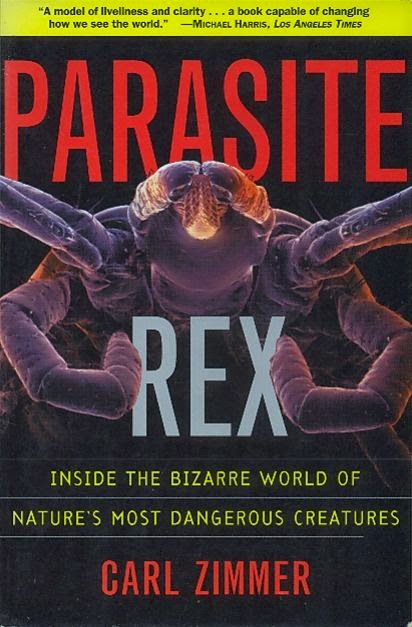
Parasite Rex

Inside the Bizarre World of Nature's Most Dangerous Creatures

It's a disturbing fact that the body of any creature, including our own, is potential habitat. We are a house and the mice want in. Or as the prologue puts it: "a vein is a river."

The life cycle of a parasite can be ingenious, complex, and gruesome, and the book provides some startling examples. Among the 16 pages of b&w photos you'll find one of a crustacean that has devoured the tongue of a fish and taken its place. But what makes this book remarkable is that it goes beyond such sensational examples and addresses broader issues.

Parasites, it seems, have been practising their trade since the dawn of life, and any ecosystem without them is likely to be unhealthy. Parasites may even have been responsible for the development of sex and language.

Then there are social parasites, like the cuckoo. Ultimately we ourselves may be seen as parasites -- with the planet our host.

Behaviour Modification

One of the truly shocking aspects of parasitism is the ability of some organisms to alter the behaviour of their host. Toxoplasma causes rats to be less wary of cats, the parasite’s final host.

Ants that have ingested lancet flukes leave their sisters and spend the night at the top of a blade of grass, the better to be consumed by a grazing mammal.

Sacculina, a parasitic barnacle, penetrates a crab’s leg joint, sends out "roots" through the crab’s entire body, and emerges as a sac on its ventral surface. The crab loses its ability to reproduce, becoming "genetically speaking, a zombie: one of the undead serving a master."


...parasites such as Sacculina...control their hosts, becoming in effect their new brain, and turning them into new creatures. It is as if the host itself is simply a puppet, and the parasite is the hand inside.


Makes one think of Heinlein’s Puppet Masters, and the movie Alien, doesn’t it? The author mentions them too.

Carl Zimmer

I enjoyed Parasite Rex so much that I immediately went out and bought two more of Zimmer’s books. Check out his website, which contains numerous articles he has written, as well as Chapter 1 from this book.

You can also find a link to his blog on Discover’s website, and there a link to a a photo gallery of scientific tattoos, the basis for a cool book coming out this fall called Science Ink.

Zimmer has had a tapeworm named after him.

A Few More Quotes


It’s time to put the parasite alongside the lion.

Castration is a strategy that any number of parasites have hit on independently...

Parasites have been a dominant force, perhaps the dominant force, in the evolution of life.

There are more human intestinal worms than humans.

Wednesday, September 14, 2011

The Good Body

An inspired blend of hockey and Canlit that makes you wonder why such an obvious combo hasn't been tried before.

Bobby Bonaduce has laboured 20 years in the minors, the high point of his career being a single shift with the Maple Leafs. Or perhaps it's a low point, for in that short span he speared an opponent's spleen, got into three fights, pushed a linesman, spit at a fan, and knocked off a cop's hat.

Now with his career over, he's heading north to reconnect with his son Jason, who is playing hockey for UNB in Fredericton. He bluffs his way into the graduate program for creative writing in the hope that he'll be able to join the team.

This makes for some great comic moments on and off the ice. Bonaduce is predictably disdainful of works like "Lady Windermere's fucking Fan" and at sea in seminars like "Canadian Writers of the British Diaspora," the first hour of which is spent defining "Britain."

The writing has a distinctive rhythm and tone, and offers up some cool observations.

Hockey


...you have the puck and you're lugging a bag of gold to market surrounded by fast bandits.


Canlit


Reading her novel, he'd felt a shovel-the-snow kinship to Atwood, though her tough-shit sharpness made him nervous; and to Davies, though he was a stuffed shirt. But you could tell they'd both shovelled driveways.


Grad school


This was pretty good, gift as a verb, one of the better ones in the new language he'd been learning here. Other verbs he didn't like so much. Dialogue. Let's dialogue. Hell, why not get Sally and trialogue. Eight of us at Murray's lousy party, octaloguing away.

He went to the bathroom, to urine.


The ex-wife


Her eyes, her bright eyes. You looked in and saw she was smarter than you but also that this wasn't a bad thing. You could also see how she felt her body to be not quite hers, or not quite her. She could hold her body at arm's length. You could see she respected her body, but also that she saw it to be a kind of playground.


The book is filled with likeable characters save for a roommate with a withered arm. But perhaps Toby and Bobby are intended as doppelgangers, as both are afflicted with a physical disability that gives an ironic twist to the book's title. The image of Bonaduce driving around with a dead Christmas tree on the roof of his car is a telling one. It's clear from the start that the book can only end one way, but funny and sad make for a powerful combination.

Hockey Lit

A good companion to this book is a more recent one by Gaston, Midnight Hockey, a non-fiction work in which he mentions his own hockey career.

You can also check out this review by Angie Abdou. Her novel, The Bone Cage, was defended by former NHL enforcer, Georges Laraque, in the CBC's 2011 Canada Reads event.

Two other hockey novels I have enjoyed: King Leary and Salvage Kings, Ya!

Sunday, September 4, 2011

Bobby Fischer Goes to War

The True Story of How the Soviets Lost the Most Extraordinary Chess Match of All Time

The "Match of the Century" has already been the subject of many books, but this one has benefited by coming out more than 30 years after the event.

Thanks to the ending of the Cold War, the authors had access to sources of information formerly unavailable. They spoke to many of the key people involved (the main exception, of course, being Fischer himself), and have put together this compulsively readable account.

In 1972 the match caught the imagination of people in the West because it was seen as a Cold War battle enacted over a chessboard, with a lone American taking on the seemingly invincible Soviet chess collective.

The authors have a different view: "Far from being a simple ideological confrontation, the championship was played out on many levels, of which the chess itself was only one." Thus their focus is more on what happened away from the board. They begin by describing the two opponents: Fischer the "enfant terrible of chess," and Spassky something of a maverick himself, a patriotic Russian who felt little allegiance to the Soviet Union. He was not a party member, and once raised hackles by asking:

"Did Comrade Lenin suffer from syphilis?"

The authors explain how Fischer was able to dictate the terms of the match in a way that had never happened before. The event almost never took place because he demanded an unprecedented amount of money. British businessman Jim Slater came to the rescue by kicking in an additional $125,000. That got Fischer to Reykjavik, but the barrage of demands continued, some of them quite ridiculous:


The legs of the $1200 custom-built mahogany table should be shortened, the sumptuous chessboard changed, the front rows of seats removed, the camera towers pushed right back to the point where filming would be nigh impracticable, the lighting brighter –- no, less bright, no, brighter than that.


Opposing him was the likeable Spassky, who had never been beaten by Fischer, and who was perhaps more accommodating than he should have been. The cumulative effect of Fischer’s tantrums and ultimatums wore down the champion even before the match began. He also undermined his own efforts by quarrelling with his handlers and insisting on putting together his own team. He did not prepare as hard as he could have, and was surprised by Fischer's use of atypical openings, like the English.

When Spassky fell behind, the Soviets expressed concern that the Americans were using “non-sporting” means to gain an advantage – telepathy, chemicals, parapsychology, etc. Fischer’s chair was x-rayed, revealing a strange u-shaped tube inside it, which did not show up on a second x-ray. Was it a diabolical device? Or was it planted then removed by the KGB?

"I'm crushing him with brute force. Haaaaaa!"

Fischer is reported to have said this during game 3, which he won -- the first time he had ever beaten Spassky. In the end he won 7 games to Spassky's 3 (one of which Fischer forfeited by not showing up). The rest were draws, though "far from being dull, lazy games, several of these had been desperate, protracted bare-knuckle brawls, exciting if not always pretty."

The final score was 12.5 - 8.5 after 21 games. Fischer earned over $150,000, while Spassky took home $93,750, making him a wealthy man in the USSR.

Fischer never defended his title despite lucrative tournament offers. When he was due to meet Karpov, the winner of the next Candidates tournament, he issued a list of 179 demands. When FIDE refused to meet them all, he resigned his title. Many observers believed he was frightened of the chessboard. After winning the championship, he had nothing left to achieve and descended into "an abyss of unreality."

A few final quotes:


Reykjavik changed chess itself.

Spassky went to Reykjavik to celebrate chess. Fischer went to fight.

There never has been an era in modern chess during which one player
[Fischer] has so overshadowed all others.


A movie based on the book is in development.

Friday, August 12, 2011

The Cunning Man

"Should I have taken the false teeth?"

A great opening line delivered by the narrator, Jonathan Hullah, a physician who grows up in Sioux Lookout where two medical practitioners are presented as possible models. One is a shamanistic healer, the other a second-rate doctor who is also the town's bootlegger.

Hullah goes away to a boarding school where he makes two close friends, Charles Iredale and Brocky Gilmartin, whose lives continue to intertwine with his own throughout adulthood. Iredale becomes an Anglican priest, Gilmartin a respected prof of English literature, and Hullah a doctor who employs unorthodox methods of diagnosis. Their professions provide the three principal motifs in the book, and give Davies a broad canvas on which to display his erudition. There is a boggling number of literary references, as well as forays into theatre, opera, painting, and church music.

But the great thing about Davies is the way he mixes his erudition with comedy, often of the ribald variety. Here is Hullah examining one of his patients:


...not that he demanded to peep up her chimney, or anythng like that...but he stared at her until she said she blushed from head to toe. Then he poked at her with an enquiring finger simply everywhere! He grabbed her tum until she thought he was trying to dislodge something inside, but it appears it was just an unusually prolonged and searching examination of the spleen. He made her turn over and did the same sort of investigation of her back, including a prolonged parting of the buttocks while he seemed to be staring at her exit – about which she seems to be extremely secretive. He did a lot about feet. Then – and this is what really shook her -- he began to sniff at her, very close up, and he sniffed her from head to foot, very slowly and even quite a lot of sniffing in that area which Miss Fothergill described as You Know Where...


But he's not merely a "twat-sniffer." He believes the health of the body is inextricably bound up with the health of the spirit, and combines modern medical techniques with enemas and poetry-reading. He refers to himself as a Paracelsian physician, melding humanism with medicine. He is the modern version of a village wise man who can also mend bones – a "Cunning Man."

The novel proceeds with a combination of satisfying plot twists, outrageous incidents, and lots of playful but wide-ranging dialogue fueled by good wine and fine scotch. There is a murder, a couple of miracles, a bad breath contest, and a scene during the war when a bomb explodes while Hullah is taking a bath, leaving him trapped in the tub for four days.

In the penultimate chapter Davies introduces a brave new character who takes over some of the narrative duties. She writes numerous letters in an amusing "schoolgirl-slangy vein," letters which later come into Hullah's possession. When he incorporates them into his Case Book and comments on them, the result is an interesting narrative crossfire.

In the final section Hullah reaches retirement age and devotes himself to working on a revolutionary approach to literature. He is going to re-evaluate the the characters of great works from a medical point of view. Was Shakespeare constipated? What about Mr. Pickwick's prostate? The Anatomy of Fiction will be the title, in homage to Robert Burton’s The Anatomy of Melancholy, from which is taken The Cunning Man's epigraph.

Some Great Lines

A brief sampling of the many delightful turns of phrase:


She blabs to conquer.
a trumpeting of flatus
a hymen like parchment
a melting young beauty
English beef-witted folly
some dark cupboard in my mind
the portcullis of respectability
the small change of her conversation
The church is an anvil that has worn out many hammers.


Names

The book has an astonishing number of characters. Many of them are minor, some appearing only once, but Davies names them all, a formidable task in itself. He always comes up with some great ones.

Dr. Ogg
Elsie Smoke
Hugh McWearie
Emily Raven-Hart
Edwin Allchin
Richard Craigie
Father Ninian Hobbes
Father Tommy Whimble
Pansy Freake Todhunter (aka Chips)
Hercules McNabb and his wife Dorsy
Lieutenant Dorrington
Prudence Vizard
Joe Sliter

An Unfinished Trilogy

One of the sweetest aspects of Davies's work is the way the books in his trilogies complement each other. The Gilmartin family tree was exhaustively explored in the preceding book, Murther & Walking Spirits, and while not necessary to understand The Cunning Man, it so enriches it that I've revised somewhat my earlier opinion of that book.

The ending in particular harkens back to Murther in a couple of respects – Esme wondering whether Gil's ghost might be hanging around, and a misdirected telephone inquiry about a movie. Those who have read Murther will immediately understand their significance.

And not only do the books in the trilogies overlap, but the trilogies themselves occasionally do. For example, Dunstan Ramsay has a brief walk-on as a history teacher at Colbourne, the boarding school attended by Hullah and his friends. And Brocky ends up a prof at Waverley University in Salterton, the setting for Davies’s first trilogy.

Unfortunately The Cunning Man is Davies’s last novel. He had begun preliminary work on another, mostly likely the concluding volume in what has been termed the Toronto series, when he died. While it's useless to speculate on what the contents of that book may have been, it's also fun. The main question is who would have been the lead character. Perhaps Nuala Conor, Brocky's wife and Hullah's lover.

Since Murther and Cunning Man both open with a death, it's not unreasonable to suppose the final volume would have done so as well. Perhaps it would have been that of Darcy Dwyer, who died of stab wounds in Gilbraltar.

There is a character in Murther known as the Sniffer. In Cunning Man, Hullah is also a sniffer, using his nose as a diagnostic tool. Would there have been another sniffer in the third book?

The Gilmartins

Since several of Brocky's relatives pop up in Cunning Man, I made an abbreviated family tree to refresh my memory. All except for Ollwen appear in Murther. The names in bold are those who appear in this book.

The Female Line (5 generations)

Anna Vermeulen + Major Gage
--Elizabeth Gage + Justus Vanderlip
----Nelson Vanderlip
------Cynthia Vanderlip + Dan Boutelle
------Virginia Vanderlip + William McOmish
--------Caroline, Minerva & Malvina McOmish

The Old World Gilmartins (5 generations)

Thomas G.
--Wesley G. (adopted)
----Samuel G.
------Polly G. + John Jethro Jenkins
------Walter G. + Janet Jenkins
--------Elaine, Maude, Lancelot, Rhodri G.

The New World Gilmartins

Rhodri G. + Malvina McOmish
--Brochwel "Brocky" G. + Nuala Conor
----Conor "Gil" G. + Esme Barron
-----Ollwen G.

Tuesday, August 2, 2011

Martin Chuzzlewit

The plot of the novel originates with a quarrel between two men, both named Martin Chuzzlewit. One is wealthy and old, the other is his grandson. They were on good terms until young Martin fell in love with Mary Graham, an orphan raised from childhood by the grandfather.

As a result young Martin is disinherited and heads to America with Mark Tapley in search of fortune, only to be conned into buying worthless swampland in a place called Eden. When they return to England, Martin has been transformed by his experiences into a better person.

During their absence, old Martin’s brother, Anthony, dies. His avaricious son, Jonas, marries Mercy, the daughter of a sanctimonious hypocrite named Pecksniff. Tigg, the prosperous chairman of the Anglo-Bengalee company, learns that Jonas hastened his father’s death with poison. Jonas is blackmailed into investing in Anglo-Bengalee, then forced to persuade his father-in-law, Pecksniff, to do the same. Tigg pays for this with his life.

Old Martin, who has pretended to fall under Pecksniff’s influence in order to expose his hypocrisy, now confronts Jonas about his role in Anthony’s death. To the surprise of everyone, including Jonas, it is learned that Anthony only pretended to take poison and died of a broken heart. Jonas, however, does not go free, as he is immediately taken into custody for the murder of Tigg, and commits suicide by swallowing poison. Old Martin denounces Pecksniff and is reconciled with young Martin, who regains his inheritance and weds Mary.

The novel was not as well-received as previous titles, and the first one to suffer a decline in readership.

Memorable Characters

Pecksniff is a major figure in the book. His smarmy hypocrisy and glib fawning ways are wonderful to behold. He is "soft and oily," has a flabby face, and is described by Jonas as "a sleek, sly chap...just like a tomcat." At one point he tells young Martin, "I am an honest man, seeking to do my duty in this carnal universe and setting my face against all vice and treachery. I weep for your depravity, sir."

Mrs. Gamp is a fat old woman with a swollen red nose and a liking for booze and snuff. She works as a nurse, midwife, and "performer of nameless offices about the persons of the dead." A comic figure and loquacious spouter of malaprops, she goes to "a lying-in or a laying-out with equal zest and relish." One of her sayings: "Rich folks may ride on camels, but it ain’t so easy for ‘em to see out of a needle’s eye."

Mark Tapley is a jolly fellow in search of a trying situation. He wishes “to come out strong under circumstances as would keep other men down.” In Martin he sees the potential he is looking for.

Highlights

The wonderful glimpses of Victorian England -- a steak wrapped in a cabbage leaf, straw on the floor of a stage-coach for passengers to shove their feet into for warmth, a medication called a slime draft, patches of pickled brown paper applied to Pecksniff's head, sacks stuffed up a chimney to keep the rain out, men carrying letters in their hats and walking arm-in-arm in convivial friendship. The draymen, thimbleriggers, underporters, and coal-heavers; and the quaint antiquarian objects -- hunting-whips, portmanteaus, tea-chests, pudding-basins, stone brandy-bottles, fish-baskets, waist-coat strings, toasting forks, key-bugles.

Dickens's delight in food: oysters for breakfast, potted boar's head, intensely pickled salmon, beef-steak pudding, sheets of ham, stewed kidneys, a hot leg of mutton, innocent young potatoes, a cool salad, a crusty loaf, cunning tea-cakes, flowing mugs of beer, jorums of hot punch.

Some fine comic scenes including the row between Mrs. Gamp and Betsey Prig, and Tigg's weaselly cadging at the beginning of the novel when he is still a shiftless bum. In fact, some consider Martin Chuzzlewit to be Dickens's funniest novel, while author John Boyd finds that chapters 8 and 9, which describe the Pecksniffs' London visit, as the "most sustained passage of comic writing in English literature." Counterbalancing the humour are some dark scenes, and though not always effective or believable, the nightmarish carriage journey undertaken by Jonas and Tigg is especially powerful.

Finally, the book is not burdened with a labyrinthine plot as some of the later novels are. It is relatively free from sentimentality; there are no cloying characters or tear-jerking death scenes. And young Martin’s slightly flawed character makes him more likeable than other bland heroes, like Arthur Clennam in Little Dorrit.

America

Dickens wrote Martin Chuzzlewit after a disappointing trip to America, and vented some of his ire in this book. Most Americans are portrayed as glib, crass, pretentious, and hypocritical. They are gluttonous feeders with swinish table manners, and have the unpleasant habit of spraying tobacco juice everywhere. Despite such comedic potential, this portion of the book (7 of 54 chapters) was the least satisfying, because the characters are pretty much cut from the same cloth, with the result that none stand out the way Pecksniff and Mrs. Gamp do. Some great names, though:

Colonel Diver
Major Pawkins
General Fladdock
General Cyrus Choke
Major Hannibal Chollop
Professor Mullit
Doctor Dunkle
Jefferson Brick
LaFayette Kettle
Zephaniah Scadder
Mrs. Hominy

Reversals & Improbabilities

As much as I enjoy Dickens I always seem to have difficulties with his plotting, and in this book the appalling bipolar behaviour of old Martin is more a function of plot than of character. The senseless quarrel with young Martin, and especially the ruse of pretending to be in Pecksniff's power, are neither credible nor creditable. Dickens has a lot of explaining to do at the end, but none of it is very convincing. He is not unaware of the problem, for he has Pecksniff declare, "Whether it was worthy of you to partake of my hospitality, and to act the part you did act in my house, that, sir, is a question which I leave to your own conscience."

Equally unbelievable is Anthony’s pretending to take poison, and Tigg's transformation from a scruffy cadger at the beginning of the book into the well-dressed and prosperous chairman of Anglo-Bengalee. Again, these are functions of plot rather than character.

Also related to Dickens's handling of plot is the way some characters are dragged back into the story when there is no need for it. Chevy Slyme shows up at the end of the book as an officer of the law, and the woman Mark assists during the journey to America reappears with her husband in Eden and again in London in the last chapter. This is perhaps an effort to make the sprawling tale seem a little more shapely than it actually is, tidying up ends that are not really loose.

Still, one might argue that some plot decisions are based on the recurring theme of character reversal, of which there are many in the book. Anthony, Pecksniff, Tigg, Slyme, Mercy, both Martins, and the suitor of Mercy's sister all undergo (or pretend to) some sort of transformative change. This is underscored by the change in Tigg's name -- from Montague Tigg to Tigg Montague.

It might also be said that some of Dickens's most entertaining characters are no more believable than his twisted plots, and that together they are but two sides of the same coin of his teeming genius.

Links

The 1994 BBC production of Martin Chuzzlewit is superb and quite faithful to the book. Paul Scofield as old Martin, Tom Wilkinson as Pecksniff, and Pete Postlewaite as Tigg are especially good. You can find clips on Youtube.

Here's a map of London showing locations mentioned in the novels of Dickens. The boarding house of Mrs. Todgers is close by the Monument near London Bridge.