Wednesday, June 26, 2013

The Road

Jack London's Road is a somewhat disjointed memoir of his hoboing days in 1894 when he hopped freights across the continent. America was crippled by one of its worst depressions ever, and he set out to join an army of the unemployed marching on Washington. Only 18 at the time, he went as more of a lark than anything else, and describes with youthful exuberance riding the rods and foiling brakemen by climbing to the roofs of, and jumping in and out of, moving boxcars.

When not on the train, he begged for food and clothes, which he looked upon as "a joyous prank, a game of wits, a nerve-exerciser." He spent 30 days for vagrancy in the Erie County Penitentiary outside Buffalo, and explains how he conned the other cons. He saw a woman being whipped, stole a brandnew hat off the head of a Chinaman, and ran with a gang of youths who rolled drunks.

Similarities between this and a more famous road book (an autobiographical novel by another Jack) invite comparisons, but my thoughts ran, or rather rambled, in another direction, and I found myself thinking about an entirely different sort of road novel.

Cormac McCarthy's Road runs through a post-apocalyptic America with a man and his young son carrying their meagre belongings in a shopping cart. The terrain is an "ashen scabland," the train they stumble across "slowly decomposing for all eternity." The few remaining people are broken-down wrecks living like animals –- a grinding filthy miserable existence fraught by growing fear and dread. "I don't think we're likely to meet any good guys on the road," the father tells his son.

Both books are short, London's clocking in at just over 50,000 words with McCarthy's in the same ballpark. London's prose remains surprisingly fresh a century after it was written, but in places its youthful vigour gives way to what sounds like adolescent boasting. Of his ability to fabricate a story at a moment's notice, he says, "I have often thought that to this training of my tramp days is due much of my success as a story-writer."

McCarthy's prose is far more grim and powerful. The stripped-down punctuation gives it an elemental quality suitable for such a tense and harrowing tale. London's own post-apocalyptic novel, The Scarlet Plague, seems positively sunny by comparison. Similar to McCarthy's Road, it begins with an old man and his twelve-year-old grandson plodding along a railway embankment and clad in skins. It is 60 years after a worldwide plague in 2013 (eerily, the same year I am writing this) killed off nearly everyone. The handful that remain live in "primitive savagery," collecting human teeth on strings and unable to count beyond ten. One of the survivors is a brutish chauffeur who takes pleasure in beating the widow of one of the most influential men in pre-plague times.

Brutality, atavism, and survival of the strongest are recurring motifs in London's work, but nothing in his oeuvre can compare to McCarthy's Road for the chilling evocation of how nasty and repellent life would really be in a world without the veneer of civilization. On the very first page of the novel is the following dream:


And on the far shore a creature that raised its dripping mouth from the rimstone pool and stared into the light with eyes dead white and sightless as the eggs of spiders. It swung its head low over the water as if to take the scent of what it could not see. Crouching there pale and naked and translucent, its alabaster bones cast up in shadow on the rocks behind it. Its bowels, its beating heart. The brain the pulsed in a dull glass bell. It swung its head from side to side and then gave out a low moan and turned and lurched away and loped soundlessly into the dark.


London's chauffeur represents a brutal working class bent on revenge, whereas McCarthy's creature stands for a world inimical to everyone, with the man and the boy struggling to remain not only alive, but human. In the end, however, it seems to me that both authors are writing about the same thing -- the savagery of American society.

Canadian Content

In 1894 London returned from his wanderings via the CPR. It took him six days to get from Montreal to Ottawa. The latter, he says, is "the hardest town in the United States and Canada to beg clothes in; the one exception is Washington, D.C."

At a Winnipeg police station he pieced together a tale convincing enough to keep him out of jail. Travelling west, he engaged in a long battle of wits with the CPR's brakemen, which he finally won enabling him to ride over 1000 miles in a boxcar half full of coal.

In a later chapter, "Hobos That Pass in the Night," he provides more detail about the journey, describing how he and another "bo" were aware of each other's presence by their noms-de-rail (London's was Sailor Jack) which they carved in wooden watertanks as they went across the prairies and through Kicking Horse Pass in the Rockies. In Vancouver they both signed on ships without once ever meeting each other.

Despite London's experiences in Ottawa and Winnipeg, James Haley writes in his biography that "London was cheered by the discovery that Canadians were more forthcoming in their sympathy for the homeless unemployed" and that "Canadian generosity left a deep impression."

On the Rods

Haley referred to London's Road as "a combination memoir of his months riding the rails and exposition of tramping as a an American subculture created by capitalist abuse of workers."

Most of the material had appeared in Cosmopolitan magazine before it came out in book form. The magazine version contained a number of illustrations not found in the book, but you can find them on the excellent Jack London site maintained by the Sonoma State University Library. The book itself was a flop, unlike McCarthy's Road, which was famously a selection by Oprah's Bookclub, won the Pulitzer in 2006, and made into a movie.

McCarthy's Suttree is probably the closest of his works to London's Road, for it describes the ragged existence of people on the margins of society in Knoxville, Tennessee. Said to be semi-autobiographical, it's a wonderful book with powerful prose, and a good one to start with if you haven't read McCarthy before, because its darkness is leavened with humour.

Links

The Road with illustrations
Jack London's Dark Side An insightful essay about his "historical castration"

Cormac McCarthy official website
McCarthy's interview with Oprah

Friday, May 17, 2013

Zugzwang

Good chess novels are hard to come by, but this is one of the better ones, set in St. Petersburg in 1914, three years prior to the Russian revolution. Lining up against each other are the Bolsheviks, of course, and the Tsar backed by his secret police, the Okhrana.

At the same time a prestigious chess tournament is being held, in which many of the world's strongest players are competing, including Lasker, Capablanca, Tarrasch, Blackburne, Nimzowitch. The tournament was real, but departing from historical fact is the inclusion of a fictional GM named Rozental (though he is based on Rubinstein). He is favoured to win.

In a third narrative strand, the main character, Dr. Otto Spethmann, is a psychoanalyst treating not only Rozental, but also Petrov, the de facto leader of the Bolsheviks with Lenin in exile, and a woman named Anna, with whom Spethmann falls in love. Thus we have the intricacies of chess mirrored by the intricacies of revolution, psychoanalysis, and love -- an impressive and ambitious conceit.

Finally, to top it all off, Spethmann is playing a correspondence game against his friend, a gifted violinist named Kopelzon. Spethmann has never beaten him, but this time he feels he has a good chance. As the book opens, they have reached a rook and pawn endgame. Spethmann has just played Rxg4 -- and the body of a liberal newspaper editor has been retrieved from a canal.

Over the course of the novel, the progress of this game is followed by means of 12 diagrams.

"Psychoanalysis is like panning for gold"

Rozental is on the verge of a mental breakdown and has been brought to Spethmann by Kopelzon. The latter is very keen that Rozental win the tournament, for both are Polish Jews, and with Poland occupied and partitioned by Russia, a victory by Rozental would be a symbolic victory against their country's oppressors. Soon after Spethmann's first session with the Rozental, two thugs invade his office and steal the GM's file.

Petrov is a champion of the city’s poor and an electrifying speaker, but he is also exhausted and depressed. His life is hellish and the party a snakepit, especially since its penetration by a traitor, codenamed King, who has been betraying comrades. He visits Spethmann under the alias of Grischuk, and tells Spethmann, "I want you to make my lives possible."

Anna is suffering from nightmares, which appear to be related to a traumatic event that happened when, as a young girl, she visited Kazan with her father, Zinnurov, from whom she is now estranged. Zinnurov, nicknamed the Mountain, is an influential industrialist and anti-Bolshevik. He warns Spethmann that his daughter is erratic and cannot be trusted to speak the truth. Their stories about events in Kazan do not match.

"A series of ingenious slayings"

That is how Spethmann describes the chess tournament. They are matched by actual slayings beginning with the newspaper editor and quickly followed by that of a young man, whose body is found with Spethmann’s card in his pocket. Inspector Lychev of the St. Petersburg police believes Spethmann’s 17-year-old daughter, Catherine, is somehow involved.

Bodies continue to pile up as Bolsheviks clash with the secret police. A notorious Polish terrorist is on the loose and a plot to assassinate the Tsar is uncovered. Nothing can be taken at face value. Everyone has a secret, allegiances shift, complications spring up, lies and spies proliferate. The dizzying complexities suggest the many possible lines in a chess match. Spethmann observes:


…I tried to be as logical about Lychev’s story as about the variations in a chess game. In chess it is easy to be panicked by a complicated position and the aggressive manoeuvring of an opponent. What is needed always is a cool eye and a clear head. Calculate. Calculate concrete variations. What do I do if my opponent does this? What do I do after that?


Spethmann's cool approach to life is turned upside-down when he is drawn into a torrid affair, thrown into jail, shot at, blown up, and finally has to flee the country. The dilemma he faces cannot be won. He, like Russia itself, is in zugzwang.

Links

Book Trailer
Author interview on Chessbase
Reviews

Friday, April 5, 2013

Jack London

Lots of interesting details in this recent bio: Jack's illegitimate birth and black wetnurse, his infatuation with surfing, his Korean and Japanese valets, his stint as a war correspondent, his bohemian friends with their vials of cyanide, his welcoming of tramps into his home, and his "supposed anti-American sympathies" that caused the FBI to open a file on him after his death.

On the literary side it was interesting to learn that there were scenes in Sea Wolf that "shocked and terrified readers;" that he purchased story ideas from Sinclair Lewis, was praised by Conrad and Kipling, and became the highest paid writer in America.

However, when the "Dickensian gloom" of a cannery was mentioned, I began to see shadowy similarities with another great writer.

London and Dickens

Both were literary dynamos. London published at least one book a year beginning in 1900, but more usually it was two or three and sometimes four. Several came out posthumously, making a total of 49 books between 1900 and 1920.

Commitment to social reform began with their experiences as child labourers, Dickens famously in a blacking factory at age 12, London in a pickle factory at age 14. Dickens's ordeal was short, lasting something like six months, but London did not escape so easily. He put in ten-hour days at a jute mill for ten cents an hour, and shovelled coal at a power plant for $30 and a single day off per month.

Before London was out of his teens his Oliver-Twist-like existence included oyster pirating, brawls with waterfront bullies, a half-year voyage on a sealing ship, riding the rails across America to join an army of the unemployed marching on Washington, and a 30-day jail term for vagrancy.

Dickens, though reform-minded, was never a revolutionary and regarded trade unions with suspicion. London on the other hand became a socialist, preaching it on street corners, writing about it in essays, and making fans of Emma Goldman and Leon Trotski. In the final year of his life he quit from the Socialist party due to its lack of "fire and fight," signing his resignation letter, "Yours for the Revolution."

Family Resemblances

Both writers were born to neglectful mothers, Dickens never forgiving his for suggesting he remain in the blacking factory when it was no longer absolutely necessary. London's mother was unstable and manipulative, "barren of maternal instinct."

John Dickens, the father of Charles, was a naval pay clerk who was unable to live within his means, and continued to embarrass his adult son by demands for money. The case was different with London, who never knew his biological father. After he was born his mother married a Civil War veteran named John London. "The best man I ever knew," Jack said of him later, but even he on occasion was embarrassed by requests for money. The difference between John Dickens and John London was that the latter was conscientious and hard-working.

An important figure in the life of Dickens was his beloved sister-in-law, Mary Hogarth. With London, it was his devoted step-sister, Eliza Shepard, daughter of John London from his first marriage. In later years she helped run Jack's ranch and manage his literary affairs during his absences.

London and Dickens married in the same year their first books were published, but the matches were unsuitable. Dickens was domineering, striving to create the sort of family life he'd missed out on, with himself at the centre; as though, writes one of his biographers, Fred Kaplan, he needed "to become father to himself." London's failure as a husband was due, at least in part, to his never having had a childhood. The marriage breakups were widely publicized and neither man proved to be a particularly able parent.

London on London

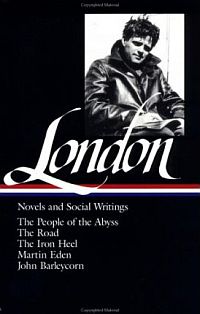
After reading the bio I was keen to dig into something by London himself, and hauled out this excellent compendium from the Library of America and which had been languishing on a bookshelf for far too long.

People of the Abyss is what I read, an expose of life in the London slums written in 1902. To my surprise and delight, the prose remains fresh and vital.

London passes himself off as a stranded American sailor in order to report on living conditions in the East End. The scenes he describes are "straight out of darkest Dickens," with people ground down by "a gross and stupid materialism" until they become stunted physically and mentally. The "gutter folk" he meets are worse off than beasts, living in "dens and lairs" and eating "pavement offal." Children take turns at night "sitting up to drive rats away from the sleepers."


Bathtubs are a thing totally unknown, as mythical as the ambrosia of the gods. The people themselves are dirty, while any attempt at cleanliness becomes a howling farce, when it is not pitiful and tragic. Strange, vagrant odors come drifting along the greasy wind, and the rain, when it falls, is more like grease than water from heaven.


(London's findings were corroborated by a government report after the second Boer War, which concluded in 1902. It found that 40-60% of the volunteers failed to pass the physical exam, a direct result of the "illness, malnutrition, and relentless hard work" experienced by the urban poor.)

People of the Abyss was a success in America but not in England, where reception was hostile -- much as Martin Chuzzlewit's had been in the U.S. for its unflattering portrait of Americans.

Thirty years later George Orwell trod similar ground in Down and Out in Paris and London and The Road to Wigan Pier. Like London, he was a socialist.

Saturday, March 30, 2013

The Age of Shakespeare


Two nicely complementary books, one on Shakespeare by the ever breezy Bill Bryson, and the other a rambling and chatty overview of Elizabethan and Jacobean playwrights by Judith Cook.

The Bryson book is the illustrated and updated edition, about 50 pages longer than the original, and a worthwhile extravagance because the images are so useful in giving a sense of the time. For example, a reproduced Elizabethan document looks like gibberish and suggests the foreignness of the age. When in 2005 a performance of Troilus and Cressida was given using Elizabethan pronunciation, one critic reckoned he understood no more than 30%.

Shakespeare's life, says Bryson, is "little more than a series of occasional sightings." We're not even sure of his name, it having been variously rendered as Shagspere, Shakspere, Shappere, Shaxberd, and perhaps even Shakeshafte. He may have been gay. We don't know whether he was Catholic or Protestant. We don't know how many plays he wrote or in what order. We know nothing about his activities during a seven-year period before his arrival in London, a period that Bryson slyly devotes an entire chapter to. Inevitably, much of the book concentrates on life in Elizabethan and Jacobean England, but context is not just necessary, it's fascinating.

However, what is known or suspected about Shakespeare is assembled with the usual Bryson industry and scope. The plays and sonnets are looked at from a variety of angles. We read about Shakespeare's stint as Burbage's house playwright, his apparent prosperity, and how his work was received in subsequent years. The book concludes with a chapter on the various claims that the plays were written by someone other than Shakespeare.

A Violent and Brutal Age

Fusing material gleaned from both books, an unsettling portrait of the times emerges. Recurring outbreaks of plague and the shifting tectonics of religion and politics made life dangerous at all levels of society. The Spanish Armada (1588) and the Gunpowder Plot to overthrow James I (1605) are two of the more famous events of the period, but there were also plots to depose or assassinate Elizabeth (e.g Essex, Ridolfi, Babington). She had an active intelligence network and at night slept with a sword by her side. Her refusal to marry or name a successor carried with it the ominous possibility of civil war upon her passing. (No wonder so many of Shakespeare's plays revolve around the transfer of power in a state.)

Hangings, bear-baiting and cock-fighting were forms of public entertainment. "Brawls," writes Bryson, "were shockingly common," as men carried swords and daggers and were quick to use them if they felt slighted. When Cook mentions the versifying of Spenser and Raleigh, she adds, "Renaissance Man indeed had many facets, but unthinking violence is rarely mentioned among them." (Which made me think of the Elizabethan adventurer, Martin Frobisher, and his ruthless dealings with the Inuit of Baffin Island, and the book by aboriginal historian Daniel Paul, We Were Not the Savages.)

"A significant proportion of the population," writes Cook, "lived below the poverty line." Vegetables were eaten mainly by the poor, while those who could afford meat supped on, among other things, "crane, bustard, swan and stork" (Bryson). Rotten teeth caused by sugar consumption was so common that some blackened healthy teeth as a fashion statement.

People believed in witchcraft. Tobacco was known but not tea or coffee. The age of consent for girls was 12, boys 14.

At the Theatre

Play-going was an intimate experience with two to three thousand people crammed into a theatre. No one was more than 50 feet from the stage and some even sat upon it. Prologues were employed due to the high level of illiteracy, yet attention spans were probably better than our own because it was an oral culture. People loved puns and wordplay.

Plays lasted three hours or more (four-and-a-half for Hamlet) without intermission. People ate and drank beer during the performance, and if they needed to relieve themselves buckets were available to piss in. Crowds were noisier than today’s audiences, unafraid to hiss or cheer, or even throw things. Pickpockets and whores were ever-present. Real bullets were used on stage.

Theatre companies consisted of about 15 actors and a handful of apprentices. Complete scripts were not handed out. Instead actors received a separate sheet or roll ("from which the word role comes" says Cook) containing only their own lines and cues. It was rare for a play to run two days in a row, which meant that over the course of a season an actor could be expected to learn 15,000 lines. Plays often concluded with a jig, an attempt to subdue post-play boisterousness.

All plays had to be approved by the Master of Revels and were subject to censorship.

Roaring Boys

Christopher Marlowe – The baby-faced fellow with the chilling stare is thought to be Kit Marlowe. Though he wrote only a handful of plays, he was hugely influential and famously praised by Ben Jonson for his "mighty line." Cook describes him as "flamboyant, outrageous in his behaviour and opinions, given to outbursts of violence," and may have served as the model for Mercutio in Romeo and Juliet. He was involved in a fatal fight before he himself died in what was long thought to be a senseless tavern quarrel, but may in fact have been an assassination, possibly related to his having worked as a government spy. In the top left corner of the portrait is a Latin motto that translates as "That which nourishes me destroys me."

Thomas Kyd – His play The Spanish Tragedy was "the single most popular and successful play of its day, remaining in repertoire for thirty years after his death" (Cook). His acquaintance with Marlowe caused him to be imprisoned and tortured, an experience that shortened his life.

Ben Jonson - Known as the most erudite of the playwrights and also one of the most ill-tempered. He killed at least one man in a duel, a fellow actor. He was imprisoned more than once for the content of his plays. He was branded on the thumb and threatened with having his ears and nose slit. Shakespeare is known to have acted in one of his plays, and may have contracted his fatal illness after they were out drinking together. Jonson once walked from London to Edinburgh. He died impoverished.

John Fletcher – Followed Shakespeare as Burbage’s house playwright, very prolific and collaborated with a number of others, most notably Beaumont. He died of the plague and was probably buried in a common grave.

George Peele – "His name," Cook writes, "became a byword for riotous living and dissipation." He died of a "loathsome disease."

Thomas Middleton – Author of A Game at Chesse, a thinly disguised allegory satirizing the Spanish court. It "ran for an unprecedented nine performances" (Cook) and caused an international incident. When the Spanish ambassador complained, the Globe was shut down and Middleton imprisoned.

Robert Greene – A compulsive gambler, he took up with the sister of the notorious highwayman Cutting Ball Jack. At the end of his life he repented his riotous living and appalling behaviour in a pamphlet called "A Groatsworth of Wit" in which he called Shakespeare "an upstart crow."

Thomas Dekker - He and Jonson became embroiled in a "Poets War," lampooning each other in their plays. Cook gives a hilarious excerpt from his pamphlet "A Gull's Horn Book" in which a newcomer to London is given advice on how to make an impression:


Never cut your hair or suffer a comb to fasten his teeth there. Let it grow thick and bushy, like a forest or some wilderness. Let not those four-footed creatures that breed in it and are tenants to that crown land, be put to death... Long hair will make you dreadful to your enemies, manly to your friends; it blunts the edge of the sword and deadens the thump of the bullet; in winter a warm nightcap, in summer a fan of feathers.


Shakespeare Portrayed in Film

Having thoroughly enjoyed both books, I settled down to view a pair of equally entertaining but very different movies. First up was Shakespeare in Love, which so cleverly conflates aspects of his life with Romeo and Juliet. Then came the newer Anonymous, in which the Bard is a boob, an illiterate opportunist who takes credit for plays written by Edward de Vere, the Earl of Oxford.

Tuesday, February 5, 2013

Dead Souls

I was astounded when I first read Gogol's short story, "The Nose." It is so absurd, so Pythonesque, I could scarcely believe it had been written in the 1830s. It begins with a barber eating a roll for breakfast and finding a nose inside. Yes, a nose, and from there the story only gets more bizarre.

I mention this because in the notes to this edition of Dead Souls, the translator, Christopher English, mentions that a rhinological theme runs through Gogol's work. The protagonist of Dead Souls is Chichikov, a name that suggests the Russian word for sneeze, while the name of another character is Nozdryov, which derives from the word nostril.

Comic Masterpiece

The book is set in rural Russia at a time when landowners paid tax on their serfs, even dead ones. This gives Pavel Ivanovich Chichikov an idea, and he visits a number of farms hoping to increase his wealth and status by acquiring the title to serfs (aka souls) who have died.

Of course, it's a shady scheme, and the comic possibilities are obvious. One of the most priceless scenes occurs when a widow dithers over whether or not to turn over her dead serfs. "They might come in useful around the farm," she says worriedly.

Sometimes the humour is pure physical comedy, but it also serves the purpose of bursting pretentions:


At this moment the footman standing behind him wiped the ambassador's nose, and not before time too, for otherwise a sizeable foreign droplet would have fallen into His Excellency's soup.


Eventually Chichikov's plan unravels due to unfounded rumours, each more ridiculous than the last. He is a spy, he is planning to abduct the governor's daughter, he is Napoleon in disguise, he is a veteran with only one arm and one leg. Wait a minute, how can that be? Chichikov is not missing any limbs. No matter, the damage is done and he has to flee.

However, it is not just humour that makes this book a masterpiece. The writing is so easy-going, so natural, we feel as though we're taking a stroll with the author through the Russian countryside. He speaks directly to us; Chichikov is "our hero."

Then there is the loving detail that Gogol weaves into the story:


The black tailcoats flashed and whizzed about, singly and in groups, like flies on a hot July day buzzing round a dazzling white sugar-loaf which the old housekeeper, standing before an open window, chips and divides into sparkling chunks, while the children gather round and gaze in fascination at the movements of her sinewy arms wielding the hammer, and the airborne squadrons of flies, buoyed up by the light air, swoop bravely in, like full masters of the house and--taking advantage of the old woman's poor eyesight, made worse by the glare of the sun--scatter over the succulent morsels, either separately, or in dense clusters.


Gogol's achievement is even more remarkable when one considers how far away in time and language is rural pre-Revolutionary Russia. Differences include the mode of dress, the many civil service ranks, the forms of measure no longer used (versts, poods, arshins), even the different kinds of carriages (droshky, britzka, troika, etc.). Yet none of these are serious obstacles to our enjoyment of the work.

Part Two

It seems that Dead Souls was conceived as a trilogy. We know at least that Gogol worked on Part Two for a number of years, but became mentally unstable at the end of his life and burned the manuscript just days before he died. However, much of it has been restored from previously existing copies. It is fragmentary in a few places, and has no ending.

Whereas in Part One Chichikov is merely engaged in a somewhat shady activity, in Part Two he is more reprehensible. At the same time a moralistic tone enters the book, which I found hard not to see as a reflection of Gogol's own crisis. It seems clear that "dead souls" refers not just to dead serfs, but also to people like Chichikov whose souls are morally dead.

Dickens

Dead Souls reminds me of another comic masterpiece, Pickwick Papers. They share a picaresque quality and protagonists accompanied in their travels by bumbling companions. They get lost, stop at inns, and listen to tales distinct from the main storyline (in Dead Souls "The Tale of Captain Kopeikin").

There is the same delight in food, and the same use of exaggeration. An army courier has moustaches two feet across, a woman wears a hoop skirt so big it takes up half the church, a colonel offers a "sauce-boat" to a lady on the end of his sabre. The miser Plyushkin, and the quarrelsome bully and inveterate liar Nozdryov, are in many ways as grotesque as anything in Dickens.

Mention is made of a man who, like Krook in Bleak House, spontaneously combusts due to excessive drinking; and when Chichikov tries to process the transfer of the serfs he has acquired, he meets the same bureaucratic obfuscation that Arthur Clennam encounters at the Circumlocution Office in Little Dorrit.

And bits like this:


And along both sides of the highroad it was the same old story: the usual succession of milestones, station-masters, wells, waggon trains, dreary villages with their samovars, countrywomen, and a spry, bearded inn-keeper, running out of his coachyard to meet them, bearing oats for the horses, a wayfarer who had trudged some eight hundreds versts in his worn-out bast shoes; small, wretched towns with the houses arranged haphazardly, with their ramshackle wooden shops, flour barrels, bast shoes, calatches, and other trifling wares; striped turnpikes, bridges under repair; fields stretching as far as the eye could see on both sides of the road; the landaus of local landowners; a mounted soldier, carrying a green box of lead shot, which bore the legend: 'Artillery Battery such-and-such'; the steppe, with its stripes of green, and gold, and freshly turned black earth; a song borne from afar; the tops of pine trees seen through the mist; the peal of church bells ringing, and fading, in the distance; crows clustered as thick as flies, and a horizon without end.


Postscript

Just as I was finishing the book, I read a newspaper article about a man who died in a Russian jail three years ago. He is to be put on trial later this month.

Thursday, January 10, 2013

Love and the Mess We're In

Two words to describe this novel: experimental and extramarital. The first because the book is a collage of text fragments, the second because the two principal characters embark upon an adulterous affair.

In Chapter 1 Clive and Viv arrive in Buenos Aires for their inaugural tryst. Multiple text windows predominate, in one instance mimicking the floor plan of a rented apartment.

Chapter 2 is perhaps the most innovative part of the book. It describes a wine-fueled dinner conversation during which Clive and Viv get hornier and hornier. There are no quotation marks, no “he said” and “she said.” Instead, Viv’s part of the conversation is presented on the left page of the spread, Clive’s on the right. Each page is also divided into two columns, one for speech and one for private thought. The conversation is not the polished talk of most novels. It is jerky and fragmented with the accompanying thoughts providing delightful subtext.

Chapter 3 describes their love-making in blocks of text suggestive of the intimacy and athleticism of sex. Sometimes the book must be rotated in order to be read. The chapter ends with a typographical climax.

In Chapter 4 the escape of Viv’s husband Tim from a mental institution is illuminated by the crackbrained constellations he sees overhead.

The final chapter finds Clive and Viv in New York, where the introduction of a new character provides a satisfying conclusion to the book.

If all of this gimmickry sounds daunting, it's not, thanks to the generous use of white space, and writing that is rich, honest, tender, humorous, and sometimes very explicit.

The National Post describes the book as “a tonic for readers tired of conventional narratives and inert prose.” The Financial Post finds it “akin to a text-based sculpture.”


You can read Stephen Marche's interactive short story, "The Missing Period of Lucy Hardin," at The Walrus.

Update

Love and the Mess We're In won first place for its designer in the prose fiction category of the 2012 Alcuin awards.

Wednesday, November 21, 2012

Postmodern Selfhelp

Two dazzling but very different forays into metafiction, yet with curious similarities. In each the protagonist is searching for his father, and in one he is also searching for his son.

How to Live Safely in a Science Fictional Universe is the name of a self-referential manual that the protagonist writes in the future and gives to himself in the past. It is "a copy of a copy of a copy" containing excerpts from itself, such as:


[this page intentionally left blank]


How to Keep Your Volkswagen Alive takes its title from a 1969 repair manual of the same name. It uses actual chapter titles from the original manual. More recursion appears in the chapter subheads, one of which is always the chapter title.

Metafictional Transport

The protagonists tool around in vehicles seemingly worlds apart, a time machine and a 1971 Volkswagen. Both however are based on similar concepts.

The TM-31 Recreational Time Travel Device is powered by a six-cylinder grammar drive with temporalinguistics architecture. It navigates within "a story space and, in particular, a science fictional universe." "Running out of fuel" is another way of saying "we're running out of book."

The Volkswagen runs on stories which can either be read to it or scanned in, and its mechanical components include a narrapedal, storypump, pagewheel, scene clutch, and engineheart. Its wordoil has to be changed every 50 pages.

Strange Characters

The author and protagonist of How to Live share the same name: Charles Yu. The author of How to Keep is Anthony Boucher, whose protagonist has pawned his name and has to go by __________. All he can remember about it is that it's French Canadian.

The vehicles are also characters with whom the protagonists have a relationship. The Volkswagen is __________'s son, while the time machine has an operating system named TAMMY whom Yu flirts with. The paradoxical nature of these vehicles is evidenced by __________ being able to climb into the Volkswagen (his son) and drive it around, while Yu shoots/gets shot by himself when he exits/sees himself exiting the time machine.

Two of __________'s girlfriends are the Lady from the Land of the Beans, and the Lady Made Entirely of Stained Glass. His friend is a Chest of Drawers and his boss a cheese named Louise. The police are dogs.

Two of the characters in the other book are named the Woman I Never Married and the Woman My Mother Should Have Been. Yu's boss Phil is married to a spreadsheet program. He has a dog named Ed, "a weird ontological entity" who "doesn't even know he doesn't exist."

Humour

Both books have a terrific sense of playfulness.

How to Live:


Had a one-night stand with something cute a couple of years ago. Not human exactly. Humanish. Close enough that she looked awesome with her shirt off. We hung out a few times, tried messing around but in the end I couldn't figure out her anatomy, or perhaps it was the other way around. There were some awkward moments. I think she had a good time anyway. I did. She was a good kisser. I just hope that was her mouth.


How to Keep:


Step 6. Open the sufferoil and pour it in. Don't touch it or contaminate it in any way. And again, make sure that it is good oil. Good sufferoil will be fine, almost cocky, when you pour it in. You want it to be saying things like, "No sweat" or "Fuck it--this is no problem." If it's hedging (talking about a loved one, asking questions like, "Are you sure this is a good idea?") don't use it.


Get Serious

But it's not all fun and games. The books also have a serious side.

How to Live:


At some point in your life this statement will be true: Tomorrow you will lose everything forever.


And in How to Keep, __________ is a single parent. Before she left, the VW's mom would...


...stay in bed until one or two in the afternoon, completely unresponsive. Even before she was gone, she was gone.


Links

The original version of How to Keep Your Volkswagen Alive.

Third Class Superhero is a great short story collection Charles Yu.

Calvin and Hobbes time travel machine.

Saturday, November 3, 2012

Tex and Molly in the Afterlife

Middle-aged hipsters Tex and Molly drive a rusty Saab and live in a houseboat whose decor falls "somewhere between Hiawatha and Jimi Hendrix."

They've donned Bear and Raven costumes to celebrate Beltane, a pagan planting festival, along with a group of ecology-minded strolling players. Afterwards they smoke up and visit a boulder formation – left by Druids, Tex insists – in the middle of which is a bottomless well.

Perhaps not the best place to go when you’re stoned, a fact amply demonstrated when they both fall to their deaths.

End of book? Nope, we’re only on page 19.

Tex and Molly managed to invoke a pair of ancient deities as they fell. Now they awaken back at their houseboat and hang around for a while as spirits, in the course of which they become acquainted with the designs of a large corporation to turn the forests of Maine into a monoculture using a genetically modified tree, the "Dawkins spruce".

What follows is a rambling, hugely entertaining tale that veers between the scientific and the magical. The writing is clever, literate, and whimsical both in form and content, incorporating headings, stage directions, lists and diagrams, "afterlife factoids," bits of verse, chunks of playscript, and the narration from a corporate slide show.

If you like Cheech and Chong, you'll like Tex. He's delightfully unfazed by the various deities he meets, including a "Primal Entity" known as the Bishop of Worms, who according to Tex is missing the big picture, without which "It's the roomful of monkeys with typewriters all over again." The Bishop responds by devouring him.

But it's still not the end because Tex is already dead, right? And we're not even halfway through the book. Tex wakes up in a squirrel's nest. He's an acorn.


You could see the roots of the yew tree overhead, swollen with vital humors they were pumping around, and huge flakes of leaf mold, rotten wood disgorged by beetles, worm castings, fractally intricate fungi, nematodes squirming through the gaps, and a ceaseless oozing of dark teeming water.


Partial List of Characters

This sampling gives a good idea of the book's comic, semi-serious intent.

1. Cold Bay Street Players:

Rainie Moss – a shade gardener
Deep Herb – a Taoist waiter
Pippa Rede – a welfare witch
Sarah Clump – a self-realized electrician
Indigo Jones – a community radio station manager

2. Other Humans:

Syzygy Prague – "some kind of gypsy"
Jesse Openhood – a Passamaquoddy Indian
Burdock Herne – Gulf Atlantic's CEO
Thistle Herne – his runaway daughter
Saintstephen Bax & Shadow Malqvist – teenage eco-hackers
Hoot Banebook – reverend at the Church of Mankind’s Destiny Among the Stars

3. Non-Humans:

Idho – a yew woman
Beale – a homeless dryad
Goblin the Cat-person – Tex and Molly’s cat
Neman & Arth Vawr - raven and bear deities invoked by Tex and Molly
Bishop of Worms – "sort of like a cross between a white hole and that thing in Dune"

Cultural References

A lot of the fun comes from the many references to music (the band Love being a particular favourite), books (Tibetan Book of the Dead, of course), and cultish consumer items ("frankincense from India imported by the good sidhas of Farifield, Iowa"), as well as quotes, signs, aphorisms, bumper stickers, and loopy sayings:


Hack the rich.
I'm OK, You're DOA.
Quoth the raven: "Never mind."
The antichrist always rings twice.
Agriculture is mechanized land-rape.
If you don't like it, you can't have any.
Randomness is a statistical hallucination.
Beatrix Farrand Memorial Refrigerator Walk.
Some days you eat the bear, and some days the bear eats you.
Ban firearms – make the streets safe for a government takeover.


The End

The only thing I didn't dig about the book was the rather apocalyptic ending, but that hasn't stopped me from eagerly seeking out more books by the author. It also reminded me of somewhat similar books: The Paper Grail by James P. Blaylock, The Magic Journey by John Nichols, and Little, Big by John Crowley -- all of which I highly recommend.

Let me leave you with a final quote:


Beale spat into the dust of the roadside. Where the saliva spattered on the gravel, a tiny seedling sprouted, grew rapidly, fattened and matured, spread its limbs, showered acorns, began to decline, rotted, and vanished.

Friday, October 19, 2012

The Salterton Trilogy

The first batch of novels by Robertson Davies makes use of his interest in theatre, journalism, and opera. They are united by setting (the fictional Ontario city of Salterton and seat of Waverly University), and by their exposure of people whose lives have been emasculated by a lack of feeling and culture.

Tempest-Tost 1951

An amateur outdoor production of The Tempest results in comedy due to an inept, egotistical, and misguided cast and crew.

Ferdinand and the assistant director (Solly Bridgetower) get into a fist-fight over Ariel, and the makeup artist (Puss Pottinger) is so old she needs a magnifying glass to apply her greasepaint. Caliban is a practical joker who crashes a rehearsal on horseback with unfortunate consequences. On opening night a seedy musical trio shows up just before the play begins: "Can we just have a little run over the play before we start? You tell me where you want the music to come in, and we’ll fit it in somehow." Prospero (Professor Vambrace) defies the director by eating grapes while reciting his lines, Juno gets sloshed, and Gonzalo tries to hang himself.

One of the central characters is a schoolteacher named Hector Mackilwraith, aka Old Binomial, who hands out negative marks to students who had "fallen into mathematical sin." Though outwardly successful, he has not been able to escape a chilly upbringing. Aged forty and living at the YMCA, he suspects something is missing in his life.

His opposite number is a raffish musician named Humphrey Cobbler, one of the few characters who, along with Solly, Solly's mother, Puss Pottinger, and Professor Vambrace's daughter Pearl, appear in all three books. Cobbler's appearance "was of the sort which causes housewives to lock up their spoons and their daughters." Yet he was "so alive, and so apparently happy, that the air for two or three feet around him seemed charged with his delight in life."

The funniest of the three novels, Temptest-Tost had me laughing throughout.

Leaven of Malice 1954

A notice in the Salterton Bellman announces the engagement of Solly and Pearl, but the announcement is a hoax and reopens an old feud between the two families.

Professor Vambrace takes particular offense. In Tempest-Tost he was portrayed as little more than a pompous boob. Now he is revealed as a domestic tyrant, "immoderate in self-esteem," who terrorizes his wife and daughter. He perceives the hoax as a blow aimed at him, and launches a libel suit against the newspaper.

Likewise Solly’s mother, who in the first book was merely a tiresome hypochondriac, is now revealed as a person for whom "pouring salt into wounds was a specialty…and the older the wound was, the better she liked it."

Caught in the middle is Gloster Ridley, the newspaper’s editor, and through whom we learn some of the tribulations of running a small-market newspaper. Due to a slip-up in record-keeping, the identity of the person posting the false announcement is unknown. Until it is discovered the issue cannot be resolved. Ironically Solly and Pearl are the least concerned and quite willing to let the whole thing drop.

Two of the best scenes in the book involve Professor Vambrace: first when he engages Ridley in a superb verbal duel, and later when he vanquishes a young half-baked psychologist who tries to foist an Oedipus complex on him.

Leaven of Malice won the Leacock Medal in 1955, but its humour is darker than in Tempest-Tost, many of its characters being malicious rather than merely foolish.

A Mixture of Frailties 1958

This book is markedly different from the other two, for while not lacking in wit, it is not a comedic novel. It has a larger cast of characters, deals with weightier situations, and more closely resembles the rich and complex novels that are to follow. Though it begins and ends in Salterton, most of it takes place outside of Canada.

Mrs. Bridgetower has just passed away, and because she resented the marriage of Solly and Pearl (now called by her middle name, Veronica), the old cow left a vengeful will. Though she had over a million in investments, the only cash she leaves her son is $100. Everything else goes into a trust to support a worthy young artist unless Solly and Veronica produce a son. Mrs. Bridgetower's friend, Puss Pottinger, who in the first book was hapless and in the second a busy-body, is now revealed as mean-spirited.

The recipient of the trust is a talented singer named Monica Gall, who is employed at the Salterton Glue Works. She goes to England where her musical development is overseen by Sir Benedict Domdaniel. Finding her suffering from "cultural malnutrition," he sends her to a vocal coach named Murtagh Molloy, who undertakes her "vocal and spiritual unbuttoning." She meets a gifted Welsh composer and "Satanic genius," Giles Revelstoke, who seduces her and treats her shabbily. She attains success when she sings in an opera written by Revelstoke, but before the novel ends she has to make several difficult decisions, one of which involves a body.

A Mixture of Frailties contains a number of things that Davies explored more fully in his later novels. For example, spirits make a brief appearance at the end of this book; in What's Bred in the Bone, they play a larger role. Davies's interest in Wales is pursued to a greater degree in Murther & Walking Spirits, as is his interest in opera in The Lyre of Orpheus.

Interestingly enough, the opera that Revelstoke writes is based on The Golden Ass. Davies himself wrote the libretto for a similar opera, which was performed after his death.

Thursday, September 13, 2012

Dombey and Son

Each novel by Dickens is like a public monument around which readers gather to admire, ponder, and debate.

This one suggests a fairy tale in which a lost girl falls into the clutches of an evil witch who steals her clothes and dresses her in rags. She is rescued by an honest young swain and returned to her merchant prince father. She has a haughty step-mother and a bestial adversary whose most distinguishing feature is his teeth.

Her moral support comes from a collection of people reminiscent of the Seven Dwarves: Mrs. Toodle the nurse, a maid called The Nipper, Diogenes the dog, an insolvent shopkeeper, an honest sea captain with an iron hook, and a tongue-tied lad named Toots with a pugilistic acquaintance known as the Game Chicken.

In the end the beast is dispatched, the honest young swain marries the princess, and the icy father has a change of heart.

See, a fairy tale.

Memorable Characters

Major Bagstock is one of Dickens's most grotesque creations, a self-described "smoke-dried, sunburnt, used-up, invalided old dog of a Major" with "eyes like a prawn" and a "complexion like a Stilton cheese". He is an outrageous toady whose bluff manner gains him the confidence of Dombey.

Captain Cuttle is the reverse of Bagstock, a retired sea captain of matchless loyalty and generosity. Both have a style of speech that is instantly recognizable: Cuttle's nautical expressions match Bagstock's constant references to himself in the third person.

Dombey's manager Carker is one of Dickens's most sinister creatures, a "smiling gentleman" who is always "airing his teeth." When he speaks his mouth is "bare to the gums," and in his smile there is something "like the snarl of a cat." He is "sly of manner, sharp of tooth, soft of foot, watchful of eye, oily of tongue, cruel of heart, nice of habit..." He sits at his desk "as if he were waiting at a mouse's hole."

Finally there is Edith Granger, a beautiful widow who bitterly submits to an arranged marriage with Dombey. When the match proves intolerable, she runs away with Carker solely to humiliate Dombey. Dickens makes her defiant to the end.

Memorable Scenes

Chapter 10 serves up a wonderful contrast between Major Bagstock's shallow machinations with the simple honesty of Captain Cuttle, who approaches Dombey seeking financial aid. Dickens surprises us by meeting Cuttle's request in an original manner -- giving the decision to Dombey's young son as a sort of lesson in capitalism.

Chapter 27 describes Dombey's courting of Edith Granger. They are accompanied by three companions who are all surface, thus imbuing their interactions with a rich irony. Bagstock, the "falsest of majors," on hearing of Edith's unpleasant encounter with a vagabond, wonders why no one can have the "honour and happiness of shooting all such beggars through the head without being brought to book for it."

Also present is Carker, whose interest in Edith is already surfacing, and Edith's mother, Mrs. Skewton, aka Cleopatra, whose disrobing at the end of the day reveals a body as hideous as her morals:


...the hair dropped off, the arched dark eyebrows changed to scanty tufts of grey, the pale lips shrunk, the skin became cadaverous and loose; an old worn yellow nodding woman with red eyes, alone remained in Cleopatra's place, huddled up, like a slovenly bundle, in a greasy flannel gown.


(The resemblance here to Good Mrs. Brown, the "witch" who robbed Florence of her clothing, is more than passing. Her daughter Alice is Edith's cousin.)

Chapter 31 drops into the present tense to describe Dombey's wedding, beginning with the "vinegary face" of Mrs. Miff the pew-opener and serving up some delightful comedy at the church when Edith's cousin gives away the wrong woman, and in signing the register "puts his noble name into a wrong place, and enrols himself as having been born that morning."

At the wedding feast several servants over-indulge, resulting in the following prophetic exchange:


Words have arisen between between the housemaid and Mr. Towlinson: she, on the authority of an old saw, asserting marriages to be made in heaven; he, affecting to trace the manufacture elsewhere...


Chapters 54 & 55 show the result of a hellish marriage. Carker, after being dumped by Edith, is chased to his doom by Dombey. It is melodrama, yes, but very good melodrama.

Defects

Orwell's essay on Dickens finds his novels full of "rotten architecture, but wonderful gargoyles." Major Bagstock is a typical gargoyle, yet to my mind Dombey and his daughter Florence are equally grotesque, though far less entertaining.

Florence is the most one-dimensional of the Dombeys, a fact underscored by her endless weeping throughout the novel. She is submissive and blindly devoted to her father despite a lifetime of indifference on his part. Only after he strikes her does she rise above her cloying sweetness and run away.

Dombey's cartoon arrogance is buffered somewhat by his agreeing to Captain Cuttle's request for assistance, and by his sponsoring of Mrs. Toodle's son at school. Though the latter act seems oddly out of character, it does provide a satisfying irony when the boy becomes Carker's cat's-paw and is instrumental in Dombey's downfall. The latter is accorded a touch of complexity when, instead of skimming off what he can from the ruins of his business, he insists on paying his debts to the best of his ability. However, his transformation into a kindly white-haired grandpa on the last page is difficult to swallow.

Finally there is Dombey's son. It was a brave move to dispatch him so early in the novel, though his death occupies an entire chapter. Fortunately it is not a long one.

Concluding Remarks

Dombey and Son is considered an advancement in Dickens's growth as a novelist because it was his first carefully plotted book, and indeed the story hangs together very well -- better in fact than some of his later books, which he worked very hard at plotting but which often fell victim to byzantine storylines.

In the Afterword to the edition I read, Alan Pryce-Jones echoes Orwell when he says of Dickens: "His faults are inseparable from his virtues."

1983 BBC TV mini-series: