Saturday, May 29, 2021
The Library Book
Friday, April 2, 2021
The Blue Fox
Set in 1883, the book opens with “a daughter of Reynard,” a blue fox indistinguishable from the stone she is resting beside. She is keeping an eye on a pursuer hiding in a snowdrift.
He has not moved in the last 18 hours. Suddenly he receives a message telling him exactly how to intercept the fox.
“Had the man received a thought message from the vixen?”
The prose is spare. Snippets of text give the opening pages the appearance of poems. On one page there is a single sentence. The visual effect suggests, for me at least, the snowy landscape in which the story takes place.
II
The second part settles into a more conventional narrative, one that grows increasingly tangled and convoluted. It centres on Fridrik Fridjonsson, a herbalist and farmer who 17 years previously rescued Abba from prison.
(No, not the Swedish pop group.)
She's a woman with Down syndrome. Her full name is Halfdis Jonsdottir and she has just died. Her sweetheart, Halfdan Atlason, has come to collect the body. He is also "the Reverend Baldur's eejit."
Fridrik gives Halfdan a letter for Baldur, who is conducting the burial service. At the end of the letter Fridrik mentions that he has dreamed of a blue fox.
The tale retreats further into the past to explain how Abba arrived by shipwreck, and describes the strange bundle she carried with her for the rest of her life. Fridrik opens the bundle and finds 48 wooden tablets. When properly assembled they reveal a quote (in Latin) from Ovid's Metamorphoses.
III
The third section continues the book's opening thread. We now know more about the person hunting the blue fox.
The shot he fired triggers an avalanche that sweeps him under a glacier, along with the fox. He meets a young woman and the Well of Life. The fox revives, digs out the shotgun pellets from her body, and engages the man in a discussion of electricity.
What happens next is even more incredible.
IV
The final section takes the form of the letter that Fridrik wrote to a friend. It sheds some light on the connection between Abba and the hunter.
Sjon
The author is a poet, playwright, and singer who has performed with Bjork. More about him can be found on his website.
The Blue Fox was first published in 2004. The English translation by Victoria Cribb appeared in 2008, and clocks in at 112 pages.
Saturday, March 13, 2021
Children in Reindeer Woods
A few years ago my wife visited Iceland and returned with a stack of books. One of them, Bloodhoof, a collection of poems in both Icelandic and English, she took a stab at translating herself with the help of a dictionary.
This is the first one I've dipped into it, and it's quite unlike anything I've ever read, It's a modern fairytale that takes place at a summer camp called Children in Reindeer Woods, and is linked by road to the Ceaseless Heath, the Endless Pass, and the Forever Valley.
The heroine is an 11-year-old girl named Billie. Her father believes he is a puppet. Whenever his arm is torn off, Billie's mother sews it back on.
Billie has several dolls. One is named Guggalugga, another is bald, and a third is pregnant.
The man in charge of the camp is a former ballet dancer with splayed feet.
Somewhere in the Distance a War is Going on.
The story begins with the arrival of a soldier named Rafael. He wants to be a farmer and gets rid of his uniform but not his weapons.
Another soldier arrives. He parachutes in with a guitar.
A pair of tax collectors show up with a briefcase full of money in the trunk of their car.
A nun comes to the back door and asks for food, then a cigarette. Rafael offers her a drink. She takes off her clothes, plays the guitar, and kisses Raphael.
The last visitor is a shepherd who has been tending a flock of sheep all summer. He plans on returning to university.
Except for Rafael, none of them stay around for any longer than a night. When he and Billie have an argument, they call each other idiot-head and pretzel-face.
Eyes of a Child
There are brief moments of violence but they are not gruesome, and some are absurd. Two dolls commit suicide. Raphael hangs a chicken for crapping in the house, and blows up two cars.
Many of the scenes are described with a childlike innocence.
The cow lowed from out back as though it was missing the fun. Mooooo.
[Billie] dried her mouth as if it were a stamp and the napkin an important document.
The automobile set off from the place. Fart Fart.
When Rafael and Billie decide to get married, the dolls are witnesses. "We'll let the hens sign the contract," says Billie.
The final chapter caps the surreal nature of the book. It takes place on the planet of the puppeteers who control Billie's father.
Author
Kristen Omarsdottir is an Icelandic author, poet, playwright, and visual artist. She has written other novels but this is the only one that has been translated into English. The translation is by Lytton Smith.
Monday, March 8, 2021
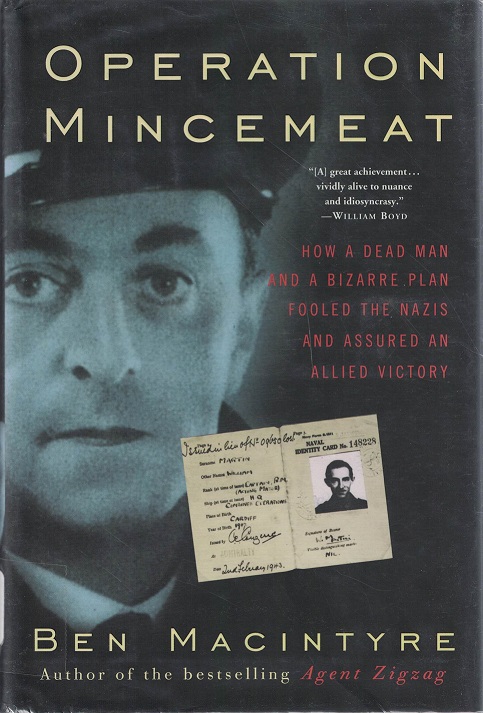
Operation Mincemeat
Operation Mincemeat was a part of a plan to convince Hitler that the Allies, following the success of their North Africa campaign, intended to mount a double-pronged invasion of Europe at Sardinia and Greece, and not Sicily, the most logical target.
Mincemeat was implemented by British Naval Intelligence. The cadaver of a derelict was fitted out with a uniform, identity papers, and a sealed envelope containing information about the bogus invasion. The body was placed in a sealed cannister filled with dry ice, and carried by submarine to Spain and deposited close enough to shore where it could be found, with the hope that the envelope would make its way into Nazi hands.
A Novel Approach
The plan took an immense amount of planning and had many possible points of failure. For example, it was not enough to plant fake ID papers on the cadaver. An entire personality had to be created. It was as if they were "constructing a character in a novel."
The author points out that "the greatest writers of spy fiction have, almost in every case, worked in intelligence before turning to writing." He mentions Somerset Maugham, John Buchan, Graham Greene, John le Carre, and of course Ian Fleming, who happened to be the personal assistant of Admiral John Godfrey, head of Naval Intelligence and a man with a "sandpaper personality." He served as the model for M in his James Bond novels.
Twin Frailties
Admiral Godrey described wishfulness and yesmanship as the "twin frailties of German intelligence"
"The Nazi high command ... when presented with contradictory intelligence reports, was 'inclined to believe the one that fits in best with their own previously formed conceptions.'" Hitler's "favourite intelligence analyst," Alexis von Roenne, told Hitler what he wanted to hear, that the information was genuine.
Yet the whole story does not end there. Unknown to anyone, von Roenne had turned against the Nazi regime. In 1944 he deliberately misled Hitler about Allied plans for the invasion of Normandy. He was executed after the failed plot to assassination Hitler. Although he played no part in it he was a close friend of several conspirators
Illustrations
There are 14 pages of b&w photos. The person on the cover is Ewen Montagu, one of the masterminds of Mincemeat. His brother, Ivor, was a communist spy.
The following map shows the route taken by the bogus information:
.
Monday, December 14, 2020
Titanic Survivor
As dranatic as these events are, they form only a minor part in the life by a remarkable woman. Violet Jessop was born in Buenos Aires to Irish parents, spoke Spanish, had a pet armadillo, and lost part of a lung due to TB during her early years in Argentina. Her brothers and sisters suffered numerous illnesses, some of which were fatal: scarlet fever, diphtheria, meningitis, smallpox, rheumatic fever, and malaria.
She was 16 when her father died. Her mother moved the family to England, and went to work as a stewardess on a steamship line. Eventually Violet followed, and thus began a 42-year career at sea, during which she became the family breadwinner. She worked for several lines -- the White Star, the Red Star, and the Royal Mail -- and saw a good deal of the world.
Titanic
Three chapters are devoted to her experiences on the Titanic.
She has kind words for Thomas Andrews, "beloved designer" of the ship
because of the consideration he showed for the crew in his plans.
Violet was in lifeboat 18. As she was boarding it, a baby was thrust into arms, and later once she was aboard the ship that rescued survivors, the Carpathia, a woman snatched the baby away from her without a word. In an epilogue we learn that just before she died, she received a mysterious phone call from a person who claimed to be that child.
Britannic
Four-and-a-half years later, during WWI she signed up as a nurse, and eventually found herself on the Britannic. It was being used as a hospital ship when it hit a mine and sank in the Aegean Sea. The captain kept her under way after the explosion, trying to make for shallower water, without realizing that the propellers were chopping up lifeboats and people in the water. Violet's head was struck three times by a prop,
Two chapters are devoted to this and the aftermath. Violet suffered a fractured skull (which she did not discover until years afterward) and a "leg pierced to the bone, which took nearly three months to heal." Twenty-eight lives were lost.
Life at Sea
What I enjoyed most about the book were Violet's observations of shipboard life. She relates a number of amusing anecdotes involving crew and passengers. A drunken steward hid under a passenger's bed. During Prohibition a woman took advantage of her ample bosom to smuggle ashore "a quart of champagne in her 'balcony'."
Then there was the time when a passenger died while at sea, and a friend kept company all night with the body and the widow in her cabin, until the ship rolled and the body fell off the bed and pinned her to the floor.
But eventually the long hours and hard work took their toll on Violet. She wearied of the "exacting demands" and "aggravating ways" of passengers.
And because she was attractive she had to put up with the unwelcome attentions of both passengers and crew. She turned down several offers of marriage. A steward ran amok with a knife after she refused to kiss him. A ship's captain, after being rebuffed, dismissed her for being a flirt. During the WWI she ate great quantities of garlic-laden salami to discourage an ardent Danish sailor.
Ironically the one man she was interested in, a gifted mechanic from Australia, was too shy to make a formal proposal.
The Book
Her memoir went unpublished, but the year before her death she was visited by John Maxtone-Graham, who was conducting research about the golden age of transatlantic liners. He took on the task of editing Violet's book, and has provided many useful details about her life.
One chapter has gone missing, and there is no mention of a marriage, which Maxtone-Graham learned from Violet's niece. She married "so briefly and disastrously that not even her husband's name remains extant with the family."
It includes 24 pages of black-and-white photos.
Tuesday, August 11, 2020
A Journal of the Plague Year
“Some were immediately overwhelmed with it,” says H.F., “and it came to violent fevers, vomitings, insufferable headaches, pains in the back, and so up to ravings and ragings with those pains; others with swellings and tumours in the neck or groin or armpits, which till they could be broke put them into insufferable agonies and torment; while others...were silently infected, the fever preying upon their spirits insensibly, and they seeing little of it till they fell into swooning and faintings and death without pain.”
“But it was all to no purpose; the audacious creatures were so possessed with the first joy and so surprised with the satisfaction of seeing a vast decrease in the weekly bills, that they were impenetrable by any new terrors, and would not be persuaded but that the bitterness of death was past; and it was to no more purpose to talk to them than to an east wind; but they opened shops, went about streets, did business, and conversed with anybody that came in their way to converse with, whether with business or without, neither inquiring of their health or so much as being apprehensive of any danger from them, though they knew them not to be sound.”
Wednesday, July 1, 2020
Flush
Other Doggy Treats
Monday, April 13, 2020
Valley of Genius
by Adam Fisher
An oral history about Silicon Valley gleaned from over 200 interviews, chopped up and re-organized by topic, making it read like a group chat.
The result is an insider's perspective, racy and insightful, its only drawback the number of times you'll have to refer to the 28-page Cast of Characters at the back of the book. Published in 2018, it logs in at 494 pages and includes 16 pages of colour photos.
Apple and Steve Jobs get the most coverage with seven chapters, Atari is next with three, and Google with two. Adding a gossipy flavour are mentions of George Lucas, Douglas Adams, William Gibson, Joss Wheedon, Wavy Gravy, R.U. Serious, the Duke of URL, and the names of people who attended the Stanford memorial service for Steve Jobs (and those who didn't).
Xerox PARC
"Everybody says Steve Jobs ripped off Xerox PARC. He didn't, Bill Gates did."
Atari
In 1981 the company's gross was more than the entire movie business in Hollywood. At one point they had 10,000 employees but only 200 by 1984.
"It was like the fall of Saigon. People were dropping equipment into the trunks of their cars from the second story."
Apple
The Apple I was "mostly made with parts from Atari."
General Magic
Despite the company's failure, "iPhones, social media, electronic commerce, it all came out of Magic."
Pixar
"But the Disney execs kept pushing us to make these [Toy Story] characters more edgy.... And so we ran into story problems along the way.... The characters, especially Woody, were just repellent. Woody was just awful, awful, awful!"
Wired
"Everyone was sleeping with everyone at Wired."
Netscape
"All of us who worked at Netscape in the early days were terrible to each other. We were all really abrasive people. We did most of our negotiation by screaming and insulting."
Cyberculture
“... about twenty-five pianos stacked against a part of the freeway, and at one point the pianos caught on fire and the Highway Patrol shut down the freeway because the flames got high enough that they were coming over the top of the freeway, fifty feet above us.”
eBay
Items offered for sale included a kidney, a rocket launcher, and someone's virginity.
“You show up in a suit? You're not getting hired.”
Napster
“Napster was the first case where you've got young founders, and the VCs came in with the 'adult supervision,' and it was an utter disaster.”
iPod
It “freed Apple from the PC wars.”
“Zuckerberg's first business cards read, I'm CEO...bitch.”
iPhone
“We're not making a phone. We're making a laptop killer.”
“It's as if they drove a clown car into a gold mine -- and fell in.”
Steve Jobs
His last words: “Oh, wow! Oh, wow! Oh, wow!”
Saturday, January 11, 2020
Yellowknife: A Novel Trip Through the Absurd
I cannot begin to tell you how much fun this book was to read. Written in the snappy, fast-paced, and detail-oriented way I find familiar from mystery or spy novels, Yellowknife: A Novel brings an international flavour to the local, combining the wild fantasies that some Southerners have of the North –- people cross-country skiing down Franklin Avenue to go to work –- with some more familiar exploration of the Yellowknife homeless community and the inescapable bureaucracy.Told in four parts and spanning the separation of Nunavut and the Northwest Territories, Yellowknife: A Novel twists the absurd perceptions some people have of the North with the truth, making the novel feel like it was set in a fantasy version of Yellowknife as opposed to the real thing. For example, there is a moment from Moyeg G. Vassanji's 2006 novel Nostalgia in which a character remarks that he is from “Yellowknife, Yukon Territory.” These odd “Nostalgia moments” are so common in Yellowknife: A Novel that it makes them feel intentional and adds a surreal quality to the novel.
Most of the novel is hilarious, usually because of the odd situations and dialogue instead of specific jokes being made, while at the same time having moments that are astonishingly beautiful or strange, making this mixed-bag of a book worth reading – both as someone who grew up here, and as someone re-discovering the history of the North.
Monday, October 14, 2019
Welcome to Lagos
They encounter a boy with an AK47. He belongs to a militant group fighting for a share of Nigerian oil profits. His name is Fineboy and he is keen to be a radio presenter.
They are joined by two women, Isoken and Oma, one a young hairdresser fleeing the fighting near her village, the other fleeing her abusive husband.
The five of them form an uneasy alliance and travel by bus to Lagos where they end up sleeping under a bridge. By chance they discover a secret underground apartment, uninhabited but fully furnished. One night the owner shows up, a high-ranking government official named Sandayo. He too is in flight. Learning that he was about to be sacked and disgusted with government corruption, he absconded with ten million dollars.
The story takes a delightful turn when the group, after taking Sandayo prisoner, decide to spend the money on much-needed supplies for schools. Information is leaked to a local journalist, the story shifts to London where the BBC get involved, and a pompous newscaster is sent with a crew to Lagos.
I enjoyed the novel most when the focus was on the original five characters and the tumultuous day-to-day life in Lagos: the sights and sounds, the snippets from a newspaper that head the Lagos chapters, and especially the pidgin spoken by many. When Yemi, who has found work as a traffic warden, is asked where he learned the moves he makes while directing traffic, he replies:
“Nah me teach myself. I dey learn some new moves I go soon display.”
“Chike doesn't see to dance,” Sandayo said.
“No o. You dey look him face think he's a small boy but inside nah old man.”
The result is a rich tapestry of life in contemporary Nigeria, as hinted at by the cover. If you take a close look at the hoarding, you'll see next to the author's name, Chibundu Onuzo, a thumbnail of the author herself.
BBC has a website in Nigerian pidgin.