Sunday, January 30, 2022

NOVEL SCOTIA

Available on Amazon as a trade paperback (CAN $20) and Kindle e-book (CAN $5).  419 pages including 14 pages of notes.

 
The following photos are intended to illustrate some of the locations visited by the characters. In the book only three gray-scale illustrations are present, one in each Tier.
 
 
THE VALLEY
 
 
The river had subsided by several feet and was now flowing in the opposite direction. How could it be so indifferent to the laws of nature?

The road dropped down to a tiny cove where a few fishing boats huddled.

Aside from a fantastic section carved away by the elements, the beach was smooth and level.

 They looked like knobby heaps separated by winding channels of gravel, some wide as a sidewalk, others narrow and twisty.

“They’re hard to paddle because they’re not streamlined. Whipple’s trying to grow one that’s a little easier to manage, one with a keel.”

Each 18-bushel bin contained about 2250 apples. The man with the sweet smile averaged seven or eight bins a day, more when the picking was good, thus earning him the nickname Mr. Pickquick.

Nina fell back with a gasp as it sailed over the fence and landed on the asphalt in a clatter of steel-shod hooves and a spray of sparks. It cantered a short way down the road, then stopped and looked around uncertainly.

Each pair was linked by a carved wooden yoke and moved into position at a stately pace like royalty, accompanied by the solemn jingle of bells attached to neck straps.


THE CITY


 The skeletal orange beasts of a container terminal, gantry cranes with their booms raised as though saluting or trumpeting.  


Flashing lights and jaunty tunes filled the air as people strolled about holding glasses of colourful liquids or sat on stools before flashy vending machines with names like Julius Cashier, Eel of Fortune, and You Bet Your Ass


He gazed up at its underbelly reticulated with girders, at the two green towers that shouldered the load of the deck, and at the graceful orange cables that swooped down and plunged into  concrete abutments, as though they were not holding up the bridge but keeping it from floating away.

He set off on a tour called Hanging Out in Halifax. It took him to the Grand Parade, the Wanderers Grounds, the Public Gardens, and a few other places where in times gone by people had danced the hempen jig.


...another battery appeared, but in much better repair. The gun emplacements were intact, and three men staggered around drunkenly on a raised proscenium, cursing and quarrelling in loud voices. Seated before them on folding chairs was a respectful audience. 

    “Thou deboshed fish.”

    “Bite him to death, I prithee.”

    “Knock a nail into his head.”

    “I will supplant some of your teeth.”

“Shakespeare-by-the-Sea,” Maps said as he and Avon backed away.


Trailer Park Boys was no longer being shot in HRM, but tourists were so interested in seeing the locations that Maps had developed a sheet on the subject. It included the sites of several noteworthy scenes, such as the bank that the boys tried to stick up, and where one of the characters, Mr. Lahey, somehow ended up on the roof in his underpants.


...a triumphal arch inscribed with the word Sebastopol in honour of two Nova Scotians who died in the Crimean War. Atop it was a stone lion. “That was once a well-hung cat,” Maps said, and addressed it with a ditty of his own composition.

O King of Beasts upon a throne

What happened to thy balls of stone?

Didst thou roar when nipped so cruelly

To reflect the times more truly?

To Avon, he added that it had been neutered to avoid disturbing Victorian sensibilities.


There was a dank smell in the air, and their footsteps echoed with a hollow sound accompanied by the faint rumble of traffic overhead. Soon they were wading through several inches of water and ducking to avoid pipes that hung from metal strapping. Presently a light appeared in the passage ahead and voices became audible.


FURTHER READING:

OTHER NOVELS SET IN NOVA SCOTIA

Bruce, Charles. 1954. The Channel Shore

Ibid. 1959. The Township of Time

Buckler, Ernest. 1952. The Mountain and the Valley

Choyce, Leslie. 1994. Republic of Nothing

Clarke, George Elliott. 1990. Whylah Falls

Day, Frank Parker. 1928. Rockbound

Holmes, Jeffrey. 1974. Farewell to Nova Scotia

MacLennan, Hugh. 1941. Barometer Rising

Norman, Howard. 1998. The Museum Guard

Raddall, Thomas. 1992. Hangman's Beach


Wednesday, December 15, 2021

Alex Colville

I knew he was a local artist with an international reputation, but did not realize until recently that much of his work is set in Nova Scotia. He spent the last 40 years of his life in Wolfville, where he and his wife lived in the house she had grown up in and which her father had built.

In looking at his work, I am reminded of Hemingway’s theory of omission, that leaving elements out of a story strengthens it. Colville does something similar in his paintings.  In many of them faces are obscured or hidden in a variety of ways. People have their backs to the viewer, their heads are turned away or are beyond the frame of the painting.  The result is that the context is incomplete, and we are left to fill in key details ourselves. Often there is a sense of impending danger.

The unsettling combination of beauty and dark possibility is evident in Horse and Train, To Prince Edward Island, Couple on Beach, and Berlin Bus.

In the National Gallery of Canada's website, Colville is quoted as saying, “I see life as inherently dangerous. I have an essentially dark view of the world and human affairs.”  

This view was doubtless a result of the time he spent in Europe as a war artist.  Additionally both he and his wife had traumatic experiences as children.  He was nine when his family moved to Nova Scotia, shortly after which he contracted pneumonia and nearly died.  His wife was around the same age when her father, sister and  brother were killed when their car was struck by a train at a level crossing just outside of Windsor NS.

Magic Realism

“...after the war he realized that his purpose as a painter was to translate archetypal myths into a contemporary visual style…  he abhorred abstract expressionism’s subjectivity and seeming undisciplined mode of representation” (Smart, p35)

Two famous American painters also associated with Magic Realism are Garth Wood (American Gothic) and Andrew Wyeth (Christina's World).

Blomidon

Another aspect of Colville's work that appeals to me is unrelated to Magic Realism. This is because the settings for much of his work are close to where I live, in the upper portion of the Annapolis Valley.  Colville had a cottage on the edge of Minas Basin, which provided the backdrop for many paintings, often with Cape Blomidon visible in the distance.

Blomidon is "a never-ending delight" wrote Esther Clark Wright on the very first page of her memoir, Blomidon Rose.

If we are coming over the hills from Halifax, "There's Blomidon!" we shout triumphantly, as soon as we catch sight of it, and we berate the roadmakers who chose a route that dips so soon behind hills and deprives us of a longer look at the beloved landmark. Outsiders are puzzled, and a little exasperated, by our enthusiasms for Blomidon.  They have seen higher mountains...

Blomidon is visible in the distance in Surveyor and Family and Rainstorm, as well in many other paintings. In West Brooklyn Road a man is waving from an overpass on Highway 101 just before it descends into the Valley and the view that Esther Clark Wright so cherished. Perhaps for Colville the serene rural environment was a suitable setting for juxtaposing the uncertainty of life.

In French Cross, a female rider passes a rigid iron monument, a memorial to the ethnic cleansing that took place in the 18th century when the British so cruelly displaced the Acadians who dwelt in the area.  The monument overlooks Minas Basin where Acadians were loaded onto ships like cattle.  In looking back over her shoulder, the rider is also looking back into history.

Sources

Alex Colville: Return by Tom Smart, Art Gallery of Nova Scotia/Douglas & McIntyre, 2003, 144 pages 

Ordinary Magic: A Biographical Sketch of Alex Coleville by J.R.C. Perkin, Robert Pope Foundation/Lancelot Press, 1995, 190 pages

Colville by David Burnett, Art Gallery of Ontario/McClelland and Stewart, 1983, 272 pages. In the book by Burnett there's a useful map showing the location of many of Colville's paintings in the upper Annapolis Valley.


Saturday, July 31, 2021

Shakespeare in Swahililand

The author spent his youth in Kenya, and returns as an adult to track the spread of Shakespeare in East Africa. 

The book is packed with historical and literary detail, and at times reads like a travellogue as the author slips into the first person to describe the places he visits and recall some youthful experiences in Kenya.

The Lake Regions

Early travellers like Richard Burton and Henry Morton Stanley carried pocket versions of Shakespeare's works as a "talisman of Englishness."

Zanzibar

A British missionary, Edward Steere, translated into Swahili four of the stories in Tales from Shakespeare by Charles and Mary Lamb. He published them as Hadithi za Kiingereza.

Mombasa

A "vibrant culture of East African Shakespeare performance in the early years of the twentieth century" was brought from India by the labourers who built the railway from Mombasa to Nairobi. Travelling theatre groups performed versions of the plays in Hindustani, Gujurati, and other Indian languages. 

"This made these Indian communities in those years a considerably more concentrated centre of Shakespeare performance than London's West End." The plays received peevish reviews by the English.

Nairobi

This section is enlivened by quotes from Karen Blixen and Evelyn Waugh. The political awakening of Jomo Kenyatta is mentioned, as described in a novel by Peter Abrahams, A Wreath for Udomo.

Kampala and Dar es Salaam

At Makerere University in Kampala the future first president of Uganda, Milton Obote, played the lead role in a production of Julius Caesar. 

In Tanzania, Julius Caesar and Merchant of Venice, were translated into Swahili by Julius Nyerere while he was president of Tanzania.

Miscellaneous Bits

  • The half-year that Che Guevara spent hiding out in Dar es Salaam.
  • The "uncannily parallel lives" of Jomo Kenyatta and Louis Leakey'
Quotes

"It is inescapably true that the story of Shakespeare in East Africa is one caught up in colonial history and its failings."

"The breakthrough novel (A Grain of Wheat,1967) of Kenya's most celebrated writer, Ngugi wa Thiong'o, includes the story of a local official in the colonial administration whose grand plan to Anglicize the local Africans is laid out in a tract entitled PROSPERO IN AFRICA."
 

Saturday, May 29, 2021

The Library Book


Front Cover & Inside Back Cover

In 1986 the Central Library in downtown LA burned for seven hours with more than a million books damaged or destroyed. 
 
The suspected arsonist was a likeable fellow and would-be actor, as well as an inveterate liar who never told the same alibi twice. The evidence against him was circumstantial and he was never convicted. 
 
But true-crime is just one aspect of this marvellous book. Author Susan Orlean has found a rich source of material, including the evolution of libraries from horseback delivery to "nonphysical books," and the many other tasks that libraries take on today, particularly social ones. 
 
"Often at the library," she writes, "society's problems are magnified." Particularly homelessness, drug use, and mental illness. "The library's commitment of being open to all is an overwhelming challenge," and not only in large urban centres. 
 
The library, she observes, "is a good place to soften solitude."

Goings On at the Library

The strange concept of air rights, which the LAPL sold for $28 million in order to finance the rebuilding of the Central Library.

Movie studios in LA used to send people into the library to steal books for research purposes. One person would go inside, gather what was needed, and toss them out a window to an accomplice waiting below.

The library's network is often hacked, mostly by people based in China or Russia, but why? What is there to be gained? A staff member says it's because the library is a relatively easy target for hackers still learning their trade. It's a training exercise.

"People searching for missing loved ones sometimes scribbled messages in library books with the hope that the person they were looking for would see the message."

Drug dealers coming into the library for help with their income tax forms

A woman who made $40K a year selling books pinched from libraries,

A patron with a service wolf, and another who said on being told that eating was now allowed, "I'm not eating, I'm snacking."

Back to the Fire 
 
The fire was so fierce that it resulted in something called a stoichiometric condition, a rare combination of fuel and oxygen almost impossible to achieve outside a laboratory. 
 
"Usually a fire is red and orange and black. The fire in the library was colorless. You could look right through it, as if it were a sheet of glass. Where the flame had any color, it was pale blue. It was so hot it appeared icy."
 
The temperature rose to 2500 degrees Fahrenheit, approaching a situation called a flashover, in which everything becomes so hot it achieves spontaneous combustion.
 
One of the most unnerving things that Orlean mentions is that some firefighters are arsonists.
 
Random Thoughts 

Most readers will have fond memories of libraries. I remember as a child looking for books about Freddy the Pig, and the excitement of my own children when many years I took them to the same library looking for titles in the Redwall series by Brian Jaques.

My mother-in-law was a librarian whose sole failing, as her daughters wrote in her obituary, was "the inability to cram more books into her library." One of her chief pleasures was sending books to her grandchildren for Xmas and birthdays.

I've been fortunate to work in a number of libraries -- providing technical support, giving computer tutorials, setting up Wi-Fi hotspots, and on one occasion writing a small program to automatically shut down computers at closing time because librarians were having trouble prying patrons away from them.

Books are important because they allow us to transcend our own fragile existence.

This is why I read. This is why I write.

Friday, April 2, 2021

The Blue Fox

Another unusual read from Iceland.

Set in 1883, the book opens with “a daughter of Reynard,” a blue fox indistinguishable from the stone she is resting beside. She is keeping an eye on a pursuer hiding in a snowdrift. 

He has not moved in the last 18 hours. Suddenly he receives a message telling him exactly how to intercept the fox. 

“Had the man received a thought message from the vixen?”

The prose is spare. Snippets of text give the opening pages the appearance of poems. On one page there is a single sentence. The visual effect suggests, for me at least, the snowy landscape in which the story takes place.   

II

The second part settles into a more conventional narrative, one that grows increasingly tangled and convoluted. It centres on Fridrik Fridjonsson, a herbalist and farmer who 17 years previously rescued Abba from prison.

(No, not the Swedish pop group.) 

She's a woman with Down syndrome. Her full name is Halfdis Jonsdottir and she has just died. Her sweetheart, Halfdan Atlason, has come to collect the body. He is also "the Reverend Baldur's eejit."

Fridrik gives Halfdan a letter for Baldur, who is conducting the burial service. At the end of the letter Fridrik mentions that he has dreamed of a blue fox.

The tale retreats further into the past to explain how Abba arrived by shipwreck, and describes the strange bundle she carried with her for the rest of her life. Fridrik opens the bundle and finds 48 wooden tablets. When properly assembled they reveal a quote (in Latin) from Ovid's Metamorphoses.

III

The third section continues the book's opening thread. We now know more about the person hunting the blue fox.

The shot he fired triggers an avalanche that sweeps him under a glacier, along with the fox. He meets a young woman and the Well of Life. The fox revives, digs out the shotgun pellets from her body, and engages the man in a discussion of electricity.

What happens next is even more incredible.

IV

The final section takes the form of the letter that Fridrik wrote to a friend. It sheds some light on the connection between Abba and the hunter.

Sjon

The author is a poet, playwright, and singer who has performed with Bjork. More about him can be found on his website. 

The Blue Fox was first published in 2004. The English translation by Victoria Cribb appeared in 2008, and clocks in at 112 pages.

Saturday, March 13, 2021

Children in Reindeer Woods

A few years ago my wife visited Iceland and returned with a stack of books. One of them, Bloodhoof, a collection of poems in both Icelandic and English, she took a stab at translating herself with the help of a dictionary.

This is the first one I've dipped into it, and it's quite unlike anything I've ever read, It's a modern fairytale that takes place at a summer camp called Children in Reindeer Woods, and is linked by road to the Ceaseless Heath, the Endless Pass, and the Forever Valley.

The heroine is an 11-year-old girl named Billie. Her father believes he is a puppet. Whenever his arm is torn off, Billie's mother sews it back on. 

Billie has several dolls. One is named Guggalugga, another is bald, and a third is pregnant.

The man in charge of the camp is a former ballet dancer with splayed feet.

Somewhere in the Distance a War is Going on.

The story begins with the arrival of a soldier named Rafael. He wants to be a farmer and gets rid of his uniform but not his weapons.

Another soldier arrives. He parachutes in with a guitar. 

A pair of tax collectors show up with a briefcase full of money in the trunk of their car.

A nun comes to the back door and asks for food, then a cigarette. Rafael offers her a drink. She takes off her clothes, plays the guitar, and kisses Raphael.

The last visitor is a shepherd who has been tending a flock of sheep all summer. He plans on returning to university.

Except for Rafael, none of them stay around for any longer than a night. When he and Billie have an argument, they call each other idiot-head and pretzel-face.

Eyes of a Child

There are brief moments of violence but they are not gruesome, and some are absurd. Two dolls commit suicide. Raphael hangs a chicken for crapping in the house, and blows up two cars.

Many of the scenes are described with a childlike innocence.

The cow lowed from out back as though it was missing the fun. Mooooo.

[Billie] dried her mouth as if it were a stamp and the napkin an important document.

The automobile set off from the place.  Fart Fart.


When Rafael and Billie decide to get married, the dolls are witnesses. "We'll let the hens sign the contract," says Billie.

The final chapter caps the surreal nature of the book. It takes place on the planet of the puppeteers who control Billie's father. 

Author

Kristen Omarsdottir is an Icelandic author, poet, playwright, and visual artist. She has written other novels but this is the only one that has been translated into English. The translation is by Lytton Smith.

Monday, March 8, 2021

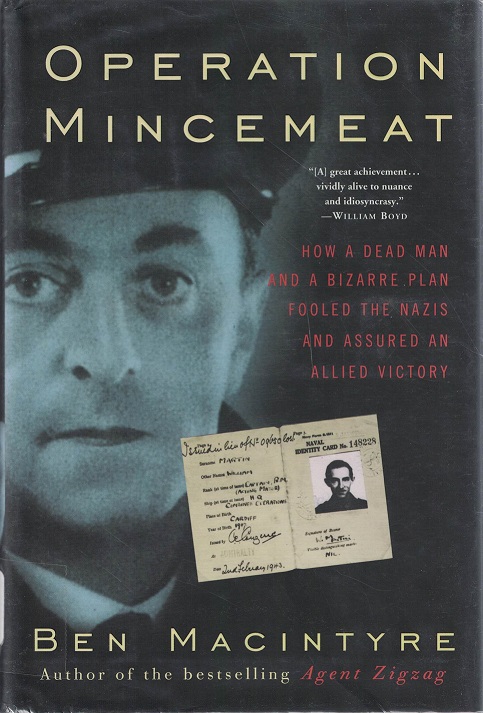
Operation Mincemeat

Operation Mincemeat: How a Dead Man and a Bizarre Plan Fooled the Nazis and Assured an Allied Victory

Operation Mincemeat was a part of a plan to convince Hitler that the Allies, following the success of their North Africa campaign, intended to mount a double-pronged invasion of Europe at Sardinia and Greece, and not Sicily, the most logical target.

Mincemeat was implemented by British Naval Intelligence.  The cadaver of a derelict was fitted out with a uniform, identity papers, and a sealed envelope containing information about the bogus invasion. The body was placed in a sealed cannister filled with dry ice, and carried by submarine to Spain and deposited close enough to shore where it could be found, with the hope that the envelope would make its way into Nazi hands.

A Novel Approach

The plan took an immense amount of planning and had many possible points of failure.  For example, it was not enough to plant fake ID papers on the cadaver.  An entire personality had to be created.  It was as if they were "constructing a character in a novel."

The author points out that "the greatest writers of spy fiction have, almost in every case, worked in intelligence before turning to writing."  He mentions Somerset Maugham, John Buchan, Graham Greene, John le Carre, and of course Ian Fleming, who happened to be the personal assistant of Admiral John Godfrey, head of Naval Intelligence and a man with a "sandpaper personality."  He served as the model for M in his James Bond novels.

Twin Frailties 

Admiral Godrey described wishfulness and yesmanship as the "twin frailties of German intelligence" 

"The Nazi high command ... when presented with contradictory intelligence reports, was 'inclined to believe the one that fits in best with their own previously formed conceptions.'"  Hitler's "favourite intelligence analyst," Alexis von Roenne, told Hitler what he wanted to hear, that the information was genuine.

Yet the whole story does not end there.  Unknown to anyone, von Roenne had turned against the Nazi regime.  In 1944  he deliberately misled Hitler about Allied plans for the invasion of Normandy.  He was executed after the failed plot to assassination Hitler.  Although he played no part in it he was a close friend of several conspirators 

Illustrations

There are 14 pages of b&w photos. The person on the cover is Ewen Montagu, one of the masterminds of Mincemeat.  His brother, Ivor, was a communist spy.

The following map shows the route taken by the bogus information:


.

Monday, December 14, 2020

Titanic Survivor

The author was a stewardess who not only survived the sinking of the Titanic, but also that of its sister ship, the Britannic.

As dranatic as these events are, they form only a minor part in the life by a remarkable woman. Violet Jessop was born in Buenos Aires to Irish parents, spoke Spanish, had a pet armadillo, and lost part of a lung due to TB during her early years in Argentina. Her brothers and sisters suffered numerous illnesses, some of which were fatal: scarlet fever, diphtheria, meningitis, smallpox, rheumatic fever, and malaria.

She was 16 when her father died. Her mother moved the family to England, and went to work as a stewardess on a steamship line. Eventually Violet followed, and thus began a 42-year career at sea, during which she became the family breadwinner. She worked for several lines -- the White Star, the Red Star, and the Royal Mail -- and saw a good deal of the world. 

Titanic

Three chapters are devoted to her experiences on the Titanic. She has kind words for Thomas Andrews, "beloved designer" of the ship because of the consideration he showed for the crew in his plans.

Violet was in lifeboat 18. As she was boarding it, a baby was thrust into arms, and later once she was aboard the ship that rescued survivors, the Carpathia, a woman snatched the baby away from her without a word. In an epilogue we learn that just before she died, she received a mysterious phone call from a person who claimed to be that child.

Britannic

Four-and-a-half years later, during WWI she signed up as a nurse, and eventually found herself on the Britannic. It was being used as a hospital ship when it hit a mine and sank in the Aegean Sea. The captain kept her under way after the explosion, trying to make for shallower water, without realizing that the propellers were chopping up lifeboats and people in the water. Violet's head was struck three times by a prop,

Two chapters are devoted to this and the aftermath. Violet suffered a fractured skull (which she did not discover until years afterward) and a "leg pierced to the bone, which took nearly three months to heal." Twenty-eight lives were lost.

Life at Sea

What I enjoyed most about the book were Violet's observations of shipboard life. She relates a number of amusing anecdotes involving crew and passengers. A drunken steward hid under a passenger's bed. During Prohibition a woman  took advantage of her ample bosom to smuggle ashore "a quart of champagne in her 'balcony'."

Then there was the time when a passenger died while at sea, and a friend kept company all night with the body and the widow in her cabin, until the ship rolled and the body fell off the bed and pinned her to the floor.

But eventually the long hours and hard work took their toll on Violet. She wearied of the "exacting demands" and "aggravating ways" of passengers. 

And because she was attractive she had to put up with the unwelcome attentions of both passengers and crew. She turned down several offers of marriage. A steward ran amok with a knife after she refused to kiss him. A ship's captain, after being rebuffed, dismissed her for being a flirt. During the WWI she ate great quantities of garlic-laden salami to discourage an ardent Danish sailor.

Ironically the one man she was interested in, a gifted mechanic from Australia, was too shy to make a formal proposal.

The Book

Her memoir went unpublished, but the year before her death she was visited by John Maxtone-Graham, who was conducting research about the golden age of transatlantic liners. He took on the task of editing Violet's book, and has provided many useful details about her life.

One chapter has gone missing, and there is no mention of a marriage, which Maxtone-Graham learned from Violet's niece. She married "so briefly and disastrously that not even her husband's name remains extant with the family."

It includes 24 pages of black-and-white photos.

Tuesday, August 11, 2020

A Journal of the Plague Year

Purports to be a firsthand account of the Great London Plague of 1665, though the author's name does not appear on the title page of the first edition. The book was published in 1722, half a century after the events described. Only near the end do we learn the initials of the narrator, H.F., and that he is dead and buried.

In other words the narrator is a fictive one, which makes the book a sort of novel. In the introduction to this edition, Anthony Burgess calls it “a cunning work of art, a confidence trick of the imagination.” 
 
Defoe was only five years old at the time of the plague, and the account may in fact be based on notes made by his uncle, Henry Foe. It is mostly reportorial in nature, and according to Anthony Burgess, “the most reliable and comprehensive account of the Great Plague that we possess.”
 
Burgess also calls Defoe "the first really modern writer" because of his "plain and dignified style," which avoids "literary artificiality." However, it must also be said that the book is disorganized and repetitious, making it something of an ordeal for modern readers. Burgess implies the "clumsiness" is intentional.
 
Timespan

London was visited numerous times by the plague. This one began in late 1664, but the number of deaths remained low until June of 1665, at which time “the richer sort of people” began fleeing the city. In July and August the number of deaths increased dramatically, with the highest weekly total of 7000 reached in September. The numbers then abated until the plague was “reckoned to be quite ceased” by the following February.

Symptoms
 
The disease was puzzling because it affected people in different ways. 
“Some were immediately overwhelmed with it,” says H.F., “and it came to violent fevers, vomitings, insufferable headaches, pains in the back, and so up to ravings and ragings with those pains; others with swellings and tumours in the neck or groin or armpits, which till they could be broke put them into insufferable agonies and torment; while others...were silently infected, the fever preying upon their spirits insensibly, and they seeing little of it till they fell into swooning and faintings and death without pain.”
Some were “walking putrefied carcases whose breath was infectious and their sweat poison, and yet were as well to look on as other people, and even knew it not themselves.”  Some did not realize they were infected until hours before they died. 

Not everyone died who was infected, and in the later stages of the epidemic people recovered faster and the disease did not seem so virulent. “If it was catched it was not so mortal.” 

Defoe, through his mouthpiece H.F., gave the total number of deaths in London as 68,590 based on the weekly “bills of mortality,” but believed this was not an accurate count and that the true figure was much higher.  A figure of 100,000 is commonly quoted today, about a quarter of London's population at the time.

He is generous with praise for city officials, but in the end offers the opinion that one of the methods used, enforced confinement, was ill-advised.

Transmission

H.F. says the infection was “spread by certain steams or fumes, which physicians call effluvia, by the breath, or by the sweat, or by the stench of the sores of the sick persons.” Some thought the plague could be spread by a mother's milk, or that an infected baby could transmit the plague by suckling.

It was also believed to be spread by clothing, and brought into houses by servants returning from errands. Animals were suspected, and as a result “forty thousand dogs and five times as many cats” were destroyed, as well as a “prodigious multitude” of mice and rats killed by poison.

The poor were “more subject to be infected” because they lived in closer quarters and less sanitary conditions, and because they had not the means to flee the city. “They died by heaps and were buried by heaps.”

Lockdown

Since there was only one pest-house in London, the city ordered that any home with an infected person be locked up for four weeks.  All members of the household, including servants and those showing no signs of the disease, were kept within. The city hired two watchmen to guard it night and day to prevent people from leaving. The house was identified by a red cross on the door. 

“All plays, bear-baitings, games, singing of ballads, buckler-play, or such-like causes of assemblies of people” were “utterly prohibited.”  “Public feasting” was banned, but taverns stayed open with the imposition of a 9pm closing.  

Churches remained open, and the Government “appointed public prayers and days of fasting and humiliation, to make public confession of sin and implore the mercy of God to avert the dreadful judgement which hung over their heads.”
 
Dead-carts were sent out daily to collect bodies. Some streets were too narrow to admit the carts, and the bodies had to be brought out by wheelbarrow.

Remedies

Many believed that the smell of pitch, tar, rosin, or brimstone, would keep them safe. Others “carried bottles of scents or perfumes,” and always had “preservatives in their mouths and about their clothes to repel the infection.” 

Houses visited by the plague were purged by burning “perfumes, incense, benjamin, rozin, and sulphur in their rooms close shut up, and then let the air carry it all out with a blast of gunpowder.” Shopkeepers sought to disinfect coins by having them placed in a pail of vinegar.

The gullible were preyed upon by quacks and mountebanks, who peddled philtres, plague water, anti-pestilential pills, as well as “cordials against the corruption of air, and papers tied up with so many knots, and certain words or figures written on them, as particularly the word Abracadabra, formed in triangle or pyramid.”

Second Wave

When the plague waned in the fall, people began “running rashly into danger, giving up all their former cautions, and all the shyness they used to practise, depending that the sickness would not reach them, or if it did they would not die. Physicians warned that this could bring about a relapse of the danger upon the whole city, which might be more serious than what had been experienced so far. 
“But it was all to no purpose; the audacious creatures were so possessed with the first joy and so surprised with the satisfaction of seeing a vast decrease in the weekly bills, that they were impenetrable by any new terrors, and would not be persuaded but that the bitterness of death was past; and it was to no more purpose to talk to them than to an east wind; but they opened shops, went about streets, did business, and conversed with anybody that came in their way to converse with, whether with business or without, neither inquiring of their health or so much as being apprehensive of any danger from them, though they knew them not to be sound.”
The result was a upsurge in deaths.

Crazy Stuff

Physicians thought that the danger of death was great if buboes were not lanced, but some were so hard that they could not be cut and so were burnt with caustics. 

Some proposed that the breath of infected persons would leave a scum on warm water, and cause a chicken to lay rotten eggs.

A man named Solomon Eagle ran naked through the streets with a pan of burning charcoal on his head.

In one incident, a man who had passed out from drink was picked up, and awoke just before he was about to tossed into a mass burial pit. Anticipating a Monty Python sketch by nearly 300 years, he says, “But I an’t dead though, am I?”

Oxford University Press Edition

This edition contains a very informative “Medical Note” as an appendix. It's not long and worth reading. It suggests that all three forms of the plague – bubonic, septicemic, and pneumonic – were present in London, which would explain the differing ways it was manifested.


The Plague Today

It's now generally believed that the plague was spread by the bite of fleas whose main host was rats. Other animals known to carry the plague are squirrels, prairie dogs, chipmunks, and marmots. 

Every year a few hundred people die from it in scattered places, including the United States. Apparently there are no reliable vaccines, but antibiotics can be used successfully if the disease is diagnosed quickly enough. However, its flu-like symptoms can make this problematic.

Reading Defoe's work, one sees many similarities between the London plague and the pandemic now sweeping the world, Covid-19. Lockdowns, social distancing, financial assistance to those afflicted, cockeyed remedies, a second wave, even crime. (In London thieves broke into houses to steal the clothes off dead bodies, while today criminals are able to use safer methods thanks to the internet.)   

Other Plague Novels

The Last Man by Mary Shelley 1826
The Scarlet Plague by Jack London 1915
The Plague by Albert Camus 1947
Earth Abides by George R. Stewart 1949
I Am Legend by Richard Matheson 1954
The Andromeda Strain by Michael Crichton 1969
The Stand by Stephen King 1978

Interestingly, both The Last Man and The Scarlet Plague are set in 2073.

Click here to see my remarks on The Scarlet Plague and Cormac McCarthy's The Road