Thursday, June 7, 2012

Manhattan Transfer

A terrific book, absolutely terrific, with writing so energetic it's as fresh today as when it first appeared in 1925, and its message so relevant it could serve as a manifesto for the Occupy Wall Street movement.

The novel takes place in NYC early in the 20th century when America was being flooded by millions of European immigrants. It begins with the birth of Ellen Thatcher who grows up to become a chorus girl. At age 18 she marries John Oglethorpe, a flamboyant thespian, in order to advance her career. Once he has guided her to early success on Broadway, she discards him for the company of more influential people.

She has an affair with Stanwood Emery, son of a senior partner in the law firm of Emery & Emery. Stan is a social parasite, a reckless fun-loving alcoholic who in a drunken moment deliberately immolates himself, leaving Ellen pregnant with his child.

The war intervenes, after which she reappears with a baby and a new husband, Jimmy Herf, who was a friend of Stan. She has given up acting and works for a magazine under the byline Helena Herf, a change in direction that Jimmy, a reporter, presumably helped with. She divorces him and agrees to marry George Baldwin, a womanizing lawyer with Emery & Emery. He`s just been appointed DA and has political ambitions.

Although Ellen, Jimmy, and George are the main characters who propel the plot forward, they are sometimes almost lost from view due to a mob of minor characters ranging from the ruthless rich to the starving poor. The view of NYC is kaleidoscopic as the book jumps from character to character, sometimes slipping into the present tense and shifting without warning between narration and inner thoughts, and offering up slangy dialogue, pungent smells, menacing policemen, clanging fire engines racing to and fro, and newspaper headlines clamouring for attention. Whew!

Style

Reading this book I was reminded of Kerouac's prose and Carl Sandburg's “Chicago" and the poetry of e.e. cummings, who was a friend of Dos Passos and fellow ambulance driver in WWI. Each chapter begins with a brief prose poem, while the text throughout eschews apostrophes (dont, mustnt, hustlin) and rams words together giving them a strange appearance (hairyhoofed, illassorted, accordionpleated, fireengines) and sometimes elevating them into neologisms (neckshave, hungersniff, hushdope, antlerhung).

People are described so vividly they seem illuminated by a flashbulb and frozen in place like images in a comic strip panel:


his face sleek as an olive
a policeman's ballbearing eyes
hats aslant on perspiring necks
a rawboned man with big sagging eyes like oysters
decks packed with upturned faces like a load of melons
a man in a checked cap with a face knobbed like a squash
his small brown eyes measure her face like antennae as he talks to her


Adding to the comic book effect are the many signs, sound effects, snatches of songs, and snippets of fractured English, all of them giving the impression of NYC as a "city of scrambled alphabets:"


Oh I'm juss wild about Harree

Say why de hell doan yous guys loin English?
The wheels rumbled in her head saying Man-hattan Tran-sfer. Man-hattan Tran-sfer
Diddledump, going south, Diddledump, going south sing the wheels...

WE BUY FALSE TEETH
BEEFSTEAK PARTIES UPSTAIRS
NIWDLAB EGROEG WAL-TA-YENROTTA


Jazzy Keroucian passages communicate the city's sprawl and rush.


In the crammed subway car the messenger boy was pressed up against the back of a tall blond woman who smelled of Mary Garden. Elbows, packages, shoulders, buttocks, jiggled closer with every lurch of the screeching express. His sweaty Western Union cap was knocked onto the side of his head. If I could have a dame like dat, a dame like dat'd be wort havin de train stalled, de lights go out, de train wrecked. I could have her if I had de noive and de jack. As the train slowed up she fell against him, he closed his eyes, didnt breathe, his nose was mashed against her neck. The train stopped. He was carried in a rush of people out the door.


Structure

The book is divided into three parts, in each of which there is a fire and a death. Bud Korpenning, a starving man with a horrible secret leaps off a bridge at the end of the first section. Stan Emery sets himself on fire near the end of the second section. Phineas Blackhead, a corrupt businessman, dies of a heart attack near the end of the book.

In the final chapter, "The Burthen of Nineveh," Dos Passos takes off his gloves and shows us what he really thinks of society's high-flyers. So far George has been portrayed as a shallow philanderer, but when Ellen keeps him waiting for 45 minutes, he "wanted to go up to her and hit her in the face."

Ellen, who has not been entirely unsympathetic, completes her transformation into a cold and heartless person. When George asks her to marry him, she says, "I guess I can stand it if you can." When a fire breaks out out at Mme Soubrine's and she sees a worker with "a seared black red face, horrible naked head," she coolly informs the other patrons that nothing serious has occured.

Later they have a dinner engagement with a "fishfaced" judge who has just sentenced a man and his girlfriend to 20 years for armed robbery. In rendering his judgement he speaks righteously of "dooty" and the "constitootion." The man is a war veteran, flat broke and unable to find work, his girlfriend pregnant.

When Blackhead dies, his servant immediately walks up to him and spits in his face.

Manhattan Transfers

The emptiness of the American dream is epitomized by a number of transformations. There is the downfall of Blackhead, and the rise to prominence of Ellen Thatcher who becomes Elaine Oglethorpe, then Helena Herf, and finally the future Mrs. George Baldwin. A French sailor known as Congo Jake starts out as a barkeep and makes a fortune as a bootlegger. He changes his name to Armand Duval (aka the Marquis des Colummiers) and marries Nevada Jones (aka California Jones), a former lover of George Baldwin. The prospect of several months in jail does not concern him because he will return to society as a millionaire.

The book ends with a reverse transformation. Jimmy Herf grew up in the Ritz, refused to follow a career path offered by rich relatives, the Merivales. Now he turns his back on NYC and leaves on foot with 3 cents in his pocket.

Monday, May 21, 2012

Dersu the Trapper

Early in the 20th century Vladimir Arseniev led a number of scientific expeditions in the Russian Far East where a chance encounter with a native man, Dersu Uzala, led to a lasting friendship.

Dersu had no permanent dwelling, carried all of his belongings in a birchbark knapsack, and possessed bush skills so extraordinary he seemed almost clairvoyant. He was able to track wild pigs by his sense of smell, and pluck grouse out trees using a stick with a noose.

He scolded a tiger for stalking them, and reproved Arseniev for throwing a piece of meat into the fire. "In taiga many sort men," he said in imperfect Russian. He was referring to any of the animals who might visit the campsite after they had left, including ants. He believed that everything had a soul, even inanimate objects.

Dersu saved Arseniev's life several times, once when a forest fire overtook them, another time when a blizzard caught them in a marshy area with only reeds for shelter. When they were starving it was Dersu who found fish heads a bear had discarded, and boiled up strips of hide to fill their stomachs.

The Taiga

Arseniev's affection for Dersu was matched by his love of the taiga, and he recorded with an eager eye the plant and animal life they encountered. There were poplars three centuries old and so immense that two or three bears could hibernate inside. Garganey, hazel hen, and eagle owls were a few of the birds he observed, while mammals included roedeer, fanged muskdeer, raccoon dogs, and herds of wild pigs, some of them weighing as much as 600 pounds.

He witnessed a battle between ants and bees, and a chipmunk airing out its cache of food to prevent rot, and a Tibetan bear shaking acorns out of a tree. When they spotted fur seals at the coast he commented on their love of music.

There were moments when even the Cossacks who accompanied him were silenced by the taiga's beauty.

The People

Living in the Russian Far East was an uneasy mixture of Russians, Chinese, Koreans, and various native groups. They hunted and trapped, gathered fungus and ginseng, and cultivated poppies for opium, but it was non-natives who so ransacked the forest that "on every side one sees nothing but robbery and exploitation."

Arseniev provided some amazing glimpses of those natives not yet "in a complete state of slavery." They lived in cedar bark huts and wore moccasins made of fish skins. In the winter they armed themselves with spears and hunted wild pigs on skis. They set nets beneath the ice in small streams, and at night herded fish into them by torchlight while pounding on the ice with mallets.

The End of Dersu

When Dersu's eyesight began to fail, he reluctantly agreed to stay with Arseniev in Khabarovsk. Unfortunately he was unused to living in "a box" and could not understand the restrictions necessary for living in a settlement.

It was not permitted to fire off a gun or pitch a tent in the street. He thought Arseniev was being swindled when he paid money for firewood. When he cut down a tree in a park, he was arrested.

Eventually he left Khabarovsk but did not get far before he was murdered. Arseniev visited the unmarked grave only once. Two years later he was unable to find the spot due to changes brought about by development.

Notes

In the introduction to this edition, it is stated that Dersu is a composite character.

When Arseniev died in 1930 there was a warrant out for his arrest. His widow was shot as a Japanese spy and his daughter imprisoned for 10 years in a gulag.

The graceful translation is by Malcolm Burr, whose life was no less interesting than Dersu's or Arseniev's. He was an entomologist with an abiding interest in the Balkans and the author of several books. He died in Istanbul in 1954.

The cover photo is a still from the motion picture by Kurosawa.

A free audio version is available in the Audio Archive section of the Internet Archive.

The book takes place in the same general region as John Vaillant's enormously readable The Tiger.

Wednesday, April 25, 2012

The Inner Game

This account of the 1993 world championship match between Kasparov and British challenger, Nigel Short, makes a great companion to Fred Waitzkin’s Mortal Games, which describes the 1990 match between Kasparov and Karpov. Where Waitzkin writes as an insider to the Kasparov camp, this book comes from the opponent's side.

It begins with Short’s qualifying victories against Gelfand, Karpov, and Timman, then describes in intimate detail each of the 20 games of the match with Kasparov. Though the champion retained his title with a decisive score of 12½ to 7½, the contest was far from dull. “Unlike almost all previous world championship matches, every game had been fought, as Kasparov himself put it, ‘to the last pawn.’”

Some highlights:

Game 1 – Short, ahead by a pawn, refused the offer of a draw mere seconds before running out of time.

Game 2 – Short playing white ”let slip the one clear winning opportunity...and the position ebbed away toward a draw.” Short said afterward, “I can tell you, he was frightened. When I doubled my rooks against his king I smelt it.”

Game 3 – “Its climactic moments were of a complexity and ferocity that reduced the spectators...to gasps of astonishment.”

Game 4 – Short unveiled “an unexploded bomb from Kavalek’s work as Bobby Fischer’s coach in the 1972 match against Spassky.” For the second time he refused a draw and lost the game.

Game 5 – “Short, armed with a brilliant new concept in the Nimzovitsch defence, had achieved a draw using only twelve minutes, while Kasparov had sweated at the board for one and a half hours.”

Game 6 – Early in the game Short played a move so surprising that American champion Patrick Wolff literally fell off his chair. Kasparov appeared to have the advantage but had eventually bluffed his way out of defeat to a draw. “The audience burst into thunderous applause.”

Game 8 - After an “improbably violent sequence of moves” Short had a winning position but was pressed for time and Kasparov was able to gain a draw by perpetual check. “A standing ovation.”

Game 10 – Short dug himself out of a hole with a queen sacrifice, then missed the win because once again he was pressed for time and had to offer a draw. From this point on (i.e. the last 11 games of the match) Short and Kasparov were exactly even with one win and nine draws each.

Game 14 – Kasparov again bluffed his way to a draw. “I had suffered enough in this game. It was very unpleasant for me. I was losing at one point. A draw is not a bad result.”

Game 16 – Kasparov’s “pawn structure looked as though it had contracted dry rot.” Short’s only win of the match.

Game 17 – Short employed a “very well-camouflaged trick, resting on a spectacular geometric sequence of moves which was particularly hard for the human eye to anticipate, but, once seen, was completely obvious, and, somehow, very funny.” Short refused Kasparov’s offer of a draw and played on for another hour “while I still had some chances to torture him.”

The Inner Game

The book's title refers to the psychological aspect of chess which, in a world championship match, is 90% of the game according to one GM quoted in the book. Here's an example:


Kasparov...developed the intimidating stare into something approaching an art form. His technique differs from that of his Soviet predecessors. While Tal specialized in straightforward aggression, and Karpov in "look no hands" brain-scans, Kasparov's gaze is designed to humiliate.

The best example, or rather the worst, that I actually witnessed was during the eleventh game of his 1987 world championship match against old snake-eyes himself, Anatoly Karpov. Karpov fell for a sinister little one-move trap which allowed Kasparov to turn a terrible position into a winning one. When Karpov fell into it, Kasparov could have flashed out his prepared winning reply. But he did not. Instead he gazed across the board with undisguised contempt.

At that moment Karpov must have realized what he had done: his right hand, which was writing down his own last move, suddenly froze in mid-hieroglyphic. Kasparov, savouring the moment, slowly lifted his own right hand from the table, and with a sweeping gesture, like a matador putting on a cape, played the killing reply. He then sat and stared at Karpov, while clapping his now free right hand over his mouth, as if to stifle a giggle.


Unfortunately for Kasparov such tactics would not be available to him a few years later in his match against a steelier opponent, Deep Blue.

Friday, March 2, 2012

The Code

Mike Hammer on skates? Why not? What better training ground for a PI than the NHL where "what we do to each other on the ice would be criminal in any jurisdiction... Even the cleanest body check would be an assault."

Thus Brad Shade, aka Shadow, a former player who had to hock his Stanley Cup ring after his career washed up and his marriage fell apart.

He worked as a snoop for a few years, doing divorce and insurance work before an old teammate offered him a job as a scout for the LA Kings.

The story begins with Brad checking out a hot young prospect playing for Peterborough in the O. The one-line evaluation he sends to the GM on his Blackberry:


I heard the kid fart and it sounded like a harp.


But a team needs more than that before committing big bucks to a potential franchise player. As Brad starts digging, a murder occurs and suddenly things don't look so rosy any more. The suspects are numerous, the draft is getting closer, and Brad's job is on the line.

Still, he hangs onto his sense of humour and cracks wise as he tries to sort it all out. A Zamboni driver is a "Guy Who Turns Right for a Living." Working out at a weight room, he tosses 225 "like a salad." He meets a guy whose "green eyes looked like two basil leaves in a big bowl of tomato soup," and a couple of plainclothesmen "who took the job title too literally."

The chapters are short, the dustjacket is clever, and there are appropriate hard-boiled observations about the game:


I never once did something impulsive on the ice. I picked my spots. And I had no loyalties, no friendships. I would do to an ex-teammate and a friend exactly what I'd do to a total stranger -- in fact, I might have even gone at it harder with guys I had run and drunk with, just because I feared that I might go soft and sentimental. Players and general managers and coaches used to say that I was "greasy," which I took as the highest compliment. If you look at the names engraved on the cup, you'll find a lot of greasy guys. Greasy guys are great to play with but brutal to play against. "Greasy" is whatever it takes with a lot of liberties and lubrication. I still think of myself that way. I couldn't be greasier if I jumped in a deep fryer and started doing the backstroke.


The author has written several non-fiction books about hockey, the most recent of which is The Devil and Bobby Hull.

Thursday, February 16, 2012

Finnie Walsh

Bad things happen in this book – a drowning, a severed arm, a jugular nicked by a skate blade, a fight in which an eye is lost. At the heart of it all is Finnie Walsh, decent, patient, loyal, and best friend of the narrator, Paul.

Hockey is the bond that draws them together. Finnie is a gifted goalie and Paul (born on the same day as the last game of the 1972 Summit Series and named after the player who scored the winning goal) is a stay-at-home defenceman.

They grow up playing on the same teams, but their choice of heroes, Bill Barilko and Pelle Lindberg, hints at future misfortune. Against all odds they make it to the NHL, but their pro careers are short. One ends in a surprisingly original on-ice brawl, and the other (less believably) during overtime in the seventh game of a Stanley Cup final.

Hockey, however, occupies less of the book than this brief summary suggests. There are no puck bunnies or locker-room scenes, and the NHL portion takes up only a few pages. It's more about Finnie's relationship with Paul's working-class family, which includes an eccentric father and a daughter with the gift of precognition. Finnie understands them better than Paul does and goes to great lengths to protect them. Finnie's own family is wealthy but consists of a distant father and some brutal older brothers.

What makes the book work is its calm measured tone. The brevity (165 pages) and lean prose make it readable in a single sitting. The book was short-listed for the Amazon/Books in Canada First Novel Award in 2000. It has gone through several printings, but the cover of this one is easily the most attractive.

The author’s third novel is the much celebrated The Cellist of Sarajevo.

Sunday, January 29, 2012

Mortal Games

The Turbulent Genius of Garry Kasparov

The author of Searching for Bobby Fischer pals around with Kasparov during his world championship match in 1990, and provides an intimate portrait of him at age 27: charming, intense, moody, flamboyant, abrasive, haughty, impatient, intimidating, and filled with prodigious energy.

Kasparov's opponent was Anatoly Karpov, whom he made no secret of his dislike, calling him "a creature of darkness" due to his close ties with the KGB and the communist party. Kasparov had been traumatized by the massacre of Armenians in his home town of Baku earlier that year, and from which he had barely escaped with his life. He claimed the pogrom was instigated by the KGB with the full knowledge of Gorbachev.

The 24-game match began in New York and ended in Lyon. There are no accompanying diagrams, only brief but exciting accounts of the games. The author is more interested in the human side of the struggle, focusing on personalities. Of Kasparov he writes:


He is beautiful when he plays, a wild creature. His body is tense, his face taut, punishing, at times fierce, as if he is about to physically attack. I have seen top grandmasters wither from his fury, becoming dishevelled, alarmed...


Both he and Karpov played brilliantly at times, sometimes arriving at positions so complex that other GMs were unable to say who had the advantage.


"These games are like Hitchcock mysteries," said Mikhail Tal, sitting in the pressroom. "No one knows what will happen next." ... In his prime he had been known as a player able to impose complications that his opponent simply could not figure out in the allotted time, but now Tal made it clear that the depth and abstraction of games 3 and 4 were beyond anything he had ever seen before in championship play. "But for all the complications, at times these games remind me of ice hockey," he said, "fast, hard, brutal."


Yet both players also committed blunders, and after 15 games each had won only a single game. Karpov was the underdog, and Kasparov's popularity had waned recently.


A large majority of the players favored Karpov in the match, and several days before, when he had won game 17, a group of them stood and cheered. In 1984, Karpov had been much hated in the chess world, but grandmasters in Lyon were calling the new Karpov "a regular guy" and "a gentleman," claiming that when you got to know him. "he was very kind."


Still, not everyone was satisfied with the course that some games took, and during game 18 Boris Spassky put on a comical show for reporters:


...he was pompous, theatrical, funny. He imitated the high nasal voice of Karpov. Mimicking Kasparov, he lumbered around like a gorilla on speed. He grabbed his nose with his hand to signal that there was something rotten about how Karpov and Kasparov were playing, but teasingly refused to elaborate. Then he crossed his fingers to signal that the game would be a draw. "They do not want to fight." His melodic voice dripped with disgust.


When Kasparov finally came away with a one-point victory, he sold the trophy he won in order to fund a relief program for Armenian refugees.

One of the most moving stories in the book is that of a reporter named Manny Topol. His father had walked out of Poland during the lead-up to WWII and survived by hustling chess for money. Eventually he wound up in America but was never able to get his son interested in the game. Now, covering this match, Manny finally saw its beauty and uttered one of the most poignant lines I have ever heard:

"Oh, what I wouldn't give to have one more chess game with my father."

Saturday, December 17, 2011

The Last Season

A strange mixture of hockey and the supernatural featuring NHL enforcer Felix Batterinski, better known as Frankenstein (opposing fans), Monster (his grandmother), and Bats (his friends). He uses stick, fists, and cheap shots to intimidate opponents, and lovingly describes the way he knocked Bobby Orr out of a game -- after Orr had scored on a breakaway.

He wins two Stanley Cups with the Broad Street Bullies, then is traded to the LA Kings who offer him a sweet contract. He thinks he's set for life until he discovers that his agent has bilked him of almost everything. He ends up as a player-coach for a semi-pro team in Finland. The reason they're in last place? "They all have their teeth. All of them, all their teeth."

When spit on by a fan during an exhibition game in Sweden, he climbs out of the penalty box and chases the fan all the way out of the arena. Then, celebrating their win after the game in a hotel bar, one of his teammates "hoots in derision" when he pours himself a small drink.


I hold up my hand, silently calling for patience. My mood is strange and I am not quite certain what it is that's making me do this, but instead of going for more alcohol to prove the point, I suddenly find myself pulling at my fly as I stand there. In front of the entire table, I whip it out and slowly pee several more shots into the glass. Then zipping back up, I raise this yellowed sparkling liquid toward the chandeliers, cut off my breath and quickly drain the glass to the bottom.


Felix batters his way through life, both on and off the ice, in part to escape his Polish heritage. He grew up in a shack without electricity or running water, a child of immigrants maligned as DPs and Bohunks. Though crude and foul-mouthed himself, he never gets over his embarrassment at his father's accent.

Worse, his personal life seems cursed, bringing death and misfortune to those he is closest to. Does it have something to do with his malevolent grandmother? The book takes place during the years of the Solidarity movement in Poland, which has implications when his Finnish team travels to Leningrad for a game, and sets up a preposterous ending when he flies back home.

The ending tells us what the author thinks of such rats, er, people, who have so deformed Canada's game -- and that includes not just enforcers like Felix but also coaches, fans and sportswriters:


"We're going to have to do something about all this violence," the late Conn Smythe once said, "or people are going to keep on buying tickets."


Review by Lucas Aykroyd

POSTSCRIPT - A comment from MacGregor in his new book, Wayne Gretzky's Ghost: "Professional hockey players who have read it [The Last Season] love it to a point where at least two have claimed that I modelled Felix on them...."

Monday, December 5, 2011

The Ghosts of Cannae

Hannibal and the Darkest Hour of the Roman Republic

Before this book I had a schoolboy’s knowledge of Hannibal: a Carthaginian who crossed the Alps with elephants. Now that vacuum in my brain has been admirably filled.

Hannibal was a military genius who never lost a major battle during his invasion of Italy. His most famous victory was at Cannae, where he annihilated a Roman army that outnumbered his by almost two-to-one. One of the chief difference-makers was his cavalry, which he used to flank the Roman thrust. By the end of the day around 50,000 Romans were dead, including a significant number of their leaders, while Hannibal’s force remained "basically intact."

But despite his battlefield brilliance, Hannibal lost the war against Rome. Eventually he returned to North Africa to defend Carthage, and finally was defeated at the Battle of Zama by another military genius, Scipio Africanus. This brought an end to the Second Punic War, "one of the most important wars in recorded history."

Hannibal was forced into exile, but continued to run afoul of the Romans. When he was about to fall into their hands he is reported to have said, "Let us now put an end to the great anxiety of the Romans, who have thought it too long and hard a task to wait for the death of a hated old man." And then took poison.

The Legacy of Cannae

The Romans soldiers who survived Cannae were scapegoated for the defeat. Their pay was withheld and they were banished to Sicily. The author refers to them as "the ghosts of Cannae." They remained in Sicily until rehabilitated by Scipio Africanus, who incorporated them into the invasion force that finally defeated Hannibal at Zama.

Poetic justice, you say? But there’s more:


...these ghosts of Cannae would live to haunt the republic. For one day, legionaries would look to their generals and not Rome for a future, and that perspective would spell civil war and absolute rule. This more than anything else was the battle’s legacy.


The ambitious Scipio "set a pattern that led eventually to Caesar and the collapse of the republic." Thus:


In the very act of fighting Hannibal, Rome put itself on the road to civil war by coming to rely on charismatic generals for survival. If this is the case, then Hannibal had the last laugh.


Cannae remains one of the most studied battles in history. Two thousand years later men like Guderian, Rommel, Eisenhower, and Schwarzkopf were trying to emulate Hannibal’s tactics.

More

A brief sampling of other interesting bits from this engagingly-written book:

After Carthage was defeated in the First Punic War, Hannibal's father, Hamilcar, made his nine-year-old son swear "an oath of eternal enmity toward the Romans."

It took Hannibal two weeks to cross the Alps, a passage that cost him three-quarters of his force and most of his elephants. His "Panzer pachyderms," however, were "a questionable military asset," as likely to trample friend as foe.

When the leader of the first Roman army to engage Hannibal in Italy was wounded, his son "led a band of horsemen back into the fight to surround and protect his fallen father." That 17-year-old was Scipio Africanus.

For a hard-headed pragmatic bunch, Romans were surprisingly superstitious, being "obsessed with the proper taking of auspices and obedience to various portents." When Hannibal invaded Italy, they consulted the Sybelline books and the oracle at Delphi to find out how to propitiate the gods.

Not only were Romans a militaristic people, but their view of honour was bound up with "individual martial courage" expressed through face-to-face combat. The author reminds us that in The Iliad, Paris was reviled for using a bow.

"If Romans harbored a national nightmare, it was the Gauls." After sacking Rome in 390 BC, they "had come to symbolize irrationality, violence, and disorder." They were taller than Romans and fought bare-chested, berserker-style.

CBC interview with the author

Friday, October 7, 2011

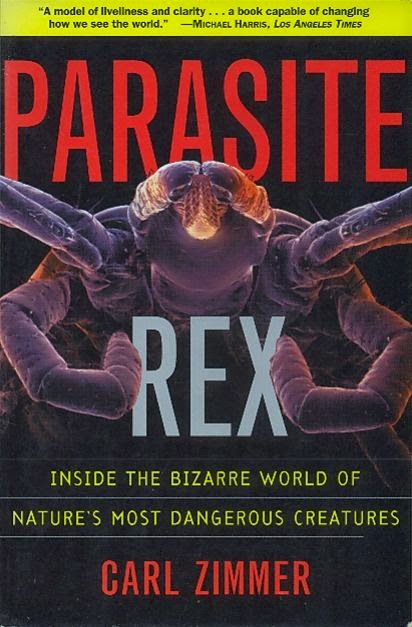
Parasite Rex

Inside the Bizarre World of Nature's Most Dangerous Creatures

It's a disturbing fact that the body of any creature, including our own, is potential habitat. We are a house and the mice want in. Or as the prologue puts it: "a vein is a river."

The life cycle of a parasite can be ingenious, complex, and gruesome, and the book provides some startling examples. Among the 16 pages of b&w photos you'll find one of a crustacean that has devoured the tongue of a fish and taken its place. But what makes this book remarkable is that it goes beyond such sensational examples and addresses broader issues.

Parasites, it seems, have been practising their trade since the dawn of life, and any ecosystem without them is likely to be unhealthy. Parasites may even have been responsible for the development of sex and language.

Then there are social parasites, like the cuckoo. Ultimately we ourselves may be seen as parasites -- with the planet our host.

Behaviour Modification

One of the truly shocking aspects of parasitism is the ability of some organisms to alter the behaviour of their host. Toxoplasma causes rats to be less wary of cats, the parasite’s final host.

Ants that have ingested lancet flukes leave their sisters and spend the night at the top of a blade of grass, the better to be consumed by a grazing mammal.

Sacculina, a parasitic barnacle, penetrates a crab’s leg joint, sends out "roots" through the crab’s entire body, and emerges as a sac on its ventral surface. The crab loses its ability to reproduce, becoming "genetically speaking, a zombie: one of the undead serving a master."


...parasites such as Sacculina...control their hosts, becoming in effect their new brain, and turning them into new creatures. It is as if the host itself is simply a puppet, and the parasite is the hand inside.


Makes one think of Heinlein’s Puppet Masters, and the movie Alien, doesn’t it? The author mentions them too.

Carl Zimmer

I enjoyed Parasite Rex so much that I immediately went out and bought two more of Zimmer’s books. Check out his website, which contains numerous articles he has written, as well as Chapter 1 from this book.

You can also find a link to his blog on Discover’s website, and there a link to a a photo gallery of scientific tattoos, the basis for a cool book coming out this fall called Science Ink.

Zimmer has had a tapeworm named after him.

A Few More Quotes


It’s time to put the parasite alongside the lion.

Castration is a strategy that any number of parasites have hit on independently...

Parasites have been a dominant force, perhaps the dominant force, in the evolution of life.

There are more human intestinal worms than humans.

Wednesday, September 14, 2011

The Good Body

An inspired blend of hockey and Canlit that makes you wonder why such an obvious combo hasn't been tried before.

Bobby Bonaduce has laboured 20 years in the minors, the high point of his career being a single shift with the Maple Leafs. Or perhaps it's a low point, for in that short span he speared an opponent's spleen, got into three fights, pushed a linesman, spit at a fan, and knocked off a cop's hat.

Now with his career over, he's heading north to reconnect with his son Jason, who is playing hockey for UNB in Fredericton. He bluffs his way into the graduate program for creative writing in the hope that he'll be able to join the team.

This makes for some great comic moments on and off the ice. Bonaduce is predictably disdainful of works like "Lady Windermere's fucking Fan" and at sea in seminars like "Canadian Writers of the British Diaspora," the first hour of which is spent defining "Britain."

The writing has a distinctive rhythm and tone, and offers up some cool observations.

Hockey


...you have the puck and you're lugging a bag of gold to market surrounded by fast bandits.


Canlit


Reading her novel, he'd felt a shovel-the-snow kinship to Atwood, though her tough-shit sharpness made him nervous; and to Davies, though he was a stuffed shirt. But you could tell they'd both shovelled driveways.


Grad school


This was pretty good, gift as a verb, one of the better ones in the new language he'd been learning here. Other verbs he didn't like so much. Dialogue. Let's dialogue. Hell, why not get Sally and trialogue. Eight of us at Murray's lousy party, octaloguing away.

He went to the bathroom, to urine.


The ex-wife


Her eyes, her bright eyes. You looked in and saw she was smarter than you but also that this wasn't a bad thing. You could also see how she felt her body to be not quite hers, or not quite her. She could hold her body at arm's length. You could see she respected her body, but also that she saw it to be a kind of playground.


The book is filled with likeable characters save for a roommate with a withered arm. But perhaps Toby and Bobby are intended as doppelgangers, as both are afflicted with a physical disability that gives an ironic twist to the book's title. The image of Bonaduce driving around with a dead Christmas tree on the roof of his car is a telling one. It's clear from the start that the book can only end one way, but funny and sad make for a powerful combination.

Hockey Lit

A good companion to this book is a more recent one by Gaston, Midnight Hockey, a non-fiction work in which he mentions his own hockey career.

You can also check out this review by Angie Abdou. Her novel, The Bone Cage, was defended by former NHL enforcer, Georges Laraque, in the CBC's 2011 Canada Reads event.

Two other hockey novels I have enjoyed: King Leary and Salvage Kings, Ya!