Showing posts with label Dickens. Show all posts

Sunday, March 20, 2016

Great Expectations

One of Dickens's most beloved works has a marvellous opening, Pip in a graveyard where his father, mother, and five brothers are buried. Having no memory of them, he forms an impression of their appearance based on their tombstones.

Like David Copperfield, the novel is a coming-of-age story written in the first person. Pip and David are both "posthumous" children, and like Dickens they are ashamed of their origins. As they strive for status, they acquire nicknames (Pip's handle being Handel and David's Daisy), are repeatedly bilked by their servants, and fall in love with the wrong woman.

David becomes a famous writer and arrives at happy matrimony after the convenient death of his first wife, the ditsy Dora. Pip too becomes a gentleman, but his world is turned upside-down when the woman he loves marries a cad and the source of his wealth turns out to be an embarrassment. It is not Miss Haversham who endowed him, but Magwitch the escaped criminal.

Biographer Fred Kaplan refers to David Copperfield as "a thinly concealed autobiographical fantasy." In Great Expectations the ugly truth is revealed and the happy ending ditched, making the book a sort of David Copperfield gone wrong. Some critics have seen this as a re-imagining of Dickens’s own later life: a wealthy and respected writer afflicted with marital unhappiness and longing for a woman he could not have, at least not publicly.

Ellen and Estella

Estella is believed by many to be based on Ellen Ternan. The agony Pip feels over the difficulty, if not impossibility, of winning of Estella is similar to that of Dickens in being unable to claim Ternan, at least openly. If so, he may have received some bitter satisfaction over the ironic reversal of their positions. Pip fails to win Estella because he is her social inferior. Dickens was in the opposite situation – wealthy and famous while Ternan was a relative unknown.

Whether or not his interest in Ternan was consummated remains as inconclusive as the ending of Expectations. How apt!

The Ending

The original ending was unequivocal: Pip and Estella do not end up together.  But Dickens was persuaded by Bulwer-Lytton to rewrite the ending, which, although I was prepared to dismiss it, I found myself preferring, my main reason being that the original ending is too brief, no more than half a page. The revised ending is fleshed out better.

Many however do not like it because they see in it a suggestion that Pip and Estella will eventually get together, which goes against the tenor of the book.  The possibility is there, but whether or not it happens is unclear. It is in fact an ambiguous and very modern ending.

The Problem of Orlick

First of all there is the improbable rescue of Pip by Herbert et al, who save him from being murdered. Yet after this violent scene Dickens then makes Orlick a comic figure by having him rob Pumblechook and getting drunk in the process. The humour seems misplaced.

It is interesting to see how movies deal with this. The Pumplechook business at the end can be easily omitted, but how to handle the improbable saving of Pip? 

The 1999 version (with Charlotte Rampling as Miss Haversham) makes a clever adjustment by having Orlick let Pip go. He does it to prove that he is better than Pip or at least better than Pip thinks he is. Thus the improbable arrival of Herbert is unnecessary, and yet is in keeping with the theme of forgiveness in the book.

The 2011 mini-series (Gillian Anderson) has Pip besting Orlick in a fight, hence needing no rescue.

The 2012 film (Helena Bonham Carter) goes one step further – it removes Orlick from the story entirely.

Sunday, December 1, 2013

David Copperfield

So there's the Game Chicken in Dombey and Son, and Mealy Potatoes in this one, but Dickens missed a great opportunity for a similar name by not providing the Peggottys with a chicken coop.

Collecting the eggs, you see, would have fallen to Em'ly and given her an oval nickname that foreshadowed her betrothal. How Mr. Peggotty would have chortled over his beloved Ham and Eggy!

The Sea

Silliness aside, there is already plenty of foreshadowing, and it begins on the very first page when we learn that David was born without a caul, an item prized by sailors as protection against drowning.

In chapter 2 he visits the Peggottys, a family of fisherfolk that includes two orphans, Em'ly and Ham, whose fathers were drowned. Em'ly herself has seen a boat torn to pieces, and trembles during storms because she seems to hear Ham and her uncle crying out for help. Yet her fear of the sea does not prevent her from flirting with danger as she walks along a jagged timber jutting out from a pier.

These events foreshadow not only the arrival of Steerforth, who uses a boat to seduce Em'ly, but also the tempest at the end of the novel, a good 50 chapters away, in which a ship is torn to pieces, and Steerforth and Ham drown.

Marriage

The marriage of Murdstone and David’s mother foreshadows David's first marriage. The similarity of the names, Clara and Dora, signal the similarity of their childish natures. "A very Baby" is how Aunt Betsey describes Clara when they first meet, and in chapter 4 Clara sounds exactly like Dora when she exclaims, "Davy, you naughty boy! Peggotty, you savage creature!" Dora, a self-acknowledged "silly little thing," asks David to refer to her as his "child-wife."

David tries to "form Dora’s mind" and teach her some useful homemaking skills, but in so doing nearly emulates Murdstone's attempt to instill "firmness" in David's mother. "I didn’t marry to be reasoned with," Dora tells David, and faints when he encourages her to read a cookbook and learn how to keep household accounts. The best she can do is hold David’s pens while he writes. She is more pet than wife.

Literature

At home David takes refuge from the Murdstones in his father's books, and at school recounts them to Steerforth in "a simple earnest narrative style of narrating." Later, while working at Murdstone's warehouse in London, he amuses himself by inventing histories for people he sees in the street. By the end of the book he has become a famous author.

David Copperfield

David is an impulsive and credulous naif. For most of the novel he is routinely cheated and gulled and taken advantage of by just about everyone he meets. As a young boy he's an easy mark for a waiter at a Yarmouth hotel, a young man with a donkey cart, a disreputable dealer in second-hand clothes, and a brutal tinker.

At school he happily hands over money and food to Steerforth, and when boarding with the Wickfields he is gutted for information by Heep and his mother. He is cowed by his landlady Mrs. Crupp and inconvenienced by a long line of servants who are incompetent, thieving, or both.

His "pliant nature" is signified by the number of names that are applied to him. Four that he happily accepts are Davy, Daisy, Doady, and Trotwood (sometimes shortened to Trot). Occasionally he is referred to as Master Murdstone, Mr. Copperfull, Young Innocence, and Brooks of Sheffield.

The Murdstones

In the early chapters Dickens uses simple declarative sentences to reflect David's viewpoint as a powerless young child. It's a touch that magnifies the menace of the Murdstones, and makes them among Dickens's most convincing villains. Thanks in no small part to them the novel gets off to a rivetting start, and one of most satisfying lines in the book belongs to Aunt Betsey when she threatens to knock off Jane Murdstone's bonnet.

Steerforth

Steerforth is one of Dickens's finest creations. David idolizes him for his charm and accomplishments while remaining blind to his less likable characteristics. Such loyalty is both foolish and admirable. Others try to warn David, and the acidic comment of Rosa Dartle is particularly apt: "He thinks you young and innocent, and so you are his friend? Well, that’s quite delightful."

Steerforth's occasional moments of honesty are what make him credible in a way that many other characters are not. His last words to David are a superb touch. When he and the Murdstones sink out of sight, the novel becomes much less interesting, and begins to sag under an increasing load of sentimentality and pointless subplots.

Uriah Heep

The red-headed Heep is one of Dickens's most picturesque villains, yet much less believable than Steerforth. Fawning and slimy, he writhes like an eel and has clammy hands and "damp fishy fingers." His favourite word is "umble."

Micawber

A comic figure always in debt and just a step ahead of his creditors, yet "never so happy as when he was busy about something that could never be of any profit to him." He loves writing letters and excels at making punch. He doesn't speak, he perorates. His favourite word is "pecuniary."

Despite their difficulties, his wife is devoted to him. Her signature line is: "I will never desert you, Micawber."

Agnes Wickfield

David's failure to recognize her as an ideal mate mirrors his blindness to Steerforth's true nature. Unfortunately Agnes is just another in a long line of bland and selfless heroines, and one of the most derided.

Dickens

Dickens called David Copperfield his "favourite child." Biographer Fred Kaplan refers to it as "a thinly concealed autobiographical fantasy."

Like David, Dickens mastered shorthand well enough to become a skilled parliamentary reporter, and became famous when he branched out into fiction. The character of Micawber is based on his own improvident father, who, like Micawber, spent time in debtor's prison.

More important is David's stint at Murdstone's warehouse. His shame, his heartfelt anguish and "secret agony of the soul," have the deep ring of truth, drawn from Dickens's own childhood experience in a blacking factory:


The remembrance of that life is fraught with so much pain to me, and so much mental suffering and want of hope, that I have never had the courage even to examine how long I was doomed to lead it. Whether it lasted for a year, or more, or less, I do not know.


The book began serial publication in 1849, after Dickens had experienced 13 years of a slowly disintegrating marriage, which was likely the inspiration for Annie's comment: "There can be no disparity in marriage like unsuitability of mind and purpose."

Ironically there was something of Murdstone in Dickens, for he was a "perfectionist who dominated the life of the household that left little room for [his wife]." (Kaplan)

Favourite Scenes

Two of the scenes I enjoyed most were humorous ones. The waiter in chapter 5 not only drinks David's ale and eats most of his dinner, but cons him out of a shilling and sends him on his way with a joke: "Take care of that child or he'll burst."

Equally funny is David's account, in chapter 44, of how he and Dora are cheated by every servant and tradesman they come in contact with. One line sounds straight out of Monty Python:


As to the washerwoman pawning the clothes, and coming in a state of penitent intoxication to apologize, I suppose that might have happened several times to anybody.


Cookery

In chapter 1, Aunt Betsey scoffs at the name that David's father gave to the Copperfield home -- the Rookery. "Cookery would have been more to the purpose," she says to Clara, "if you had any practical ideas about life, either of you." This comment introduces a topic that crops up later.

As for food mentioned in the book, we have Mrs. Micawber making a little jug of egg-hot to revive herself after fainting, and Aunt Betsey drinking warm ale with a teaspoon and soaking strips of toast in it. Other delights:

pigeon-pie
cold boiled bacon
hot kidney pudding
a saveloy and a penny-loaf
a basin of mutton broth dimpled all over with fat
mushroom ketchup
porter and oysters
warm sherry negus
very hot port

Ironically, Catherine Dickens, whatever her deficiencies, was not the helpless idiot that Dora is. She published a cookbook entitled What Shall We Have for Dinner? under the name Lady Maria Clutterbuck. It went through several editions.

Trivia

How many Betsey Trotwoods are there?
a) two
b) three
c) four
d) five

What is the original name of the boat Steerforth buys?
a) Blue Noddy
b) Sooty Tern
c) Stormy Petrel
d) Little Shearwater

Match:
a) Tungay..............1) a dwarf
b) Mortimer............2) a servant
c) Traddles............3) has a wooden leg
d) Mealy Potatoes......4) has a scarred lip
e) the Orfling.........5) Annie's mother
f) the Old Soldier.....6) Micawber's alias
g) Miss Mowcher........7) Mr. Dick's real name
h) Rosa Dartle.........8) draws skeletons
i) Richard Babley......9) works in a warehouse

Answers


Saturday, August 10, 2013

American Notes

In 1842 Dickens arrived in America starry-eyed with admiration for the young, vigorous, and self-made republic, no doubt seeing in it a reflection of himself. At the same time America was no less admiring of an author who at 30 years of age was already an international celebrity.

Dickens got the sort of reception that the Beatles did more than a century later. Indeed, with his long hair, he would not have looked out of place alongside the Fab Four, as can be seen in the portrait below, which was painted in Boston at the beginning of the tour. It gives one a fresh appreciation for the writer who had already produced at such a young age Pickwick Papers, Oliver Twist, Nicholas Nickleby, Old Curiosity Shop, and Barnaby Rudge.

Despite getting off to an excellent start, the tour soon went sour. Dickens was pummelled in the press for urging the need for international copyright, beleaguered by legions of curious fans, and finally worn out by months of travel.

He met people from all strata of society, from its most elite (including the President) to its most wretched. He saw much to admire but also much to despise: filth, boorishness, hypocrisy, swinish table manners, and more.

Filled with loathing, he returned to England and produced a travel book with the ungainly title of American Notes for General Circulation.

It is not much read today, one reason being the endless inspections of public institutions, which make for rather dull reading. Yet at the same time there are many fine passages that sparkle with his trademark wit, exaggeration, and keen eye for detail.

His journey was retraced recently in a BBC TV series called Dickens in America. Hosted by actress Miriam Margolyes, it comes on three disks and clocks in at five hours.

Great Expectorations

At first Dickens struggles to maintain the stance of an impartial observer, but it does not take long for his bottled rage to escape. He portrays Americans as humourless idlers and "leaden people." Meals are eaten with "no conversation, no laughter, no cheerfulness, no sociality, except in spitting." People thrust knives and forks down their throats or suck them meditatively. Hot corn bread is "almost as good for the digestion as a pin cushion," while sherry cobbler and mint julep are to be avoided "by those who wish to preserve contented minds."

The press is "a monster of depravity," politicians "legislators of coarse threats, of words and blows such as coalheavers deal upon each other." The Mississippi is a "foul stream," the town of Cairo a "detestable morass." Roads are bad, hotel bedrooms "conducive to early rising," and overheated stoves a "detested enemy."

Running like a theme through the book is his disgust for "salivatory phenomenon." Washington is "the head-quarters of tobacco-tinctured saliva" with "the universal disregard for the spittoon" existing even in the Senate and House of Representatives, where the carpets "are squirted and dabbled upon." Gentlemen in the President’s mansion "bestowed their favours…abundantly on the carpet." The driver of a mail-coach "chews and sprays," while sleepers on a canal boat "expectorate in dreams."


I was surprised to observe that even steady old chewers of great experience are not always good marksmen, which has rather inclined me to doubt that general proficiency with the rifle, of which we have heard so much in England. Several gentlemen called upon me who, in the course of conversation, frequently missed the spittoon at five paces, and one (but he was certainly short-sighted) mistook the closed sash for the open window, at three.


The book closes with a denunciation of slavery and examples of extreme cruelty and brazen violence. Slave-owners are the "miserable aristocracy spawned of a false republic."

A Touch of Pickwick

Non-fiction, yes, but details are captured with the eye of a novelist, some indelibly so. Onboard the Cunard steamship RMS Britannia, "every plank has its groan, every nail its shriek." A stove is a "red-hot demon" and a train has a "mad dragon of an engine." A young girl has a "loquacious chin," while a man's beard is "shaved down to blue dots." Pigs have backs like "the lids of old horsehair trunks," while prisoners in striped uniforms resemble "faded tigers."

Even better, Dickens does not restrain his comic genius, and at such moments it's almost as if Pickwick, not Dickens, is on tour. The horizon seems drunk when crossing the Atlantic, and the motion of the ship makes beds "a practical joke." Stage-coaches sink up to their windows in mire, and passengers are either "flung together in a heap at the bottom" or have their heads crushed against the roof.

And here is an example of the sort of rudeness that infuriated him:


Being rather early, those men and boys who happened to have nothing particular to do, and were curious in foreigners, came (according to custom) round the carriage in which I sat; let down all the windows; thrust in their heads and shoulders; hooked themselves on conveniently by their elbows; and fell to comparing notes on the subject of my personal appearance, with as much indifference as if I were a stuffed figure.

I never gained so much uncompromising information with reference to my own nose and eyes, and various impressions wrought by my mouth and chin on different minds, and how my head looks when it is viewed from behind, as on these occasions.

Some gentlemen were only satisfied by exercising their sense of touch; and the boys (who are surprisingly precocious in America) were seldom satisfied, even by that, but would return to the charge over and over again. Many a budding president has walked into my room with his cap on his head and his hands in his pockets, and stared at me for two whole hours: occasionally refreshing himself with a tweak of his nose, or a draught from the water jug; or by walking to the windows and inviting other boys in the street below, to come up and do likewise: crying, "Here he is!" "Come on!" "Bring all your brothers!"


American Connection

The trip to America was Dickens's first major setback as an adult, and may have wounded him as deeply as his childhood experience in a blacking factory. Is there a connection between his need for adulation and his almost demonic energy, traceable perhaps to his negligent mother? His visits to jails, insane asylums, and other public institutions, though admirable, seem at times almost pathological, as though satisfying a morbid need to see how low he himself might have sunk had he not written his way out of penury.

In any event, he returned from America deeply shaken. He vented his disappointment in American Notes and the American passages of the novel that came next, Martin Chuzzlewit. The latter, however, was the first of his novels to suffer a decline in popularity as it was being published, and led to him switching publishers. It was as though his American experiences were still casting a shadow across his life.

Twenty-five years later he made a second trip to America and conducted a very successful reading tour. This time he was favourably impressed and promised to include in all future editions of American Notes and Martin Chuzzlewit a postscript recording the changing of his views.

But the reading tour took its toll. A gouty swollen foot made it difficult to walk, and he needed assistance taking the stage in New York for his final readings. He returned to England exhausted, yet almost immediately began preparations for another round of readings in England. He survived one more year.

Canadian Connection

In 1842 the RMS Britannia made a brief stopover in Halifax, and Dickens recorded a few observations at the end of Chapter II.

Later, after visiting Niagara Falls, which was one of the few sights that lived up to its billing, he continued north to Toronto, Montreal and Quebec City. About half of Chapter XV is devoted to this portion of his tour. Canada, he wrote, was a "sound and wholesome state," which would hold "a foremost place in my remembrance."

After his death in 1870, one of his shiftless sons wangled an appointment to the North West Mounted Police. Frank Dickens served in Canada for 12 years, beginning in 1874 and ending in 1886. After his discharge, he hoped to revive his declining fortunes with a lecture tour in the US, but on the day of his first scheduled appearance he died of a heart attack at the age of 42.

The Canadian Dictionary of Biography has this to say of him:


Francis Dickens made a definite, if negative, impact on the Canadian west. He was partly responsible for the serious deterioration in relations between the NWMP and the Blackfoot in the 1880s. His misadventures also contributed to the strong prejudice against English officers that existed in the mounted police in the late 19th century.

Friday, April 5, 2013

Jack London

Lots of interesting details in this recent bio: Jack's illegitimate birth and black wetnurse, his infatuation with surfing, his Korean and Japanese valets, his stint as a war correspondent, his bohemian friends with their vials of cyanide, his welcoming of tramps into his home, and his "supposed anti-American sympathies" that caused the FBI to open a file on him after his death.

On the literary side it was interesting to learn that there were scenes in Sea Wolf that "shocked and terrified readers;" that he purchased story ideas from Sinclair Lewis, was praised by Conrad and Kipling, and became the highest paid writer in America.

However, when the "Dickensian gloom" of a cannery was mentioned, I began to see shadowy similarities with another great writer.

London and Dickens

Both were literary dynamos. London published at least one book a year beginning in 1900, but more usually it was two or three and sometimes four. Several came out posthumously, making a total of 49 books between 1900 and 1920.

Commitment to social reform began with their experiences as child labourers, Dickens famously in a blacking factory at age 12, London in a pickle factory at age 14. Dickens's ordeal was short, lasting something like six months, but London did not escape so easily. He put in ten-hour days at a jute mill for ten cents an hour, and shovelled coal at a power plant for $30 and a single day off per month.

Before London was out of his teens his Oliver-Twist-like existence included oyster pirating, brawls with waterfront bullies, a half-year voyage on a sealing ship, riding the rails across America to join an army of the unemployed marching on Washington, and a 30-day jail term for vagrancy.

Dickens, though reform-minded, was never a revolutionary and regarded trade unions with suspicion. London on the other hand became a socialist, preaching it on street corners, writing about it in essays, and making fans of Emma Goldman and Leon Trotski. In the final year of his life he quit from the Socialist party due to its lack of "fire and fight," signing his resignation letter, "Yours for the Revolution."

Family Resemblances

Both writers were born to neglectful mothers, Dickens never forgiving his for suggesting he remain in the blacking factory when it was no longer absolutely necessary. London's mother was unstable and manipulative, "barren of maternal instinct."

John Dickens, the father of Charles, was a naval pay clerk who was unable to live within his means, and continued to embarrass his adult son by demands for money. The case was different with London, who never knew his biological father. After he was born his mother married a Civil War veteran named John London. "The best man I ever knew," Jack said of him later, but even he on occasion was embarrassed by requests for money. The difference between John Dickens and John London was that the latter was conscientious and hard-working.

An important figure in the life of Dickens was his beloved sister-in-law, Mary Hogarth. With London, it was his devoted step-sister, Eliza Shepard, daughter of John London from his first marriage. In later years she helped run Jack's ranch and manage his literary affairs during his absences.

London and Dickens married in the same year their first books were published, but the matches were unsuitable. Dickens was domineering, striving to create the sort of family life he'd missed out on, with himself at the centre; as though, writes one of his biographers, Fred Kaplan, he needed "to become father to himself." London's failure as a husband was due, at least in part, to his never having had a childhood. The marriage breakups were widely publicized and neither man proved to be a particularly able parent.

London on London

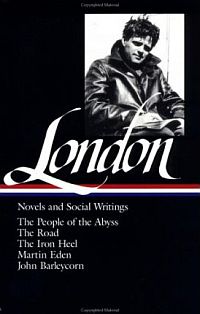
After reading the bio I was keen to dig into something by London himself, and hauled out this excellent compendium from the Library of America and which had been languishing on a bookshelf for far too long.

People of the Abyss is what I read, an expose of life in the London slums written in 1902. To my surprise and delight, the prose remains fresh and vital.

London passes himself off as a stranded American sailor in order to report on living conditions in the East End. The scenes he describes are "straight out of darkest Dickens," with people ground down by "a gross and stupid materialism" until they become stunted physically and mentally. The "gutter folk" he meets are worse off than beasts, living in "dens and lairs" and eating "pavement offal." Children take turns at night "sitting up to drive rats away from the sleepers."


Bathtubs are a thing totally unknown, as mythical as the ambrosia of the gods. The people themselves are dirty, while any attempt at cleanliness becomes a howling farce, when it is not pitiful and tragic. Strange, vagrant odors come drifting along the greasy wind, and the rain, when it falls, is more like grease than water from heaven.


(London's findings were corroborated by a government report after the second Boer War, which concluded in 1902. It found that 40-60% of the volunteers failed to pass the physical exam, a direct result of the "illness, malnutrition, and relentless hard work" experienced by the urban poor.)

People of the Abyss was a success in America but not in England, where reception was hostile -- much as Martin Chuzzlewit's had been in the U.S. for its unflattering portrait of Americans.

Thirty years later George Orwell trod similar ground in Down and Out in Paris and London and The Road to Wigan Pier. Like London, he was a socialist.

Thursday, September 13, 2012

Dombey and Son

Each novel by Dickens is like a public monument around which readers gather to admire, ponder, and debate.

This one suggests a fairy tale in which a lost girl falls into the clutches of an evil witch who steals her clothes and dresses her in rags. She is rescued by an honest young swain and returned to her merchant prince father. She has a haughty step-mother and a bestial adversary whose most distinguishing feature is his teeth.

Her moral support comes from a collection of people reminiscent of the Seven Dwarves: Mrs. Toodle the nurse, a maid called The Nipper, Diogenes the dog, an insolvent shopkeeper, an honest sea captain with an iron hook, and a tongue-tied lad named Toots with a pugilistic acquaintance known as the Game Chicken.

In the end the beast is dispatched, the honest young swain marries the princess, and the icy father has a change of heart.

See, a fairy tale.

Memorable Characters

Major Bagstock is one of Dickens's most grotesque creations, a self-described "smoke-dried, sunburnt, used-up, invalided old dog of a Major" with "eyes like a prawn" and a "complexion like a Stilton cheese". He is an outrageous toady whose bluff manner gains him the confidence of Dombey.

Captain Cuttle is the reverse of Bagstock, a retired sea captain of matchless loyalty and generosity. Both have a style of speech that is instantly recognizable: Cuttle's nautical expressions match Bagstock's constant references to himself in the third person.

Dombey's manager Carker is one of Dickens's most sinister creatures, a "smiling gentleman" who is always "airing his teeth." When he speaks his mouth is "bare to the gums," and in his smile there is something "like the snarl of a cat." He is "sly of manner, sharp of tooth, soft of foot, watchful of eye, oily of tongue, cruel of heart, nice of habit..." He sits at his desk "as if he were waiting at a mouse's hole."

Finally there is Edith Granger, a beautiful widow who bitterly submits to an arranged marriage with Dombey. When the match proves intolerable, she runs away with Carker solely to humiliate Dombey. Dickens makes her defiant to the end.

Memorable Scenes

Chapter 10 serves up a wonderful contrast between Major Bagstock's shallow machinations with the simple honesty of Captain Cuttle, who approaches Dombey seeking financial aid. Dickens surprises us by meeting Cuttle's request in an original manner -- giving the decision to Dombey's young son as a sort of lesson in capitalism.

Chapter 27 describes Dombey's courting of Edith Granger. They are accompanied by three companions who are all surface, thus imbuing their interactions with a rich irony. Bagstock, the "falsest of majors," on hearing of Edith's unpleasant encounter with a vagabond, wonders why no one can have the "honour and happiness of shooting all such beggars through the head without being brought to book for it."

Also present is Carker, whose interest in Edith is already surfacing, and Edith's mother, Mrs. Skewton, aka Cleopatra, whose disrobing at the end of the day reveals a body as hideous as her morals:


...the hair dropped off, the arched dark eyebrows changed to scanty tufts of grey, the pale lips shrunk, the skin became cadaverous and loose; an old worn yellow nodding woman with red eyes, alone remained in Cleopatra's place, huddled up, like a slovenly bundle, in a greasy flannel gown.


(The resemblance here to Good Mrs. Brown, the "witch" who robbed Florence of her clothing, is more than passing. Her daughter Alice is Edith's cousin.)

Chapter 31 drops into the present tense to describe Dombey's wedding, beginning with the "vinegary face" of Mrs. Miff the pew-opener and serving up some delightful comedy at the church when Edith's cousin gives away the wrong woman, and in signing the register "puts his noble name into a wrong place, and enrols himself as having been born that morning."

At the wedding feast several servants over-indulge, resulting in the following prophetic exchange:


Words have arisen between between the housemaid and Mr. Towlinson: she, on the authority of an old saw, asserting marriages to be made in heaven; he, affecting to trace the manufacture elsewhere...


Chapters 54 & 55 show the result of a hellish marriage. Carker, after being dumped by Edith, is chased to his doom by Dombey. It is melodrama, yes, but very good melodrama.

Defects

Orwell's essay on Dickens finds his novels full of "rotten architecture, but wonderful gargoyles." Major Bagstock is a typical gargoyle, yet to my mind Dombey and his daughter Florence are equally grotesque, though far less entertaining.

Florence is the most one-dimensional of the Dombeys, a fact underscored by her endless weeping throughout the novel. She is submissive and blindly devoted to her father despite a lifetime of indifference on his part. Only after he strikes her does she rise above her cloying sweetness and run away.

Dombey's cartoon arrogance is buffered somewhat by his agreeing to Captain Cuttle's request for assistance, and by his sponsoring of Mrs. Toodle's son at school. Though the latter act seems oddly out of character, it does provide a satisfying irony when the boy becomes Carker's cat's-paw and is instrumental in Dombey's downfall. The latter is accorded a touch of complexity when, instead of skimming off what he can from the ruins of his business, he insists on paying his debts to the best of his ability. However, his transformation into a kindly white-haired grandpa on the last page is difficult to swallow.

Finally there is Dombey's son. It was a brave move to dispatch him so early in the novel, though his death occupies an entire chapter. Fortunately it is not a long one.

Concluding Remarks

Dombey and Son is considered an advancement in Dickens's growth as a novelist because it was his first carefully plotted book, and indeed the story hangs together very well -- better in fact than some of his later books, which he worked very hard at plotting but which often fell victim to byzantine storylines.

In the Afterword to the edition I read, Alan Pryce-Jones echoes Orwell when he says of Dickens: "His faults are inseparable from his virtues."

1983 BBC TV mini-series:

Tuesday, August 2, 2011

Martin Chuzzlewit

The plot of the novel originates with a quarrel between two men, both named Martin Chuzzlewit. One is wealthy and old, the other is his grandson. They were on good terms until young Martin fell in love with Mary Graham, an orphan raised from childhood by the grandfather.

As a result young Martin is disinherited and heads to America with Mark Tapley in search of fortune, only to be conned into buying worthless swampland in a place called Eden. When they return to England, Martin has been transformed by his experiences into a better person.

During their absence, old Martin’s brother, Anthony, dies. His avaricious son, Jonas, marries Mercy, the daughter of a sanctimonious hypocrite named Pecksniff. Tigg, the prosperous chairman of the Anglo-Bengalee company, learns that Jonas hastened his father’s death with poison. Jonas is blackmailed into investing in Anglo-Bengalee, then forced to persuade his father-in-law, Pecksniff, to do the same. Tigg pays for this with his life.

Old Martin, who has pretended to fall under Pecksniff’s influence in order to expose his hypocrisy, now confronts Jonas about his role in Anthony’s death. To the surprise of everyone, including Jonas, it is learned that Anthony only pretended to take poison and died of a broken heart. Jonas, however, does not go free, as he is immediately taken into custody for the murder of Tigg, and commits suicide by swallowing poison. Old Martin denounces Pecksniff and is reconciled with young Martin, who regains his inheritance and weds Mary.

The novel was not as well-received as previous titles, and the first one to suffer a decline in readership.

Memorable Characters

Pecksniff is a major figure in the book. His smarmy hypocrisy and glib fawning ways are wonderful to behold. He is "soft and oily," has a flabby face, and is described by Jonas as "a sleek, sly chap...just like a tomcat." At one point he tells young Martin, "I am an honest man, seeking to do my duty in this carnal universe and setting my face against all vice and treachery. I weep for your depravity, sir."

Mrs. Gamp is a fat old woman with a swollen red nose and a liking for booze and snuff. She works as a nurse, midwife, and "performer of nameless offices about the persons of the dead." A comic figure and loquacious spouter of malaprops, she goes to "a lying-in or a laying-out with equal zest and relish." One of her sayings: "Rich folks may ride on camels, but it ain’t so easy for ‘em to see out of a needle’s eye."

Mark Tapley is a jolly fellow in search of a trying situation. He wishes “to come out strong under circumstances as would keep other men down.” In Martin he sees the potential he is looking for.

Highlights

The wonderful glimpses of Victorian England -- a steak wrapped in a cabbage leaf, straw on the floor of a stage-coach for passengers to shove their feet into for warmth, a medication called a slime draft, patches of pickled brown paper applied to Pecksniff's head, sacks stuffed up a chimney to keep the rain out, men carrying letters in their hats and walking arm-in-arm in convivial friendship. The draymen, thimbleriggers, underporters, and coal-heavers; and the quaint antiquarian objects -- hunting-whips, portmanteaus, tea-chests, pudding-basins, stone brandy-bottles, fish-baskets, waist-coat strings, toasting forks, key-bugles.

Dickens's delight in food: oysters for breakfast, potted boar's head, intensely pickled salmon, beef-steak pudding, sheets of ham, stewed kidneys, a hot leg of mutton, innocent young potatoes, a cool salad, a crusty loaf, cunning tea-cakes, flowing mugs of beer, jorums of hot punch.

Some fine comic scenes including the row between Mrs. Gamp and Betsey Prig, and Tigg's weaselly cadging at the beginning of the novel when he is still a shiftless bum. In fact, some consider Martin Chuzzlewit to be Dickens's funniest novel, while author John Boyd finds that chapters 8 and 9, which describe the Pecksniffs' London visit, as the "most sustained passage of comic writing in English literature." Counterbalancing the humour are some dark scenes, and though not always effective or believable, the nightmarish carriage journey undertaken by Jonas and Tigg is especially powerful.

Finally, the book is not burdened with a labyrinthine plot as some of the later novels are. It is relatively free from sentimentality; there are no cloying characters or tear-jerking death scenes. And young Martin’s slightly flawed character makes him more likeable than other bland heroes, like Arthur Clennam in Little Dorrit.

America

Dickens wrote Martin Chuzzlewit after a disappointing trip to America, and vented some of his ire in this book. Most Americans are portrayed as glib, crass, pretentious, and hypocritical. They are gluttonous feeders with swinish table manners, and have the unpleasant habit of spraying tobacco juice everywhere. Despite such comedic potential, this portion of the book (7 of 54 chapters) was the least satisfying, because the characters are pretty much cut from the same cloth, with the result that none stand out the way Pecksniff and Mrs. Gamp do. Some great names, though:

Colonel Diver
Major Pawkins
General Fladdock
General Cyrus Choke
Major Hannibal Chollop
Professor Mullit
Doctor Dunkle
Jefferson Brick
LaFayette Kettle
Zephaniah Scadder
Mrs. Hominy

Reversals & Improbabilities

As much as I enjoy Dickens I always seem to have difficulties with his plotting, and in this book the appalling bipolar behaviour of old Martin is more a function of plot than of character. The senseless quarrel with young Martin, and especially the ruse of pretending to be in Pecksniff's power, are neither credible nor creditable. Dickens has a lot of explaining to do at the end, but none of it is very convincing. He is not unaware of the problem, for he has Pecksniff declare, "Whether it was worthy of you to partake of my hospitality, and to act the part you did act in my house, that, sir, is a question which I leave to your own conscience."

Equally unbelievable is Anthony’s pretending to take poison, and Tigg's transformation from a scruffy cadger at the beginning of the book into the well-dressed and prosperous chairman of Anglo-Bengalee. Again, these are functions of plot rather than character.

Also related to Dickens's handling of plot is the way some characters are dragged back into the story when there is no need for it. Chevy Slyme shows up at the end of the book as an officer of the law, and the woman Mark assists during the journey to America reappears with her husband in Eden and again in London in the last chapter. This is perhaps an effort to make the sprawling tale seem a little more shapely than it actually is, tidying up ends that are not really loose.

Still, one might argue that some plot decisions are based on the recurring theme of character reversal, of which there are many in the book. Anthony, Pecksniff, Tigg, Slyme, Mercy, both Martins, and the suitor of Mercy's sister all undergo (or pretend to) some sort of transformative change. This is underscored by the change in Tigg's name -- from Montague Tigg to Tigg Montague.

It might also be said that some of Dickens's most entertaining characters are no more believable than his twisted plots, and that together they are but two sides of the same coin of his teeming genius.

Links

The 1994 BBC production of Martin Chuzzlewit is superb and quite faithful to the book. Paul Scofield as old Martin, Tom Wilkinson as Pecksniff, and Pete Postlewaite as Tigg are especially good. You can find clips on Youtube.

Here's a map of London showing locations mentioned in the novels of Dickens. The boarding house of Mrs. Todgers is close by the Monument near London Bridge.

Friday, December 17, 2010

Nicholas Nickleby

What better time of year to read Dickens than Xmas, with his cosy celebrations of family, friends, food and drink, while Scroogelike villains pinch their pennies?

My choice for this season was Nicholas Nickleby, which Dickens produced next but one after my current favourite, Pickwick Papers. I was hoping for something simpler and more comic than the last three I read, Bleak House, Our Mutual Friend, and Little Dorrit -- and until midway through the book I was not disappointed.

The plot moves along in a straightforward and unencumbered fashion. Ralph Nickleby finds employment for his nephew Nicholas with a brutal one-eyed schoolmaster named Wackford Squeers. Nicholas thrashes Squeers and runs away with a simple-minded young man named Smike, an abandoned student kept on at Dotheboys Hall as a servant. Nicholas finds employment tutoring French for the Kenwigs family, then he and Smike end up with a theatrical company run by Vincent Crummles. They return abruptly to London on receiving an urgent message from Newman Noggs, Ralph’s clerk. It regards Nicholas’s sister, Kate.

Ralph is a familiar figure in the pantheon of Dickensian villains, an implacable “usurer” whose chief goal in life is the acquisition of money. After finding employment for Kate with a milliner named Madame Mantalini, he dangles her before two debauched noblemen, Sir Mulberry Hawk and Lord Verisopht, as an inducement to maintain their financial dependence on him. They pursue Kate when she takes up new employment as a lady's companion with Mrs. Wititterly.

By this time Nicholas is back in the city and happens to overhear Kate’s name being bandied about by Hawk and his confederates. He accosts Hawk, rescues Kate from the Wititterlys, and denounces Ralph.

This is a very condensed version of the novel's first half, which I enjoyed enormously. But then a change takes place as Dickens starts herding his characters toward a conclusion. Comedy gives way to cloying sentiment, unlikely coincidences, contrived backstory, ridiculous melodrama, and stuffy Victorian morals. All of these elements are present to some extent in any Dickens novel, but they overwhelm the last half of this one. The turning point comes with the introduction of the insufferable Cheeryble brothers, through whose charitable hands money pours "as freely as water" (chapter 35), and the astonishing change of Lord Verisopht from a weak-willed dupe to a defender of Nicholas and Kate (chapter 38).

Dickens is forced to introduce several shady new characters to service the plot - Bray, Brooker and Arthur Gride. Squeers is dragged back into the story more times than is necessary. There is a soppy death scene for Smike, and an outrageous passage where Frank Cheeryble and Newman Noggs sneak into a room and get close enough to Squeers to peer over his shoulder at an important document – a will, of course. The marriage of Madeleine Bray to a disgusting old miser (Gride) is prevented by the timely passing of her father, which not only contributes to Ralph’s ruin but also saves her for Nicholas (who loves her even though he has scarcely spoken to her).

The worst is saved for the end – the revelation that Smike is Ralph’s son (with an implausible explanation of how he ended up with Squeers), followed by a saccharine triple wedding. One illustration in particular sums up all the corny melodrama.

This is not to say the last half of the book is without merit. Chapter 50, for example, is a fine set piece, culminating in the duel between Hawk and Verisopht. Overall, though, the final half fails to live up to the superb promise of the first half.

Characters

For me the most memorable characters are Wackford Squeers and Mr. Mantalini. Is it not odd that two such scoundrels are also the most amusing? The combination of humour and villainy makes for doubly potent comedy, and is one aspect of Dickens’s genius that I greatly admire.

I also enjoyed seeing Nicholas portrayed as a headstrong and fiery young man. His physical courage in confronting Squeers, Hawk, the actor Mr. Lenville, and his uncle Ralph is refreshing; while Kate as a spirited young woman is more satisfying than the meek and long-suffering Madeleine Bray, who serves as a template for subsequent boring heroines like Esther Summerson.

One of the best scenes in the book occurs when Nicholas seeks employment with an MP named Gregsbury, at the same time that he is being confronted by dissatisfied constituents. The Crummles theatrical troupe also affords a number of excellent moments.

Of no interest whatsoever are the saintly Cheeryble twins, who are as credible as Tweedledum and Tweedledee. Also, the machinations of Ralph Nickleby are a little too convoluted to be completely believable, though a trace of remorse early in the novel for manipulating Kate is a nice touch, as is his rationalization for doing so.

Marriage

Marriage, family, and parental responsibility figure large in the work of Dickens, but here they are of central importance. Of the five weddings in the book, three of them take place at the very end -- Nicholas and Madeleine, Kate and Frank, Tim Linkinwater and Miss La Creevy. The other two occur earlier and offstage -- John and Tilda Browdie, and Mr. Lilyvick and Henrietta Petowker. The latter relationship ends when Henrietta runs off with a half-pay captain. A sixth wedding (Madeleine and Gride) is aborted at the last moment, and a wedding anniversary is celebrated by the Kenwigs.

In Chapter 4 we are introduced to Mr. Snawley, who, having just married, is sending his two stepsons off to Dotheboys Hall to prevent his new wife from squandering money on them. Dotheboys Hall, it turns out, is a dumping ground for unwanted children. Ironically Squeers is devoted to his wife and offspring. The Squeers and Mantalini families form a suitable contrast to the happy Kenwigs and Crummles (the latter containing the celebrated "Infant Phenomenon").

Family contrasts are also central to the Nickleby saga. The secretive marriage of Ralph ended badly, his wife running away with another man, his child (unbeknownst to him) ending up at Dotheboys Hall. Nicholas senior, on the other hand, married for love and headed up a happy family. Unfortunately, while Mrs. Nickleby's heart is in the right place, her brain isn't. She urged her husband to speculate, which led directly to his death and the family's financial ruin. She completely misjudges Hawk and Squeers, and in this respect resembles another incompetent parent, Madeleine's father. Apparently she is modelled on Dickens's own mother.

As important as love is, it takes second place to other things, and not just money. Nicholas and Kate are both ready to forgo it for the sake of appearances; they don't want the Cheerybles to think they are being taken advantage of. In a similar confusion of values, Madeleine Bray is willing to suffer a loveless marriage out of blind devotion to a worthless father.

Tuesday, February 16, 2010

Little Dorrit

Duke Classics ebook
Though one of his later and darker novels, there is also much humour and exuberance here, and the storyline is easier to follow than that of the last two by Dickens I read, Bleak House and Our Mutual Friend

In Book I (“Poverty”), Mr. Dorrit is confined to Marshalsea, the same debtor's prison that Dickens' father had been incarcerated in.  He and his daughter, Little Dorrit (born in prison), are visited by Arthur Clennam, whose generosity includes discreet financial assistance.

In Book II (“Wealth”) Mr. Dorrit enjoys unexpected riches, while other people are suddenly ruined, including Clennam, who ends up in Mr. Dorrit's former room in Marshalsea.  Now it is Little Dorrit who comes visiting.

Theme

Little Dorrit is about imprisonment. The book opens in Marseilles -- first in a jail, then behind walls where some travellers have been quarantined. The story moves on to London – first to a decrepit house where Arthur's mother has been confined to a wheelchair for years, then to the Marshalsea prison.

These visible forms of imprisonment are matched by self-imposed barriers. When Mr. Dorrit is set free, he remains trapped by his own pride and vanity. Arthur Clennam has been a prisoner in the family business for 20 years.  Miss Wade is a “self-tormentor,” caged by her own bitterness and resentment. The Circumlocution Office is a bureaucratic fortress with the power to enslave the unwary in its labyrinthine coils.

Marriage can be a prison too. Mrs. Clennam's sterile morality divides her from her husband and sends him into exile, while the Merdles and the Sparklers are bound together in arid unions based entirely on money and appearances. Mrs. Flintwinch is so bullied by her husband that her life becomes a nightmare. All are marriages of convenience.

Memorable Characters

Mostly they are villains. Chief among them is an arrogrant cartoon Frenchman named Blandois, who overflows with extravagant speech and gestures. He snaps his fingers at everyone and cries out “Holy blue!” at the drop of a hat. Somehow Dickens manages to make him sinister and comic at the same time.

Flintwinch is Mrs. Clennam's servant turned business partner.  He has a wry neck and twisted body, and moves like a “screw-machine that fell short of its grip.” His poor wife Affery is so bullied by him that she's forever throwing her apron over her head in fright.

Gowan is a careless fellow who excels at nothing except his own self-interest. His nonchalant and patronizing comments are superb, especially when he cloaks his disparaging remarks in words of praise.

Mrs. General is the companion that Mr. Dorrit hires for his two daughters while they are touring Europe. Her idea of genteel breeding is never to show an interest in anything unpleasant.  To be genteel is to have an impervious, highly polished surface, and Dickens has great fun when he refers to her efforts at “varnishing” the two young ladies.

My favourite character is the collection agent Mr. Pancks, who is compared to a steam-tug, constantly puffing and snorting and towing away other people:


Mr. Pancks, who was always in a hurry, and who referred to a little dirty notebook which he kept beside him (perhaps containing the names of the defaulters he meant to look up by way of dessert), took in his victuals as if he were coaling; with a good deal of noise, and a good deal of dropping about, and a puff and a snort occasionally, as if he were nearly ready to steam away.


Gripes

Little Dorrit and Arthur Clennam are the least interesting characters in the book. Little Dorrit is selfless to the point of sainthood (which suggests a title change, Little Doormat), while the bland Clennam is more of a plot device than a character, linking up the Clennams, the Dorrits, the Meagles, and others. Though he spent 20 years in China, he shows no evidence of it, returning without souvenirs, anecdotes, or mannerisms.

Another problem is the age difference between hero and heroine. Little Dorrit is 22, yet petite enough to be mistaken for a child. Clennam, who is 40, frets about his age and often addresses her as "My dear child." Their first embrace is described as that of a father embracing a daughter. Since this is a prelude to a sexual relationship, the whole thing strikes me as rather creepy.

(There is an interesting sidelight to this in Dickens's own life. He met Ellen Ternan in 1857, the year he completed Little Dorrit. He was 45, she 18. Soon afterward, he left his wife and conducted a lengthy affair with Ternan. While he didn't meet her early enough for their relationship to influence the book, it's an odd coincidence, almost as though he were imagining, and perhaps justifying, a future involvement with a woman young enough to be his daughter.)

Then there are the usual things that modern readers tend to roll their eyes at -- an unexpected legacy, an overwrought death scene, a secret twin, and an improbably melodramatic event. The latter, which is intended to mirror the financial collapse brought about by Merdle's swindles, is the sudden disintegration of Mrs. Clennam's house. Dickens sets it up beforehand in various ways, but it's no more convincing than the spontaneous combustion of Krook in Bleak House.

And wait a minute, how does the paralyzed Mrs. Clennam survive the collapse of her house? Well, just before the house falls apart she miraculously regains the use of her limbs, leaping to her feet and rushing out to Marshalsea prison. But seriously, having been wheelchair-bound for years, it's unlikely she would have made it to the door, let alone down the stairs.

Finally, I mentioned earlier that the narrative is easy to follow. That's true, except for the denouement, when Dickens launches into a lengthy explanation of the book's backstory. It's so convoluted that the Penguin edition I read includes a precis of it in the appendix.

Canadian Connection

For several years Dickens managed a house for "fallen" women called Urania Cottage.  One of the young women was Rhena Pollard, a headstrong girl with dark hair and dark eyes. She seems to have been the model for Tattycoram (an orphan taken on as a maid by the Meagleses). Pollard eventually came to Canada, where she married and settled down to a respectable life in Ontario.

Tattycoram is also the subject of a novel of the same name by Canadian author Audrey Thomas. Thomas has been nominated twice for the GG.

Mrs. Merdle's son, Edmund Sparkler, was born in "St. John's, New Brunswick."

Links

After reading the book I watched the recent and most excellent BBC production of Little Dorrit. It was interesting to see how the book was shaped for the screen I urge you to see it. You can find out more at the following sites:

BBC
Jane Austen's World

Here's a review of Jenny Hartley's Charles Dickens and the House of Fallen Women. The book discusses the role of Dickens in running Urania Cottage.

I also discovered that there is a Dickens World in England. Wouldn't that be fun to visit!