Showing posts with label Translations. Show all posts

Friday, April 2, 2021

The Blue Fox

Another unusual read from Iceland.

Set in 1883, the book opens with “a daughter of Reynard,” a blue fox indistinguishable from the stone she is resting beside. She is keeping an eye on a pursuer hiding in a snowdrift. 

He has not moved in the last 18 hours. Suddenly he receives a message telling him exactly how to intercept the fox. 

“Had the man received a thought message from the vixen?”

The prose is spare. Snippets of text give the opening pages the appearance of poems. On one page there is a single sentence. The visual effect suggests, for me at least, the snowy landscape in which the story takes place.   

II

The second part settles into a more conventional narrative, one that grows increasingly tangled and convoluted. It centres on Fridrik Fridjonsson, a herbalist and farmer who 17 years previously rescued Abba from prison.

(No, not the Swedish pop group.) 

She's a woman with Down syndrome. Her full name is Halfdis Jonsdottir and she has just died. Her sweetheart, Halfdan Atlason, has come to collect the body. He is also "the Reverend Baldur's eejit."

Fridrik gives Halfdan a letter for Baldur, who is conducting the burial service. At the end of the letter Fridrik mentions that he has dreamed of a blue fox.

The tale retreats further into the past to explain how Abba arrived by shipwreck, and describes the strange bundle she carried with her for the rest of her life. Fridrik opens the bundle and finds 48 wooden tablets. When properly assembled they reveal a quote (in Latin) from Ovid's Metamorphoses.

III

The third section continues the book's opening thread. We now know more about the person hunting the blue fox.

The shot he fired triggers an avalanche that sweeps him under a glacier, along with the fox. He meets a young woman and the Well of Life. The fox revives, digs out the shotgun pellets from her body, and engages the man in a discussion of electricity.

What happens next is even more incredible.

IV

The final section takes the form of the letter that Fridrik wrote to a friend. It sheds some light on the connection between Abba and the hunter.

Sjon

The author is a poet, playwright, and singer who has performed with Bjork. More about him can be found on his website. 

The Blue Fox was first published in 2004. The English translation by Victoria Cribb appeared in 2008, and clocks in at 112 pages.

Saturday, March 13, 2021

Children in Reindeer Woods

A few years ago my wife visited Iceland and returned with a stack of books. One of them, Bloodhoof, a collection of poems in both Icelandic and English, she took a stab at translating herself with the help of a dictionary.

This is the first one I've dipped into it, and it's quite unlike anything I've ever read, It's a modern fairytale that takes place at a summer camp called Children in Reindeer Woods, and is linked by road to the Ceaseless Heath, the Endless Pass, and the Forever Valley.

The heroine is an 11-year-old girl named Billie. Her father believes he is a puppet. Whenever his arm is torn off, Billie's mother sews it back on. 

Billie has several dolls. One is named Guggalugga, another is bald, and a third is pregnant.

The man in charge of the camp is a former ballet dancer with splayed feet.

Somewhere in the Distance a War is Going on.

The story begins with the arrival of a soldier named Rafael. He wants to be a farmer and gets rid of his uniform but not his weapons.

Another soldier arrives. He parachutes in with a guitar. 

A pair of tax collectors show up with a briefcase full of money in the trunk of their car.

A nun comes to the back door and asks for food, then a cigarette. Rafael offers her a drink. She takes off her clothes, plays the guitar, and kisses Raphael.

The last visitor is a shepherd who has been tending a flock of sheep all summer. He plans on returning to university.

Except for Rafael, none of them stay around for any longer than a night. When he and Billie have an argument, they call each other idiot-head and pretzel-face.

Eyes of a Child

There are brief moments of violence but they are not gruesome, and some are absurd. Two dolls commit suicide. Raphael hangs a chicken for crapping in the house, and blows up two cars.

Many of the scenes are described with a childlike innocence.

The cow lowed from out back as though it was missing the fun. Mooooo.

[Billie] dried her mouth as if it were a stamp and the napkin an important document.

The automobile set off from the place.  Fart Fart.


When Rafael and Billie decide to get married, the dolls are witnesses. "We'll let the hens sign the contract," says Billie.

The final chapter caps the surreal nature of the book. It takes place on the planet of the puppeteers who control Billie's father. 

Author

Kristen Omarsdottir is an Icelandic author, poet, playwright, and visual artist. She has written other novels but this is the only one that has been translated into English. The translation is by Lytton Smith.

Tuesday, December 15, 2015

Jealousy

In a house next to a banana plantation resides a woman known only as "A..."

She receives a visitor named Franck, who arrives without his wife, Christiane. The house, a servant, and the surroundings are described in precise but monotonous detail, e.g. the angle of a shadow on the veranda and a squashed cockroach on the wall. Fragments of banal conversation are overheard.

There is no narrative flow, just a series of scenes presented out of order, rather like the pieces of a jigsaw puzzle dumped on a table. The fragmented tale is all surfaces, and many of the bits are obsessively repetitious, as though being viewed from different angles in order to extract meaning from them.

Here's a typical passage, which occurs when A... and Franck are sitting side-by-side on the balcony having a drink:


The four hands are lying in a row, motionless. The space between A...'s left hand and Franck's right hand is approximately two inches.


It's hardly rivetting, yet the passage is brilliant and typical Robbe-Grillet with the focus on meaningless numbers. And those four hands! They suggest a point of view mysteriously unnamed in the narrative, which is told as though through slitted eyes.

At first it's not clear what the point of the story is, but after a while it appears that the central event is a trip to the city, and that it is not upcoming but has already taken place, during which an auto breakdown necessitated an overnight stay.

The story ends with no overt denouement and leaves it to the reader to make sense of what's going on. The novel's title supplies a clue. Could the story's mysterious and unnamed narrator, his presence deduced by the lacuna it leaves, be A...'s husband? Are his obsessive observations due to suspicion that the trip to the city and the breakdown of the auto were not entirely innocent?

Included is a plan of the house, which seems as pointless as the "four hands" and "two inches" noted above, yet is another example of the neurotic nature of the story. The legend is as follows:

I. Southwest pillar & its shadow at beginning of novel
II. Veranda: 1) Franck's chair, 2) A...'s chair, 2) empty chair, 5) cocktail table
III. A...'s room: 1) bed, 2) chest, 3) dressing table, 4) writing table, 5) wardrobe
IV. Office: 1) desk, 2) photograph of A...
V. Hallway
VI. Bathroom
VII. Small bedroom: 1) bed
VIII. Living/dining room: 1) sideboard, 2) table, 3) mark of centipede on wall
IX. Pantry
X. Storage room or other (not described)

It's a short novel, not much more than 100 pages, and in its elusiveness reminded me of Paul Auster, Stanislaw Lem, and the "condensed novels" of J.G. Ballard.

Thursday, November 6, 2014

t zero

A protean character named Qfwfq -- previously introduced to readers in Cosmicomics -- reappears in many of the stories here.

The book is divided into three sections.  The stories in the first are surreal, while those in the second address the reader directly with rambling, playful, convoluted discourses about identity, love, and cellular reproduction.  

The last section, which is the one I enjoyed most, approaches stories like problems in physics.

Part One – More of Qfwfq

The Soft Moon
Mucus-like biological matter drips from the approaching Moon and covers the Earth. When the Moon recedes it takes with it pieces of glass and steel captured from Earth.

The Origin of Birds
The sudden appearance of birds on Earth is described in comic-book form, and Qfwfq marries Queen Or after travelling to the Land of the Birds in the following fashion:


The frame is empty. I arrive. I spread paste on the upper right-hand corner. I sit down in the lower left-hand corner. A bird enters, flying, from the left, at the top. As he leaves the frame, his tail becomes stuck. He keeps flying and pulls after him the whole frame stuck to his tail, with me sitting at the bottom, allowing my self to be carried along.


Crystals
The sudden formation of crystals -- "an invasion of angled blossoming" -- creates a rift between Qfwfq and his wife Vug, who appreciate them differently.

Blood, Sea
Swimming through a primeval sea/driving with another couple in a Volkswagen, Qfwfq and Zilphia fall to "fertilizing with a will" to outcompete the other couple with "me-sardines" and "Zilphia-sardines."

Part Two – Priscilla

Mitosis

Qfwfq, in love with Priscilla, remembers his life as a cell in the grip of reproductive forces.


To tell you properly the way things proceeded I must remind you of how I was made, a mass of protoplasm like a kind of pulpy dumpling with a nucleus in the middle. Now I'm not just trying to make myself sound interesting, but I must say that in that nucleus I led a very intense life.


Meiosis
"Characters are multicellular organisms." In this case, camels.

Death
Reproduction and the desire to remain eternal is a battle that spills onto the printed page.

Part Three – t zero

t zero
A hunter with a notched arrow faces a leaping lion. "In a second I'll know if the arrow's trajectory and the lion's will or will not coincide at a point X crossed both by L and by A at the same second tx."

The Chase
A man is pursued by another man in heavy traffic. As he tries to plot his escape and anticipate the countermoves of his pursuer, it becomes unclear who is chasing whom.

The Night Driver
The narrator, who lives in A, quarrels on the telephone with his girlfriend Y, who lives in B. On being told she is going to call his rival Z, the narrator repents and jumps in his car to see Y in order to patch things up. On the way he tries to anticipate possible outcomes:


it would be terrible if I were to run to Y jealous of Z and if Y were running to me, repentant, avoiding Z, while Z hasn’t remotely though of stirring from his house.


The Count of Monte Cristo
Edmund Dantes is imprisoned (in a cell, of course) in an Escher-like Castle d’If. At one point a hole appears in the ceiling, and another inmate, the Abbe Faria, emerges and walks across the walls like a fly. Eventually Faria burrows into the study of Alexandre Dumas.

Monday, May 5, 2014

Ijon Tichy

The Star Diaries (321 pages)

Ijon Tichy is the hero of this collection of absurd, fantastic, playful, and satirical tales. Many are as cartoonish as the Jetsons or anything on Saturday morning TV. Indeed, one of Tichy's forbears has his head flattened by a steam roller.

Tichy flies about in a jalopy of a rocketship. It has a rudder, and needs new brakes and a paint job. He cooks his meals on the atomic pile, and when he passes too close to a star he climbs into the refrigerator to cool off. When he runs out of fuel he dives his ship into a volcano, causing an eruption which propels him back into space. Someone goes by riding on a meteor.

Some of the supporting cast are robot friars, feral furniture, intelligent potatoes, edible space ships, dogs in spacesuits, and "interstellar vagabonds known as Gypsonians" who hire themselves out for the cleaning of moons, and whose children throw stones at comets.

Time Travel

Voyage 7 – The ship becomes packed with so many versions of Tichy they have to form committees in order to make decisions.

Voyage 12 – He uses a time machine to speed up evolution on a primitive planet, but breaks off a knob and sets it in reverse, causing him to revert to a baby.

Voyage 20 - He is recruited by his future self to head up a project to improve history with disastrous results. Mars is burnt to a crisp.

Strange Societies

Voyage 13 – A political allegory about a repressive regime that convinces people they are fish, and another where everyone wears an identical mask and individualism is forbidden. People are interchangeable right down to the family level, with mothers, fathers, and children trading places every day.

Voyage 23 – The planet of the Whds is so crowded its people reduce themselves to their constituent atoms to order to get some sleep at night, and to travel by mailing themselves in a cassette. "Look out, you’re spilling my daddy," Tichy is warned by a youngster. When he tries the process, there is an error of some sort and he is reconstituted as Napoleon.

Memoirs of a Space Traveller
Further Reminiscences of Ijon Tichy
(153 pages)

The rather convoluted publishing history of these stories is mentioned in a note at the end of Star Diaries, which appeared in English in two volumes, the second being this one, Memoirs of a Space Traveller. It contains two further voyages as well as several stories of the mad scientist variety.

Voyage 18 - Tichy creates the universe using a chronocannon. Two of the members of his team are Lou Cipher and Eve Addams. The universe, a scientist declares, "is an illegal loan of matter and energy." It is a "Debtor to Nothingness."

Voyage 24 – A planet runs into a multitude of civic problems when machines put people out of work. A Governing Machine is created to restore harmony, which it does by transforming people into "solid beautiful durable forms" and arranging them into "pleasing symmetrical designs."

Mad Scientists

Denser and more serious in tone, these stories are rather like thought experiments about the nature of perception and reality. Tichy visits a number of scientists whose misshapen appearance is representative of their unbalanced attempts at playing god. One creates a synthetic soul, another electronic brains in boxes ("Leibnizian monads") unaware of the true nature of their existence. A third has secretly been replaced by his own clone, and a fourth creates a fungoid creature that begins experimenting on the scientist.

The Washing Machine Tragedy

This story appeared in The New Yorker and describes the development of advanced washing machines. They mend and iron clothes, then progress to doing the children’s homework, interpreting dreams, singing lullabies, eventually becoming less capable of performing their original duties. Some are weaponized and associate with criminal elements. Others end up on the streets panhandling. Illegal parts factories spring up, and self-defence courses teach people how to defend themselves using a canopener or a pair of pliers.

Let Us Save the Universe
Ijon Tichy decries the ill-effects of cosmic tourism -- billboards and space garbage, graffiti on asteroids, comets without tails. Women exceed the speed limit because they will age slower. The impact on fauna in a Preserve is particularly harmful, and the story morphs into an illustrated bestiary of weird creatures whose lives have been disrupted by human contact. One is a bird called the sribblemock:


...the counterpart of the terrestrial parrot, except that it writes instead of talks. Often, alas, it writes on fences the obscenities it picks up from tourists from Earth. Some people deliberately infuriate this bird by taunting it with spelling errors.


The Futurological Congress (142 pages)

According to the translator's note at the end of Star Diaries, this novella was also part of that original collection.

It takes place on Earth and begins in Costa Rica where Tichy is attending a futurological congress. There is much unrest, which is combated by the use of a calming drug in the water of the hotel where he is staying, and which results in a hallucinatory experience involving giant rats.

When he comes to his senses he finds that he has been cryogenically preserved and resuscitated in the future where society has solved its problems chemically. It is a pharmocracy in which people vote on the weather and eat books instead of reading them. Poets use sonnetol and "children learn their reading and writing from orthographic sodas." Tichy is told, "We keep this civilization narcotized, for otherwise it could not endure itself."

Ijon Tichy appears in at least one other book: Peace on Earth.

Links

Tichy's adventures became the subject of a German TV series loosely based on Star Diaries. If you go to Youtube and do a search for Ijon Tichy, you'll find a few episodes with English subtitles. His rocket ship is a coffee press.

Lem's Official Site
Ijon Tichy Raumpilot

Sunday, October 6, 2013

Tales of Pirx the Pilot

Unlike the whimsical fantasy of The Cyberiad, these five stories attempt to portray space travel realistically during a time of routine interplanetary voyages.

There are no aliens, no space battles. Instead the plots turn on malfunctioning equipment: a short circuit, a burnt-out condenser, a "loose charge" in a CRT screen.

Although the stories are more than 40 years old and often sound dated, the overall effect is not as negative as one might expect.

The attempt at realism has already been undercut by the author’s use of a likeable but somewhat bumbling hero, and by language that is often folksy and jocular, resulting in a semi-comic feel. At one point Pirx wonders:


"What were those rockets firing, anyway? Dumplings?"


It's an odd but interesting combination, and gives the stories a retro feel (e.g. a pilot smoking a cigarette on his acceleration couch, his ship "a relic of atomic architecture" with "scars of old radiation leaks") that goes well with the subversive use of humour, whose purpose (I think) is to camouflage a deep pessimism. If space travel becomes possible, it will only give us a larger stage on which to demonstrate our shortcomings.

The Test – The opening story is the most comedic, with Pirx a chubby cadet who must take a ship to the Moon and perform a series of maneuvers, during which he is tormented by a couple of flies.

The Conditioned Reflex – Pirx is assigned to a Moon station whose construction was marked by bickering and wrongheaded engineering decisions. Pirx and his partner are replacing two men who died under mysterious circumstances, and unexpectedly find themselves recreating their final moments. This is the longest story in the book and the Moon is described in great detail.

On Patrol – Two men are lost on patrol, and Pirx comes close to suffering the same fate.

The Albatross – While travelling in a luxury liner, a distress call is received and Pirx becomes witness to a disaster in space. In the middle of a botched rescue effort, the passengers want to know when they can resume dancing.

Terminus – Pirx is assigned to a rebuilt tub following an accident in which the entire crew perished, save a robot now suffering from post traumatic stress. It has "oily wrists" and is "so old it was almost blind and deaf." One of its duties is looking after the ship's mice, which are used as "live radiation gauges." The story and the book end with the following observation:


[Pirx] began thinking about the innocence of machines, about how man had endowed them with intelligence and, in doing so, had made them an accomplice of his mad adventures. About how the myth of the golem – the myth of the machine that rebelled against its creator – was a lie, a fiction invented by the guilty for the sake of self-exoneration.


More Tales of Pirx the Pilot

The original Tales of Pirx the Pilot was first published in 1966. The English translation arrived in 1979 but contained only half of the stories. The remainder appeared in 1982 under the title More Tales of Pirx the Pilot.

Pirx is now an older and more respected figure but the mishaps continue, mainly due to human foibles and a misplaced confidence in technology.

Pirx's Tale - While hauling space junk from Mercury to Earth, Pirx witnesses an abandoned alien craft making a swing through the solar system. Unfortunately his ship is so beaten-up that "every lift-off or landing was a violation of the laws of physics," and his crew has just come down with the mumps.

The Accident - In the only story that takes place beyond the solar system, Pirx is "stuck in the mountains of an utterly worthless planet" with two feuding colleagues. Just as their mission is coming to an end, a robot fails to return from a routine task. When they go out in search of it, Pirx makes surprising discovery, one that he keeps to himself.

The Hunt - Damaged in an accident on the Moon, a mining robot turns a laser on its makers. Pirx is one of several men sent out to destroy it, but when he comes face-to-face with it he finds danger coming from a different direction.

The Inquest - In the longest and most complex of the stories, Pirx is on trial for an accident that occurred on a flight to Saturn, during which he was to test a new model of robot -- in fact, an android indistinguishable from a human being. During the flight several crew members attempted to tip off Pirx about the robot's identity. One person even claimed that he himself was the robot, and gave reasons why he wanted to fail. Who could Pirx trust?

Ananke - The first of a new class of super-freighters crashes while attempting to land on Mars. Was it a freak accident or does the same fate await the next two ships already en route?

Pirx also appears in a later novel, Fiasco.

Official website

Monday, May 21, 2012

Dersu the Trapper

Early in the 20th century Vladimir Arseniev led a number of scientific expeditions in the Russian Far East where a chance encounter with a native man, Dersu Uzala, led to a lasting friendship.

Dersu had no permanent dwelling, carried all of his belongings in a birchbark knapsack, and possessed bush skills so extraordinary he seemed almost clairvoyant. He was able to track wild pigs by his sense of smell, and pluck grouse out trees using a stick with a noose.

He scolded a tiger for stalking them, and reproved Arseniev for throwing a piece of meat into the fire. "In taiga many sort men," he said in imperfect Russian. He was referring to any of the animals who might visit the campsite after they had left, including ants. He believed that everything had a soul, even inanimate objects.

Dersu saved Arseniev's life several times, once when a forest fire overtook them, another time when a blizzard caught them in a marshy area with only reeds for shelter. When they were starving it was Dersu who found fish heads a bear had discarded, and boiled up strips of hide to fill their stomachs.

The Taiga

Arseniev's affection for Dersu was matched by his love of the taiga, and he recorded with an eager eye the plant and animal life they encountered. There were poplars three centuries old and so immense that two or three bears could hibernate inside. Garganey, hazel hen, and eagle owls were a few of the birds he observed, while mammals included roedeer, fanged muskdeer, raccoon dogs, and herds of wild pigs, some of them weighing as much as 600 pounds.

He witnessed a battle between ants and bees, and a chipmunk airing out its cache of food to prevent rot, and a Tibetan bear shaking acorns out of a tree. When they spotted fur seals at the coast he commented on their love of music.

There were moments when even the Cossacks who accompanied him were silenced by the taiga's beauty.

The People

Living in the Russian Far East was an uneasy mixture of Russians, Chinese, Koreans, and various native groups. They hunted and trapped, gathered fungus and ginseng, and cultivated poppies for opium, but it was non-natives who so ransacked the forest that "on every side one sees nothing but robbery and exploitation."

Arseniev provided some amazing glimpses of those natives not yet "in a complete state of slavery." They lived in cedar bark huts and wore moccasins made of fish skins. In the winter they armed themselves with spears and hunted wild pigs on skis. They set nets beneath the ice in small streams, and at night herded fish into them by torchlight while pounding on the ice with mallets.

The End of Dersu

When Dersu's eyesight began to fail, he reluctantly agreed to stay with Arseniev in Khabarovsk. Unfortunately he was unused to living in "a box" and could not understand the restrictions necessary for living in a settlement.

It was not permitted to fire off a gun or pitch a tent in the street. He thought Arseniev was being swindled when he paid money for firewood. When he cut down a tree in a park, he was arrested.

Eventually he left Khabarovsk but did not get far before he was murdered. Arseniev visited the unmarked grave only once. Two years later he was unable to find the spot due to changes brought about by development.

Notes

In the introduction to this edition, it is stated that Dersu is a composite character.

When Arseniev died in 1930 there was a warrant out for his arrest. His widow was shot as a Japanese spy and his daughter imprisoned for 10 years in a gulag.

The graceful translation is by Malcolm Burr, whose life was no less interesting than Dersu's or Arseniev's. He was an entomologist with an abiding interest in the Balkans and the author of several books. He died in Istanbul in 1954.

The cover photo is a still from the motion picture by Kurosawa.

A free audio version is available in the Audio Archive section of the Internet Archive.

The book takes place in the same general region as John Vaillant's enormously readable The Tiger.

Wednesday, September 22, 2010

Death with Interruptions

A light-hearted tale set in a small European country where people stop dying on January 1st, with unwelcome consequences for hospitals, funeral homes, insurance companies, and religious institutions.

Worst off are those permanently stuck on the verge of death, neither recovering nor passing away. Soon family members find a very pragmatic solution. They cart their loved ones across the border, where death still has dominion, and bring them back for burial.

After seven months of these moral and economic difficulties, a letter arrives from death. People will resume dying after being notified one week in advance so they can put their affairs in order.

At this point we meet death herself, who is portrayed as a skeleton, and learn of a difficulty of her own. A letter she has sent out is inexplicably returned. It was intended for a cellist in a local orchestra, but somehow he remains alive.

Death clothes herself in flesh and pays him a visit.

Mortal Syntax

When death's initial letter is published in a newspaper, after its grammatical errors are cleaned up, including the "obsessive elimination of paragraphs" and "the intentional and almost diabolical abolition of the capital letter," death pens a heated response.

In fact, the same "syntactical blunders" in the letter are present throughout the entire novel.


What letter is that, Let's just say that I wrote it after attending the rehearsal for your concert, You were there, Yes, I was, But I didn't see you, Of course not, you couldn't, Anyway, it's not my concert, As modest as ever, And saying let's just say isn't the same as saying what actually happened, Sometimes it is, But not in this case, Congratu-lations, you're not only modest, your're very perceptive too, What letter do you mean, You'll find out in time, So why didn't you give it to me if you had the opportunity, Two opportunties, Exactly, so why didn't you give it to me, That's what I hope to find out...


Saramago won the Nobel in 1998. He died earlier this year.

Saturday, April 4, 2009

A Hero of Our Time

The prose in this slim volume is as clear and bracing as a mountain stream.

The book presents five episodes in the life of a Byronic character named Pechorin. The unusual narrative structure allows us to see him first through the eyes of other characters, for whom he is a cipher.

The core of the book, both in terms of length and psychological depth, is the fourth episode, "Princess Mary," which is told in Pechorin's own words. He describes himself as a "moral cripple."

The final piece, "The Fatalist," has an eerie Poe-like quality to it, describing a man with "the mark of death" on his face.

Now examine the cover of the novel above. This is a portrait of Lermontov. Do you see the mark of death on his face?

Lermontov was a soldier as well as a Romantic poet -- brave, dashing, and equipped with a lethal wit. He was twice exiled to the wild Causcasus region, once for a poem he wrote on the death of Pushkin, and the second for fighting a duel. The character of Pechorin is clearly modelled on himself.

Byron (the name comes up several times in the book) was an important influence. Another was Pushkin's Eugene Onegin. Pechorin and Onegin (both characters named after rivers) are similarly bored but dangerous men. Both kill a friend in a duel.

The duel in A Hero of Our Time is impossibly Romantic. It takes place on the ledge of a cliff against a backdrop of mountains. Even a wound is likely to prove fatal. A coin is flipped to see who will shoot first. The men are positioned six paces apart, so that a miss is highly unlikely.

Like Pushkin, Lermontov himself was killed in a duel. He died in 1841, the year after A Hero of Our Time was published. He was only 27.

Mikhail Lermontov was the greatest Russian poet of his age, after Pushkin, and his influence on later Russian writers has been great -- Tolstoy, Chekhov, Dostoevsky, Pasternak.

Tuesday, March 31, 2009

The Rat

It takes considerable skill to pull off such a fantastic and convoluted work as this, but Grass is equal to the task. The book is far richer than any brief summary can indicate.

Narrative duties are shared by the author and a rat, while another character, Oskar Matzerath, pipes up now and then to suggest how the novel should proceed. There are several plotlines that twist, double back on themselves, and branch out in truly amazing directions.

Really Big Spoilers

1. The narrator gets a rat for Xmas. It speaks to him in dreams and explains how rats survived the Flood and what really happened at Hamelin. Eventually rats cause WW3 by infiltrating the computers of Eastern and Western powers. The only human to survive is the narrator, who is orbiting the earth in a space capsule. Meanwhile the rats prosper, though their fur has turned green. Eventually a new species of rat appears -- with blue eyes, blond hair, and a penchant for marching in columns.

2. The narrator convinces Oskar to make a film about the plight of dying forests. Oscar is a successful producer whose company, Post Futurum, "pre-enacts" future scenes -- "prevision" or "clairvoyant film" it's called at one point. While visiting Gdansk to celebrate his grandmother's 107th birthday, WW3 takes place. His withered remains and those of his grandmother are treated by the rats as relics.

3. The narrator's partner, Damroka, and four female shipmates (all of whom were romantically involved with the narrator in the past) embark on a scientific journey to count jellyfish in the Baltic Sea. A talking flounder directs them to the submerged city of Vineta, but just as they reach it they are incinerated by an atomic blast.

4. Fairy tale characters take up the plight of the dying forests. They travel to Bonn to appeal to the Grimm Brothers who head up the Ministry of Medium-Term Forest Damage. Rumpelstilkskin drives a car that runs on witch piss. Other characters include Little Red Cap, who pops in and out of a wolf's zippered belly, and Snow White and her sex-crazed dwarfs. They take the Chancellor prisoner in a fairy tale fashion, but eventually are crushed (literally) by the military.

5. A painter named Lothar Malskat successfully completes a magnificent art forgery in a Lubeck cathedral. The narrator compares him to two "political forgers," Konrad Adenauer and Walter Ulbricht, leaders of the postwar Germanies. Grass writes:


That was the era of winking, of appearances, of whitewashing. In the decade of innocent lambs and clean bills of health, of murderers holding public office and Christian hypocrites, no one wanted to know too much, regardless of what happened.


6. Oskar returns from Gdansk to celebrate his 60th birthday. The party is attended by the narrator and Damroka.

Notes

Reading this, I imagined a resemblance between Grass and another famous writer. The avuncular mustaches, the similar war records (each captured by the other's army and held as a POW), a taste for the fantastic, the use of recurring characters, and the importance of WW2 as a central theme, especially in their most famous works, Slaughterhouse-5 and The Tin Drum. Both grappled with political and moral issues. Both were graphic artists.

Oskar Matzerath is the protagonist of Grass's first novel, The Tin Drum.

Damroka and the talking flounder are characters who first appeared in The Flounder (the only other novel by Grass that I've read). So too a woman named Ilsebill, after whom the boat in this book is named.

Lothar Malskat is not a fictional character.

The cover image is a fine pen-and-ink drawing by the author.

Gunter Grass won the Nobel Prize for literature in 1999.

Other Ratworthy Books

Doctor Rat by William Kotzwinkle - During a lab revolt, an insane rat becomes an apologist for animal testing.

The Papers of Andrew Melmoth by Hugh Sykes Davies - A scientist disappears into the sewers where he has been studying rats.

King Rat by China Mieville - A young man in London discovers he's part rat.

Daybreak 2250 AD by Andre Norton - One of her earliest and best YA books. After a nuclear war, rats have mutated into creatures that walk on their hind legs, wear loin-cloths, and wage war on humans.

Rats: Observations on the History and Habitat of the City's Most Unwanted Inhabitants by Robert Wilson - A personal investigation into the life of the modern rat.

Saturday, March 7, 2009

The Cyberiad

Tales for the Cybernetic Age

In this collection of whimsical nonlinear tales, vanity gets a pair of friendly rivals into a number of ridiculous predicaments, often at the expense of a good shellacking.

Trurl and Klapaucius are "constructors," but everything they build has unforeseen effects or does not work properly. Some of their contraptions are:
-an electrobard
-a kingdom in a box
-a probability amplifier for summoning up dragons
-a machine that can create anything beginning with the letter n.

While not all the tales are equally good, the language throughout is imaginative and fun. There are photon schooners, ion crumpets, antimatter sabres, and three Voltaic brothers. There is also a Battery Age and an Empire of the Cold Welders. Someone wears a semi-permeable cummerbund. Another is "innocent as a brand new fuse."

As the stories progress it becomes apparent that Trurl and Klapaucius are robots, and gradually a serious, if not bitter, undertone creeps in. In the penultimate story a philosopher describes the utter failure of robotkind's godlike powers to bring peace and happiness to the universe.

The last tale in the book (and the only one that does not include Trurl and Klapaucius) concerns a princess who spurns "every suitor who seeks her radioactive hand." She will marry no one but a human. Infatuated, a neighbouring prince dons a disguise that is "flaccid, drooping, doughy." His description of human customs is hilarious.

Misc

The Cyberiad was first published in 1967. This edition was translated by Michael Kandel, and illustrated with delightful line drawings by Daniel Mroz. There is no introduction or afterword, which could have illuminated some of the challenges in translating Lem's prose, which contains many made-up words.

The book's subtitle might easily have been Don Quixote in Space, for the tales take place in an "age of electric errantry." Indeed, Lem uses the same word as Cervantes when he describes these adventures as "sallies."

The author, a famous and prolific Polish writer of SF, passed away in 2006. His work has been compared to that Kafka, Vonnegut, and Douglas Adams.

Official website

Sunday, February 22, 2009

Don Quixote

Considered the first modern novel, and one of the greatest works of world literature, Don Quixote has been translated into English many times. This version by Samuel Putnam appeared in 1949.

The book, whose full title is The Ingenious Gentleman Don Quixote De La Mancha consists of two parts that were published separately in 1605 and 1615. Together they take up more than 1000 pages in the Putnam translation.

One of the book's most remarkable aspects is the freshness of the language. It does not sound like a work that is 400 years old.

The Story

Don Quixote, approaching 50 years of age and guilty of reading too many books of chivalry, takes it into his head to go on the road as a knight-errant. He cobbles together a suit of armor, including a helmet with a pasteboard visor, and sets out on a bony nag named Rocinante.

His self-appointed task is to right wrongs, defend honour, and proclaim the beauty of a farm girl he's never met. Upon her he bestows a grand-sounding name, Dulcinea del Toboso.

Accompanying him is a fat peasant named Sancho Panza, who is simple and loyal, happiest when his stomach is full. He rides out on an ass, spouting proverbs and malapropisms, sustained by the hope of receiving an earldom or the governorship of an island.

As a result of his delusions, Don Quixote is repeatedly thrashed, pummelled, and humiliated. He mistakes windmills for giants, an inn for a castle, and a brass pot for a helmet. Yet despite such mishaps his faith in himself never wavers, and he has a convenient explanation for his misfortunes. They are the work of an evil enchanter.

Part I contains a number of famous scenes (the windmills, the slaying of wineskins, the attack on a flock of sheep) and is said to be the more popular of the two books. Putnam’s preference, however, is for Part II, which he considers a more accomplished work.

Part I is weighed down by several tales of romantic intrigue. There is "The Captive's Tale" and "The Story of the One Who Was Too Curious for His Own Good," as well as some improbable love affairs that displace Don Quixote and Sancho Panza for large portions of Part I.

In Part II there are still a number of romantic interludes, but none are as intrusive or cloying as those in Part I.

As evidence of the novel's modernity, I present the following excerpt in which Don Quixote tells Sancho Panza of a balm that can restore health despite the severest injury. The scene is eerily similar to the famous encounter with the Black Knight in Monty Python and the Holy Grail. Don Quixote says:


…whenever in any battle you see my body cut in two—as very often happens—all that is necessary is for you to take the part that lies on the ground, before the blood has congealed, and fit it very neatly and with great nicety upon the other part that remains in the saddle, taking care to adjust it evenly and exactly. Then you will give me but a couple swallows of the balm of which I have told you, and you will see me sounder than an apple in no time at all.


Narrative Structure

In Part I the narrator tells us the book has been written in Arabic by a Moor named Cid Hamete Benengeli. The narrator has only a fragment in his possession, but in Chapter IX discovers the complete work in a Toledo marketplace, and hires a Moor to translate it.

In Part II the narrator frequently interrupts the tale with comments about the fictional author and translator. It is a delightful irony that most readers will be reading a real and not a phony translation.

A metafictional layer is added when the characters begin talking about Part I, whose success has made Don Quixote and Sancho Panza famous. Other characters are aware of their exploits, and several shortcomings in Book I are discussed.

A further complication is the existence of a spurious Part II, which was published one year before Cervantes’ Part II. In the latter, Don Quixote learns that the rival version has him visiting Sargossa to take part in a tournament, and this causes him to deliberately bypass it.

If Don Quixote is the first modern novel, it is also the first post-modern novel.

Miguel de Cervantes

Not much is known about his early life, other than that his childhood was itinerant and impoverished. As an adult he spent time in Italy before entering military service. He took part in the Battle of Lepanto, where he was shot in the chest and lost the use of his left hand.

When he recovered, he resumed active duty only to be captured by pirates and held as a slave for a number of years in Algiers. He was finally ransomed by his family after several abortive escape attempts. These events are reflected in the Captive’s Tale.

Even after his return to Spain, Cervantes’ life continued to be somewhat precarious. He wrote plays, became a purchasing agent for the Spanish Armada, and was imprisoned more than once.

He died in the year following the publication of Book II of Don Quixote – 23 April 1616 – the same date as Shakespeare’s death.

So popular was Don Quixote that it had a significant impact on the Spanish language.

Sunday, February 1, 2009

Invisible Cities

Another unusual and bewitching work from the ever-imaginative Italo Calvino -- though novel may not be the correct term for this collection of sketches.

The narrator, Marco Polo, is describing to Kublai Khan the cities he has visited in his travels. There are 55 in all, described in spare but evocative prose.

My favourite is the city of Armilla, which consists only of plumbing. No houses, only a forest of water pipes rising in the air. Occasionally one glimpses a woman bathing in a tub or showering in midair.

But most sketches are far less visual than this, focusing instead on mysterious behaviour and odd routines. Sophronia, for example, is composed of two half-cities, one permanent, one temporary. The former is an amusement park of roller coasters and ferris wheels. The latter is made of stone and marble; every year it is dismantled and transported to vacant lots in the amusement park.

There is no plot to unify these tales, and the reader, like Kublai Khan, struggles to extract meaning from them. Wide and exotic his kingdom may be, yet how can such cities be real? Are they different views of the same city, Marco Polo's Venice perhaps? Can they be likened to squares on a chessboard, or an atlas of cities not yet discovered?

Further complications are the names of the cities (all feminine) and the order in which they appear. The 55 cities are composed of eleven groups:

Cities and memory
Cities and desire
Cities and signs
Thin cities
Trading cities
Cities and eyes
Cities and names
Cities and the dead
Cities and the sky
Continuous cities
Hidden cities


Within each group there are five cities, numbered thusly:

Cities and memory 1
Cities and memory 2
Cities and memory 3
Cities and memory 4
Cities and memory 5


These sketches are scattered throughout the book in nine numbered sections. The middle sections (2-8) contain five fables each, while the first and last sections contain ten each. The order of the first section seems arbitrary:

1
Cities and memory 1
Cities and memory 2
Cities and desire 1
Cities and memory 3
Cities and desire 2
Cities and signs 1
Cities and memories 4
Cities and desire 3
Cities and signs 2
Thin cities 1


But a glance at the second section reveals the secret:

2
Cities and memory 5
Cities and desire 4
Cities and signs 3
Thin cities 2
Trading cities 1


The numerical pattern is repeated through the remaining sections, save the last, whose order is now predetermined:

9
Cities and the dead 5
Cities and the sky 4
Continuous cities 3
Hidden cities 2
Cities and the sky 5
Continuous cities 4
Hidden cities 3
Continuous cities 5
Hidden cities 4
Hidden cities 5


The significance of the book's mathematical structure is murky. Either it is done purely for effect (unlikely), or it is invested with a meaning I've not been able to decipher (likely).

Eventually I found myself imagining the book as a deck of cards, the kind used for divination, partly because of the elusive meaning of the tales, and partly because the eleven city groups reminded me of suits.

Were I to read this book again, I might forsake the order of the sketches as they appear in the book, and read them group by group in correct numerical sequence.


Wednesday, January 28, 2009

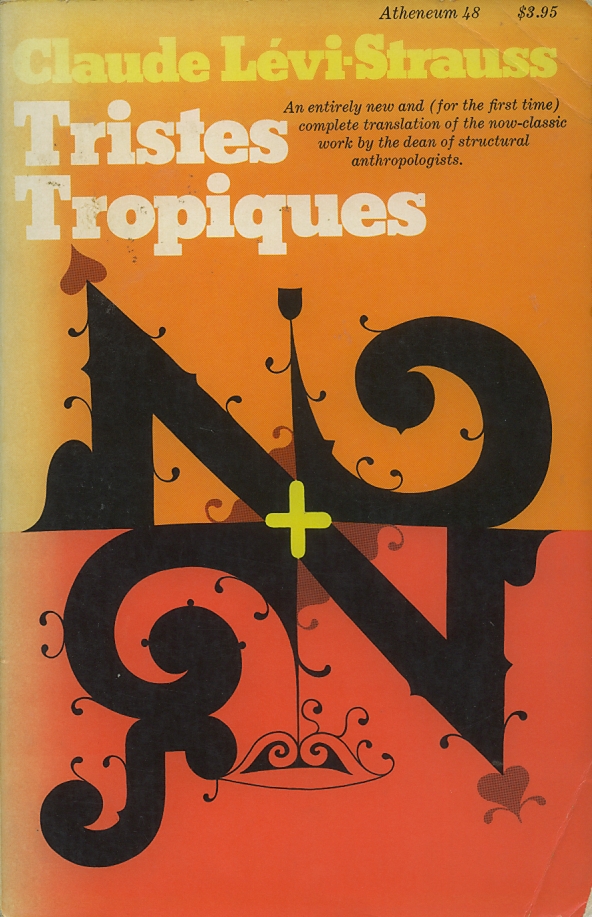
Tristes Tropiques

Part memoir, part travelogue, and part anthropological essay, this is Levi-Strauss's most personal book.

He mentions his debt to Rousseau, his attachment to Marxism, and his rejection of Existentialism. He devotes six pages to describing a sunset, summarizes a play he'd written based on one by Corneille, and describes his escape from France during WW2 (which played out in my mind like a scene from Raiders of the Lost Ark).

The writing is often erudite and abstruse, yet enlivened by arresting phrases (the "nostalgic cannibalism of history"); arresting ideas ("the primary function of written communication is to facilitate slavery"); and arresting images (the moon "an anguished lantern drifting across the sky," cultivated fields like "geographical musings by Paul Kee," and "date merchants with their produce piled up in sticky mounds of pulp and stones suggesting the excreta of some dinosaur").

The bulk of the book, and the most accessible part, describes the time spent by the author among the Bororo and the Nambikwara in South America. Here are poisoned arrows and penis sheaths (foreskin required), brazil nuts big enough to kill if they struck an unlucky head, parasitic fish able to swim up a stream of urine, and an astonishing 4-hour opera performed by a man in a trance.

The book communicates the dizzying intoxication of anthropology, especially in its narcissistic examination of primitive cultures (though it made me wonder to what extent anthropologists themselves, by their prying and poking, contribute to the wreckage of such societies).

Levis-Strauss, himself brooding on the role of anthropology, points out that it is a discipline that only Western society has produced. The anthropologist "is incomprehensible except as an attempt at redemption; he is the symbol of atonement."

Tuesday, January 13, 2009

The Erasers

Nine murders have taken place in nine days, all at exactly the same time. Special agent Wallas is sent to investigate the most recent death. He's new at the job and it's a confusing case. He spends a lot of time walking the streets and getting lost. He stops in at several shops to buy an eraser.

Soon the reader is as confused as Wallas. It's difficult to know what's real and what's imagined. Even the identity of certain characters, who are often described in terms of the coats they wear, becomes blurred. The writing is packed with banal detail, often in the form of numbers and measurements, as though this is the only way to pin down what's demonstrably real:


...on a bed of toast, spread with margarine, is arranged a broad filet of herring with silvery-blue skin; to the right, five quarters of tomato, to the left, three slices of hard-boiled egg; set on top, at specific points, three black olives.


Finally Wallas, who is on job probation, begins to doubt himself. At the post office he receives a "pneumatic message" that appears to be incriminating. It seems that he physically resembles the alleged murderer and has the same type of gun that was used in the shooting. When he returns to the scene of the crime, he ends up killing the man whose death he was sent to investigate.

Characters

Roy-Dauzet - Minister of the Interior, who, distrusting his own police force, sends Wallas to take charge of the investigation.

Commissioner Laurent - the local police chief.

Daniel Dupont - a professor who receives a superficial gunshot wound.

Albert Dupont - a wood exporter mistakenly identified in the newspaper as the original victim, later killed in an auto accident.

Dr. Juard - a gynecologist who issues a fake death certificate to protect Daniel Dupont's life.

Marchat - a wood exporter in collusion with Juard and Daniel Dupont who comes to believe that he is the next victim.

Garinati - bungles the murder of Daniel Dupont.

Jean Bonaventure - Garinati's boss, aka Bona.

Fabius - the best sleuth in Europe, adept at disguises, Wallas's immediate superior.

Madame Dupont - Daniel Dupont's estranged wife, from whom Wallas purchases an eraser.

Jean - Daniel Dupont's illegitimate son, who may or may not exist.

Anna Smite - Daniel Dupont's half-deaf housekeeper who thinks Juard killed Dupont.

Juliette Dexter, Emilie Lebermann, and Madame Jean - post office employees.

Andre WS - the addressee of the "pneumatic message," described by post employees as resembling Wallas; the message's sender is indicated by a set of initials, J.B.

Madame Bax - a watcher at a window.

Nameless drunk - keeps turning up at the Cafe des Allies, where Wallas is lodging, to ask meaningless riddles.

Nouveau Roman

The Erasers was first published in 1953 as Les Gommes. At its most superficial, it could be read as a humourless parody of a detective novel, a recursive tale that keeps doubling back on itself. At a deeper level, it's a statement about the nature of reality.

The author, Alain Robbe-Grillet, was a leading figure in the nouveau roman movement. The translation is by Richard Howard.

Friday, August 15, 2008

Nikolski

Beyond the uttering of superlatives, this is not an easy book to write about briefly. It’s a knotty postmodern tale in which a bookstore clerk in Montreal refers to his unborn self as “an imperceptible comma in an as yet unwritten novel.”

Later he acquires a “three-headed book” composed of fragments from three separate works that are as self-referential as the toy compass he wears around his neck. As he himself says, “I refrain from specifying that my compass did not point north but toward Nikolski—the story is already convoluted enough, thank you.”

Proof occurs on the last page when the reader cannot help but exclaim, “WHAT!” and immediately start flipping happily through the pages again. Happily, because the writing is playful and imaginative, full of marine imagery that is apt and entertaining: a high school career counselor named Mr. Barrier, a poissonnerie that sells sea horses in Cajun sauce, a cloud of phosphorescent plankton swirling around a street light.

In short, this is a nautical yarn set on dry land with three strange fish as protagonists. Noah, who never knew his father, was raised on the prairies by his aboriginal mother. They led a nomadic existence, living in a trailer with ancestral ghosts. Noah leaves for Montreal to study archeology, and falls under the influence of a prof who specializes in trash.

Joyce, who was abandoned by her mother, grew up in Tete-a-la-Baleine. She is a descendant of Acadian buccaneers and niece of Jonas Doucet, father of Noah and the aforementioned bookclerk. Joyce runs away to Montreal, takes up dumpster diving, and fulfills a childlhood dream of becoming a pirate.

Noah's and Joyce's stories are told in the third person and alternate throughout the book, while (in a brilliant conceit) the nameless bookclerk's story surfaces haphazardly and is told in the first person.

There are many more plot elements, most but not all neatly dovetailed together. The tantalizing loose ends simply add to the manifold pleasures of this book.

But enough already. (Though if you'd like to know more, I recommend this review.)

Nikolski was first published in Quebec in 2005 and won a slew of awards. In 2007 it was translated into English by Lazer Lederhendler. It’s a beautifully designed book, right down to the typographic fish used to indicate section breaks. The cover is gorgeous.

Another Whopper

Nikolski reminded me of another postmodern fish story that I read recently, Gould’s Book of Fish by Richard Flanagan. You can read my review here.

Wednesday, July 16, 2008

Tretiak: The Legend

I've wanted to read this book by Tretiak for a long time, and was particularly interested in getting a Soviet perspective on Canadian hockey. However, the English version of this book appeared in 1987 when the Soviet Union was still intact, so in many places the book reads like propaganda. Advice given by coaches is often trite or couched in language that reeks of ideology.

When the Soviet team fell behind in a game against the Canadiens, "the coaches suggested that our players skate faster and be more accurate with their passing."

In another game they said, "Lock up your opponents in their zone, force the goalie to make mistakes, fool the defensemen, and most importantly, show your character."

I assume the book was vetted by Soviet censors, making it impossible to know how accurately it reflects Tretiak's views. I have no doubt he is patriotic, so it is possible his words are genuine.

After retiring, he became a political worker with the Central Red Army Sports Club. And though he dismisses as "ridiculous" the suggestion that Soviet athletes were engaged in subversive indoctrination, he also says:


Athletes are, in fact, on the main line of the ideological fight of two social systems. Our athletes have to prove constantly that they are not only the strongest and most talented, but, more importantly, they must let the world know that behind them is the strength of Communist ideals, the all-triumphant truth of Soviet morality.


Hockey Thuggery

A number of Tretiak's complaints while playing in North America are similar to those made by Dryden, Esposito, and others while in Moscow during the 1972 Summit Series -- complaints about food, officiating, and accommodation. But Tretiak's harshest words are reserved for the "gladiator psychology" of NHLers.


The dirty tricks, punches, threats to the referees, and after-the-whistle hits were all tactics that the Canadians demonstrated without any trace of shame. They employ their tested weapon -- dishonest, dirty hockey. [They have] malicious, twisted faces, foaming at the mouth.


Tretiak overstates his case, but there is some truth in what he says. In The Game, Ken Dryden provides a careful analysis of the differences between the Russian and the Canadian styles. Because Russian hockey developed differently, it was able to avoid the limitations of the North American game, where (Dryden says) "violence had been allowed to make sense."

Compliments

Tretiak has many gracious things to say about us. He's particularly complimentary about Bobby Hull: "The legends about him are told for a reason. What a shot!"

Gerry Cheevers is "fearless, skillful and calm."

Bobby Clarke: "To look at him, you'd swear that Bobby was a wanted murderer, but once you got to know him, you realized what a very friendly and kind fellow he was."

Phil Esposito: "...his superb ability to control the puck, his powerful game in front of the net, and his astounding intuition were, as always, distinct Esposito trademarks."

He refers to the Montreal Forum as "a great hockey citadel" and suggests that Russians "could learn from the Canadiens everything that concerns respect for fans and players."

Trivia

Tretiak, like all the Russians, did an incredible amount of dryland training. This included having someone hit tennis balls at him with a racket. During games he watched the eyes of incoming players so intently that he was accused of hypnotizing them.

Before the first game of the Summit Series, Jacques Plante made a surprise visit to give him tips on how to play the Canadian forwards.

He was fascinated by Gerry Cheevers, who smoked a cigar before games, and had a clause in his contract permitting him to drink beer between periods.

He addresses Ken Dryden directly, responding to comments made in Dryden's first book, Face-Off at the Summit. "You're right, Ken. We all had the same feelings..."

The Stanley Cup: "a huge, paunchy, glittering trophy that looks like a Russian samovar."

Retirement

"Vladik" retired in 1984, stating that he never wanted to play in the NHL. "It wouldn't suit me, as an officer and Soviet citizen..." This may or may not be the truth.

The Wikipedia entry on him indicates he may have retired because he was not allowed to go to the NHL, and also because he no longer wanted to play for Tikhonov. It was Tikhonov who pulled Tretiak during an Olympic match against the Americans in Lake Placid (the "Miracle on Ice"), after Tretiak had let in a weak goal at the end of the first period.

In 1987 there was a reunion of the Summit Series players. Tretiak writes:


Now there was no trace of the old antagonism. We had become wise and kind. We looked at one another's aging faces and couldn't hold back the laughter, thinking about what bullies we had been in 1972.


Tretiak is one of the most admired and respected hockey players in the world. He was elected to the Hockey Hall of Fame in 1989.

The following year he became the goaltending coach for the Chicago Blackhawks. Among those he tutored are Ed Belfour, Martin Brodeur, and Dominic Hasek. Any goalie wearing number 20 does so as a tribute to Tretiak.

In 2006 he was awarded the Meritorious Service Medal by the Governor General.

He runs the Vladislav Tretiak Elite School of Goaltending in Toronto.

The translation is by Sam and Maria Budman.

Monday, April 28, 2008

The Golden Ass

This is a rambling collection of shaggy tales whose unifying thread is Lucius, a young man with a misplaced interest in magic. He seduces a maid named Photis and convinces her to steal a shape-changing ointment used by her mistress to transform herself into a bird.

When Photis brings the wrong stuff he makes an ass of himself, literally, and falls in with bandits, catamite priests, and various other captors. Twice he defends himself by defecating on his tormentors, and narrowly escapes castration, butchering, and a starring role in a sex show.

Occupying a central portion in the book is the tale of Cupid and Psyche. The latter has never seen her husband, who visits her only under cover of darkness. Convinced by her jealous sisters that he is a serpent who must be killed, she lights a lamp while he is asleep and discovers that he is a deity, a beautiful winged man. Cupid flees, and his mother, Venus, exacts retribution. Eventually Jupiter puts an end to the quarrel, and Cupid and Psyche are reunited.

Other tales of greed, cruelty, murder, cuckoldry, and divine meddling are recounted. In an ursine equivalent of the Trojan horse, a bandit named Thrasyleon allows himself to be sewn up in a bear hide to gain admittance to a rich man’s home. Thelyphron’s nose and ears are cut off by witches and replaced with wax replicas.

Miscellaneous Notes

Lucius is rescued by the divine intervention of the Egyptian goddess Isis, who at the time was not a mythological figure in the same sense that Cupid and Psyche are, but actively worshipped throughout the Greco-Roman world.

Romans often diluted their wine with hot water.

Sex is described in mock-heroic terms, either as a wrestling match or form of combat:


"Engage," she said, "and do so bravely. I shall not yield before you, nor turn my back on you. Direct your aim frontally, if you are a man, and at close quarters. Let your onslaught be fierce; kill before you die. Our battle this day allows no respite."


Despite such raunchiness (remarkably vital after 2000 years), I found the book rather shapeless and hard going in places. The combination of magic, gods, and alien culture makes it difficult to understand the author's intentions, and the literary nuances are lost on anyone without a sound knowledge of the classics.

Background

The Golden Ass (aka Metamorphoses, not to be confused with the Metamorphoses of Ovid) is the only Latin novel from the classical period to survive in its entirety. “Its later influence on the vernacular literatures of Europe has been immense,” writes P. G. Walsh, translator of the Oxford University Press edition. Boccaccio imported several of the tales into the Decameron, Bottom is transformed into an ass in A Midsummer Night’s Dream, and a scene in which a drunken Lucius carves up three wineskins, mistaking them for ruffians, is replicated in Don Quixote.

The book’s author, Apuleius, was born in present-day Algeria during the 2nd century AD, educated in Carthage and Athens, and resided for a time in Rome. Though he lectured in Greek and Latin, Punic was most likely his native tongue. A Platonist and devotee of Isis, he was once indicted on a charge of magic (employing love-philtres to induce a rich woman into marriage).

The first English translation was by William Adlington in 1566 and is available here, at the Gutenberg Project. Many other translations are available, some fairly literal, others taking liberties to communicate the style and flow of the original.

An informative discussion of the book can be found here.