Showing posts with label War. Show all posts

Friday, February 17, 2023

John Boyd and the Art of War


If you've seen Top Gun, you probably have a stereotyped image of brash and cocky fighter pilots. Boyd was just such a person, a true maverick. He wasn't just loud, he ate fast, talked fast, and poked others in the chest (including senior officers) to make a point. 

"He appeared a wild man. His reputation was like the shock wave in front of an aircraft; it rode ahead of him and disturbed everyone it washed over. It left people rolling in its wake, confused and often angry." 

He flew with the same abandon, pushing a plane to its limits, wanting to know what it could and could not do. The one time he had to eject led to the discovery of an undocumented design flaw in the aircraft. If someone boasted of a perfect safety record among the pilots he was training, Boyd said he was failing them.

Though Boyd was crude at times, he was also one of the best fighter pilots in the world, and after the Korean War became an instructor at Fighter Weapons School at Nellis AFB, the equivalent of the Navy's Top Gun. While there he discovered a "quick and violent maneuver" that solved the adverse yaw problem with the F-100 Super Sabre, "one of the most quirky and treacherous fighter planes in the history of the Air Force." He made a standing offer to all comers that he could reverse positions with a plane on his tail in 40 seconds. He was never defeated and became known as Forty-Second Boyd.

The F-100 Super Sabre


He was also a thinking fighter pilot at a time when dogfighting was "almost a lost art in the Air Force." After Korea, the Air Force's main focus was strategic bombing, much to the disgust of fighter pilots, who thought flying a B-52 was much like driving a bus. Boyd became obsessed with quantifying the performance of a jet fighter, and developed his Aerial Attack Study, a 150-page manual that explained how, if a pilot knew the position and velocity of his opponent, he would then know what maneuvers the enemy could perform and what counter-maneuvers were available. 

"Within ten years the Aerial Attack Study became the tactics manual for air forces around the world. It changed the way they flew and the way they fought. Forty years after it was written, even with the passage of the Vietnam War and the Gulf War, nothing substantial has been added to it."

The Air Force sent Boyd to university where he learned about thermodynamics and the difference between available and unavailable energy -- in other words, entropy. This enabled him to further refine his thinking and resulted in his Energy-Maneuverability Theory, which was based on thrust and drag ratios. His work showed that in many respects Soviet aircraft were superior to US aircraft. He continued to elaborate the theory after graduating, but had to do so in evenings and on weekends. He also had to "steal" computer time at the base where he was stationed, and in this he was helped by an influential friend, Tom Christie, who "flew top cover" for him. Christie was the first of several gifted loyal supporters of Boyd.

The Pentagon

Ordered there in 1966, he tried to apply his E-M theory in the development of a new fighter. The generals he briefed were rattled by what they heard, e.g. that the two primary aircraft being used in Vietnam, the F-105 Thuds and F-4 Phantoms, were inadequate, and that the F-111, which was under development at the time, had many faults. It turned out to be "one of the most scandal-ridden aircraft in US history."

The F-111 Aardvark, a swing-wing fighter


Politics at the Pentagon were "byzantine and deadly." The rivalry between Air Force and Navy was intense, particularly in the area of funding, and the place was staffed with officers fearful of damaging their careers if they disagreed with superiors. Boyd faced opposition at every step, and his bullheadedness and extravagant behaviour made him many enemies. He was so intemperate in his speech and actions that to many he seemed out of control. His "manner went beyond the coarseness, the close-in spittle-flying conversations, the arm waving and loud voice, the long hair and disheveled appearance, and the nocturnal work habits." He once burned a hole in the necktie of a general with his cigar. "His behaviour bordered on insubordination."

One of his achievements was ramming through a decision to use a fixed-wing instead of a swing-wing design. "History has proven Boyd correct. The variable-sweep wing was one of the major engineering blunders of the century. Hollywood and the movie Top Gun notwithstanding, the F-14 Tomcat is a lumbering, poor-performing aerial truck." Although Boyd is acknowledged as the father of one of the finest aircraft of its type at the time, the F-15 Eagle, he remained unhappy with its weight and expense. He and a few close friends began working in secret on a new lightweight fighter, which eventually became the F-16 Falcon, another highly regarded aircraft.

The F-14 Tomcat, another swing-wing fighter


The F-15 Eagle


The F-16 Falcon, a lightweight fighter


Patterns of Conflict

He began to study war itself, and over a span of years produced Patterns of Conflict, which was an updating of Sun Tzu and a repudiation of von Clausewitz. He praised commanders who fought at a high operational tempo and practised the rapid exploitation of opportunity." The goal was to create chaos by using ambiguity, deception, and multiple thrusts. "To attack the mind of the opponent, to unravel the commander before a battle even begins, is the essence of fighting smart." He referred to this as "maneuver warfare." At the heart of Patterns is something called the Observe-Orient-Decide-Act cycle, or the OODA Loop, which since then has been applied not just to war but any form of conflict, such as business and sports.

Meanwhile, following the war in Vietnam, the American military hit a low point and began taking hits from the press. In 1979 an article entitled "The Muscle-Bound Superpower" appeared in The Atlantic. Much of it revolved around Boyd and his Patterns of Conflict, which questioned the value of the high technology solutions so favoured by the military. This thinking was backed up by the failure in 1980 to rescue hostages in Teheran. Jim Fallows, the author of the Atlantic article, later wrote a book, National Defense, a damning indictment of the Pentagon and the defense industry, and it portrayed Boyd and his friends as Reformers who might have the solution to all that was wrong.

In 1983 Time magazine ran a piece on the military with one of Boyd's associates, Chuck Spinney, on the cover. Spinney had authored a report called "Defense Facts of Life," "one of the most important documents ever to come out of the Pentagon." It claimed that "the unnecessary complexity of major weapon systems was wrecking the military budget." Pentagon officials were in shock and the Air Force declared war on Spinney. Generals ridiculed him, and one became so over-wrought during a briefing by Spinney that he collapsed.

The Army

Another of Boyd's associates, James Burton, was put in charge of testing weapons at a time when the Bradley Fighting Vehicle was in early production, and testing was largely done by computer modelling. When Burton ordered field testing, the results were faked. "Time after time the army lied about the realism of its testing. Billions of dollars hung in the balance. Boyd told Burton, "Jim, you can't have a normal career and still do the good work. You have to decide."

The Army responded by trying to transfer Burton to Alaska and changing his position description. When reporters got wind of what was happening and a Congressional hearing announced, Burton was told that everything he planned to say was classified. By then Burton was worn out and retired. Later he wrote a book about it called The Pentagon Wars, which was subsequently turned into a film of the same name. (As of the date of this review, the film is streaming on Crave.)

The Bradley Fighting Vehicle


The Marines

Boyd's name became anathema at the Pentagon, and the Air Force did its best to bury him. He was spied upon, given poor performance appraisals, and passed over for promotion. Only the Marines embraced him wholeheartedly.

"No two branches of the American military are farther apart than the Air Force and Marines... The Air Force is a technocracy while the Marines are a warrior culture... Marines are utterly contemptuous of the Air Force." Boyd became a regular lecturer at the Marine Corps and took an active part in tactics classes, emphasizing fluid and fast-moving tactics that disrupted enemy thinking. Marines were instructed to bypass resistance, and to use multiple thrusts and ambiguity to confuse the enemy. The Marine Corps became the most intellectual branch of the US military.

When Boyd died, the Air Force "all but ignored his passing," while at his funeral the Marines were conspicuous by their presence. "Placing the symbol of the US Marine Corps on a grave is the highest honour a Marine can bestow. It is rarely seen, even at the funeral of a decorated combat Marine."

Further Reading

  • Hammond, Grant. 2012. The Mind of War: John Boyd and American Security
  • Richard, Chester. 2004. Certain To Win: The Strategy of John Boyd Applied to Business
  • Robinson, Stephen. 2021. The Blind Strategist: John Boyd and the American Art of War
The most recent book on the list finds flaws in Boyd's thinking.

Monday, March 8, 2021

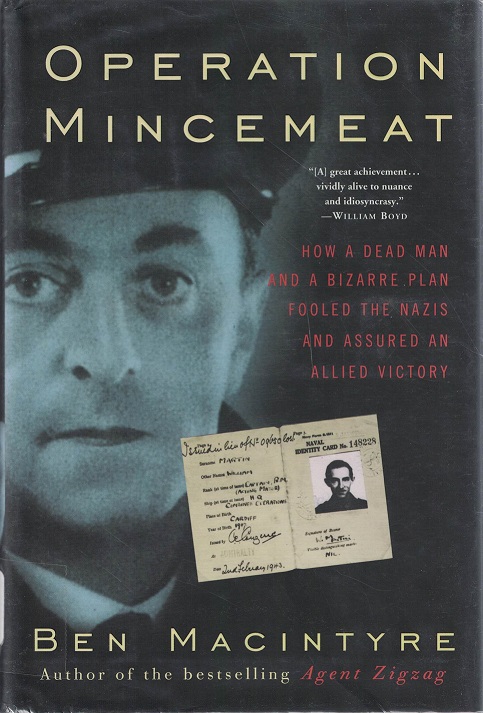
Operation Mincemeat

Operation Mincemeat: How a Dead Man and a Bizarre Plan Fooled the Nazis and Assured an Allied Victory

Operation Mincemeat was a part of a plan to convince Hitler that the Allies, following the success of their North Africa campaign, intended to mount a double-pronged invasion of Europe at Sardinia and Greece, and not Sicily, the most logical target.

Mincemeat was implemented by British Naval Intelligence.  The cadaver of a derelict was fitted out with a uniform, identity papers, and a sealed envelope containing information about the bogus invasion. The body was placed in a sealed cannister filled with dry ice, and carried by submarine to Spain and deposited close enough to shore where it could be found, with the hope that the envelope would make its way into Nazi hands.

A Novel Approach

The plan took an immense amount of planning and had many possible points of failure.  For example, it was not enough to plant fake ID papers on the cadaver.  An entire personality had to be created.  It was as if they were "constructing a character in a novel."

The author points out that "the greatest writers of spy fiction have, almost in every case, worked in intelligence before turning to writing."  He mentions Somerset Maugham, John Buchan, Graham Greene, John le Carre, and of course Ian Fleming, who happened to be the personal assistant of Admiral John Godfrey, head of Naval Intelligence and a man with a "sandpaper personality."  He served as the model for M in his James Bond novels.

Twin Frailties 

Admiral Godrey described wishfulness and yesmanship as the "twin frailties of German intelligence" 

"The Nazi high command ... when presented with contradictory intelligence reports, was 'inclined to believe the one that fits in best with their own previously formed conceptions.'"  Hitler's "favourite intelligence analyst," Alexis von Roenne, told Hitler what he wanted to hear, that the information was genuine.

Yet the whole story does not end there.  Unknown to anyone, von Roenne had turned against the Nazi regime.  In 1944  he deliberately misled Hitler about Allied plans for the invasion of Normandy.  He was executed after the failed plot to assassination Hitler.  Although he played no part in it he was a close friend of several conspirators 

Illustrations

There are 14 pages of b&w photos. The person on the cover is Ewen Montagu, one of the masterminds of Mincemeat.  His brother, Ivor, was a communist spy.

The following map shows the route taken by the bogus information:


.

Friday, March 31, 2017

The Men Who Lost America

British Leadership, the American Revolution, and the Fate of the Empire

This book is so readable, the subject so fascinating, that not a single page escaped my highlighting pen.

The basic thesis is that the British did not lose the American Revolutionary War through ineptitude.

 "The perception of the British leadership as incompetent has disguised the extent to which the outcome of the war was in doubt until the very end. It diminishes the achievements of American generals like George Washington and Nathanael Greene, who won against enormous odds and able opponents..."  

Yet the author also maintains that from the start the war unwinnable for the British. First of all they were misled by the belief that there was a significant amount of Loyalist support in America.

Secondly (and perhaps most surprisingly) they did not have naval superiority. This was due to a period of peace in Europe, during which Britain's traditional enemies, France and Spain, were not distracted by conflicts at home. Britain meanwhile had to protect its interests abroad, of which its American colonies were only one, and at the same time be ready to fend off a threatened invasion from France. "Britain was more isolated than at any other time in its history, even more than in 1940."
         
Each of the nine chapters focuses on a major British figure in the war. What follows are a few factoids skimmed from the book.

1. George III

He reigned in tumultuous times -- not just the American Revolution but also the French Revolution, the Gordon Riots, the Spithead and Nore mutinies, and a portion of the Napoleonic Wars. Though "the driving force" behind the war in America, he was not the tyrant portrayed by colonial America, having "less power than virtually any other monarch in Europe." He was frugal, devout, accomplished, hard-working, devoted to his wife, mixed easily with his subjects, and calmly survived survived several assassination attempts. Thirty thousand people attended his funeral. Yet today he is best remembered for losing America and for going mad.

2. Lord North

North was prime minister at a time when this office was not official. In an age of great orators (Burke, Fox, Sheridan, the younger Pitt), he was one of the most skilful, able to speak for hours at a time without notes. He was particularly esteemed for his wit, and even enjoyed the barbs of his opponents. However, the job was so demanding that he pleaded with the king numerous times to resign. Eventually he went blind and had to be led to his seat by his son for his final appearance in the House of Commons.

 "It was a testimony to North's abilities that Britain remained solvent while France was bankrupted by its participation in the American War of Independence." 

3. Admiral Howe & General Howe

The Howe brothers were "famously taciturn" and known for their "almost reckless courage." Together they orchestrated the capture of Philadelphia, which put to flight the Continental Congress. It was a short-lived victory, for General Howe was ordered to abandon the city and criticized for proceeding with the attack instead of supporting General Burgoyne's southward thrust from Canada. Both Howes resigned and "became an embarrassment to the government."

4. General Burgoyne

Vain and exceedingly ambitious, he was "a popular subject of parody in contemporary satires and lampoons." Despite initial successes, the army he led south from Canada finally met with defeat at Saratoga. He blamed others for the loss, and "together with the Howe brothers he aimed to obtain a court martial or parliamentary inquiry to clear his name." He wrote several successful plays but died "virtually insolvent."

5. Lord George Germain

The minister responsible for the war had previously been declared "unfit to serve his Majesty in any military capacity whatever" by a court martial following his role in the Battle of Minden in Europe. It was a humiliation that dogged him for the rest of his life.

6. Sir Henry Clinton

He replaced General Howe as commander-in-chief of the British army, but had at his disposal "fewer troops than his predecessor and a third of the naval support," which made him pessimistic of success. Although reduced to a mainly defensive stance, he won a spectacular victory at Charleston. Fearing he would be scape-goated for losing America, he repeatedly asked to resign, but ironically failed to do so when given the opportunity.

7. Lord Cornwallis

Unlike Clinton, to whom he was second-in-command, Cornwallis had the approval of the king due to his aristocratic upbringing and his boldness on the field of battle. His forces captured Daniel Boone and occupied Monticello, which later resulted in Governor Thomas Jefferson being accused of cowardice. Despite having "won every major battle that he had commanded in the south," he was trapped at Yorktown, where French and American guns pounded his army into submission while the French fleet blocked its escape. Although he lost the final battle of the war, he returned to England a hero.

8. Sir George Rodney

Before the war, he had fled England to escape imprisonment for debt. He was "notorious for being unscrupulous in financial matters" and when charged with the defence of British colonies in the Caribbean, he captured and plundered the Dutch trading centre of St. Eustatius. Preoccupied with his loot, he failed to send timely intelligence to Clinton about the arrival of the French fleet, and then sailed for England to answer criticism of his actions. However, due to a later victory, he emerged as "one of the few British heroes of the Revolutionary War."

9. The Earl of Sandwich

This chapter gives a fascinating look at the state of British naval affairs. John Montagu, the Earl of Sandwich, was the first lord of the Admiralty, and despite leading a "lurid personal life" he worked tirelessly to build up and refurbish the overstretched British navy. Nevertheless he was so unpopular that "during the Gordon Riots in London in the summer of 1780, he was dragged out of his carriage and had his face cut before being saved by the Horse Guards."

George Washington

Though no chapter is devoted to American leaders, there are many peripheral comments about them. Two regarding George Washington I found particularly interesting.  One, that he was a tall man at six foot four. The other, that he was "the only person to receive universal acclaim from the British press."

Nicknames

Epithets applied to public figures provide an interesting insight into the times. Some are affectionate, others not.

The British:
George III - Farmer George
Admiral Howe - Black Dick
General Burgoyne - General Elbow Room
Earl of Sandwich - Jemmy Twitcher
Vice Admiral Byron (grandfather of the poet) – Foul Weather Jack
Major Patrick Ferguson - One-Armed Devil
General Charles Grey - No Flint Grey

The Americans:
General Anthony Wayne - Mad Anthony
General Daniel Morgan - Old Wagoner
General Thomas Sumter - the Carolina Gamecock
General Henry Lee (father of Robert E.) - Light Horse Harry 
Francis Marion - the Swamp Fox
Andrew Jackson - Old Hickory*

* The nickname was acquired during the War of 1812. He was a boy during the Revolutionary war when he was scarred for life by the saber of a British officer after refusing to clean the officer's boots.

Thursday, December 29, 2016

Mimi and Toutou Go Forth

A slightly daft fellow named Spicer-Simson was stuck at a desk job in 1915 when a slightly daft assignment fell into his lap: he was to lead an overland expedition from South Africa to the Belgian Congo, transporting a pair of armed motorboats to neutralize the German naval presence on Lake Tanganyika.

He christened the motorboats Mimi and Toutou (after his original names had been rejected, Miaou and Bow-wow). They were transported from Captetown to Elizabethville by train, but after that had to be dragged by steam-tractors and ox-teams over a difficult terrain.

Spicer-Simson had been court-martialled twice and had a "reputation for disaster." Vain and full of preposterous boasts, he smoked monogrammed cigarettes, claimed to speak Chinese, used a form of semaphore unknown to anyone else, and took to wearing a khaki skirt (not a kilt) to better show off his heavily tattooed body.

Africans called him Lord Bellycloth and some regarded him as a god, worshipping clay statues of him. His men had a different view, and by the end of the expedition he was communicating with them only in writing.

After the war he was awarded a DSO but never another command. Years later he settled in Canada and died in Courtney BC in 1947.

The Bizarre Battle of Lake Tanganyika

Despite Spicer-Simson's eccentricities, Mimi and Toutou captured the first German vessel they encountered and renamed it Fifi. They also took prisoners, including an African stoker who switched sides and remained on the job when the Mimi and Fifi attacked and sank a larger German vessel.

With a British land force advancing toward Bismarckburg (now Kasanga), Spicer-Simson was ordered to prevent the Germans from fleeing by water. Intimidated, however, by the fort's wooden cannons, he took no part in the operation. For this, he received a dressing down from the commander of the British column and fell into a lethargy, taking to his bed for months.

Literary Echoes

There are passing references to Livingston and Stanley, both of whom travelled through the area around Lake Tanganyika searching for the source of the Nile, and to Joseph Conrad who made his Congo River journey in 1890 (which provided him with the material for Heart of Darkness) approximately 25 years before Spicer-Simson's expedition. There are several quotes from Remote People by Evelyn Waugh, who visited the area in 1930.

The penultiimate chapter in Mimi and Toutou Go Forth is devoted to The African Queen. Spicer-Simson's expedition was the inspiration for C.S. Forester's book. Scenes for the movie version were filmed in the Congo, with Katherine Hepburn recording her memories of the shoot in The Making of the African Queen, or How I Went to Africa with Bogart, Bacall and Houston, and Almost Lost My Mind. 

Peter Viertel, a screenwriter who worked with director John Huston on the film in Africa, portrayed Huston in a novel, White Hunter, Black Heart, which itself was subsequently filmed.

The Author

The final chapter of Mimi and Toutou ends with an account by the author, Giles Foden, of his own visit to the area and a trip on the MV Liemba on Lake Tanganyika. The vessel was originally the Graf von Gotzen, the Germans' largest asset on the lake and which they scuttled. Refloated by the British after the war, it now serves as a passenger ferry.

Foden received the Somerset Maughan award for his first book, The Last King of Scotland. Mimi and Toutou Go Forth was published in 2004 and has helpful maps and delightful illustrations for chapter headings drawn by his wife, Matilda Hunt.

At the back are silhouettes of the vessels involved and a useful bibliography. The endpapers of the hardcover edition show a fuzzy photographic image of Spicer-Simson in semaphore mode -- a nice touch for an entertaining and well-researched book.

Tuesday, December 30, 2014

The Avro Arrow

The Story of the Great Canadian Cold War Combat Jet -- In Pictures and Documents

Published earlier this year, this book is proof that the Avro Arrow didn't die when the plane was scrapped in 1959.

It still exists in the numerous video clips that can be found on the Internet, in the feature-length film with Dan Ackroyd, and in the many publications that it continues to inspire, one of which -- Storms of Controversy -- is now in its 4th edition. The Arrow even has its own Heritage Minute.
 
But if you're new to the subject, this slim volume by Lawrence Miller is a great place to start. It's along the lines of a photo album and can easily be read in a single sitting. Even those familiar with the story will find in the photos a compelling visual statement.

The Arrow was produced by Avro Canada, which in the 1950s was a world leader in aircraft design. The plane was a revolutionary supersonic interceptor, its purpose to counter long-range bombers from the USSR that might penetrate Canadian airspace on their way to the US.

But the Arrow had the bad luck to be rolled out on the very same day that Sputnik was launched. Suddenly the Space Age had begun and warplanes seemed on the verge of obsolescence. Production of the Arrow was cut by the government after only six had been produced. Avro at the time was Canada's third largest employer, and released 14,000 people. Including subcontractors, 40,000 to 50,000 workers suddenly found themselves jobless.

Miller's book brackets the main story with interesting details about some of Avro's other projects, including the Jetliner that came out prior to the Arrow, and the “flying saucer” that it worked on afterwards. The former was a jet-equipped airliner much admired by Howard Hughes and the American press, but it too was stepped on by the Canadian government.

The Legend Grows

The government not only scrapped the Arrow, it ordered every vestige of the project be eradicated. Even the airworthy Arrows were cut up and destroyed. Later (with a smacking of foreheads) the government realized it needed interceptors after all, and had to make do with a number of used Voodoos, an airplane that it had rejected years previously.

Just how good was the Arrow? Well, more than 50 years later, Major-General Lewis Mackenzie claimed in the National Post that “the Arrow’s basic design and platform still exceed any current fighter jet” and was a cheaper alternative than the problematic F-35 with its ever-spiralling price tag.

Miller's book doesn't dredge up any of the tantalizing conspiracy theories surrounding the Arrow, or the persistent rumour that one of them escaped the cutting torch.

The Arrow remains a thorn embedded in our national psyche. Its sheer physical beauty, cutting-edge technology, and savage dismemberment have turned it into an aeronautical unicorn.

Monday, December 5, 2011

The Ghosts of Cannae

Hannibal and the Darkest Hour of the Roman Republic

Before this book I had a schoolboy’s knowledge of Hannibal: a Carthaginian who crossed the Alps with elephants. Now that vacuum in my brain has been admirably filled.

Hannibal was a military genius who never lost a major battle during his invasion of Italy. His most famous victory was at Cannae, where he annihilated a Roman army that outnumbered his by almost two-to-one. One of the chief difference-makers was his cavalry, which he used to flank the Roman thrust. By the end of the day around 50,000 Romans were dead, including a significant number of their leaders, while Hannibal’s force remained "basically intact."

But despite his battlefield brilliance, Hannibal lost the war against Rome. Eventually he returned to North Africa to defend Carthage, and finally was defeated at the Battle of Zama by another military genius, Scipio Africanus. This brought an end to the Second Punic War, "one of the most important wars in recorded history."

Hannibal was forced into exile, but continued to run afoul of the Romans. When he was about to fall into their hands he is reported to have said, "Let us now put an end to the great anxiety of the Romans, who have thought it too long and hard a task to wait for the death of a hated old man." And then took poison.

The Legacy of Cannae

The Romans soldiers who survived Cannae were scapegoated for the defeat. Their pay was withheld and they were banished to Sicily. The author refers to them as "the ghosts of Cannae." They remained in Sicily until rehabilitated by Scipio Africanus, who incorporated them into the invasion force that finally defeated Hannibal at Zama.

Poetic justice, you say? But there’s more:


...these ghosts of Cannae would live to haunt the republic. For one day, legionaries would look to their generals and not Rome for a future, and that perspective would spell civil war and absolute rule. This more than anything else was the battle’s legacy.


The ambitious Scipio "set a pattern that led eventually to Caesar and the collapse of the republic." Thus:


In the very act of fighting Hannibal, Rome put itself on the road to civil war by coming to rely on charismatic generals for survival. If this is the case, then Hannibal had the last laugh.


Cannae remains one of the most studied battles in history. Two thousand years later men like Guderian, Rommel, Eisenhower, and Schwarzkopf were trying to emulate Hannibal’s tactics.

More

A brief sampling of other interesting bits from this engagingly-written book:

After Carthage was defeated in the First Punic War, Hannibal's father, Hamilcar, made his nine-year-old son swear "an oath of eternal enmity toward the Romans."

It took Hannibal two weeks to cross the Alps, a passage that cost him three-quarters of his force and most of his elephants. His "Panzer pachyderms," however, were "a questionable military asset," as likely to trample friend as foe.

When the leader of the first Roman army to engage Hannibal in Italy was wounded, his son "led a band of horsemen back into the fight to surround and protect his fallen father." That 17-year-old was Scipio Africanus.

For a hard-headed pragmatic bunch, Romans were surprisingly superstitious, being "obsessed with the proper taking of auspices and obedience to various portents." When Hannibal invaded Italy, they consulted the Sybelline books and the oracle at Delphi to find out how to propitiate the gods.

Not only were Romans a militaristic people, but their view of honour was bound up with "individual martial courage" expressed through face-to-face combat. The author reminds us that in The Iliad, Paris was reviled for using a bow.

"If Romans harbored a national nightmare, it was the Gauls." After sacking Rome in 390 BC, they "had come to symbolize irrationality, violence, and disorder." They were taller than Romans and fought bare-chested, berserker-style.

CBC interview with the author

Thursday, July 8, 2010

Battle Cry of Freedom

The Civil War Era

This 900-page treatment of the Civil War was published in 1988. It won the Pulitzer Prize, and may be the finest one-volume history of the war.

It's not just an account of the terrible battles that took place. It also provides political, economic, and social commentary. The first shots are not fired until page 273.

Having read the book, it now seems to me impossible to understand the United States without having a sound knowledge of the Civil War. As the author points out, more books have been written about it than on any other topic of American history.

There are useful quotes from speeches, newspapers, diaries, and letters from soldiers. Scarcely a page escapes a footnote, yet the writing is clear and easy to follow.

There are two sections of black-and-white photos, and numerous battlefield maps.

Lincoln

The Civil War (1861-65) exactly defined Lincoln's presidency. His election in 1860 triggered the secession of seven Southern states before he even took office. The month after he was inaugurated in 1861, the first shots were fired at Fort Sumter, and four more states joined the Confederacy. Four years later, within days of Lee's surrender to Grant, he was assassinated by a Rebel sympathizer who took umbrage at a speech promoting black suffrage.

Lincoln was the first Republican president. The party had only been in existence for a few years. It opposed the pro-Southern Democrats, and one of its avowed goals was to prevent the sanctioning of slavery in newly formed states. Since it was composed completely of Northerners (making it the first "sectional" party in power), the South realized it had lost the ability to influence the federal government, and thus elected to secede.

Lincoln took an active role in the war -- haunting the telegraph office for reports from the battlefield, suggesting strategy to his generals and urging them to take the offensive, visiting fortifications when Rebels invaded the North (where he was told to keep his damn fool head down). When the Confederate capital of Richmond was captured, Lincoln was sitting in Jefferson Davis's study within 40 hours of the Confederate President's departure.

During the war Lincoln and the Republicans enjoyed public support as long as the war was going well. At other times there was widespread alarm, panic and even riots. Confederate forces at one point were five miles from the White House. Lincoln feared that he would not win re-election in 1864.

Generals

In combat, officers "led from the front, not the rear" and "generals suffered the highest combat casualties, their chances of being killed in battle were 50 percent greater than the privates'." In one battle, when Robert E. Lee tried to lead "a desperate counterattack," his troops pleaded with him to return to the rear.

Two of the Confederacy's most effective generals, Stonewall Jackson and James Longstreet, were mistakenly felled by Rebel fire. Jackson died, and Longstreet was out of combat for five months.

During the war several Union generals were removed from command for their timidity in engaging the enemy.

John C. Breckinridge, Vice President under James Buchanan (the President who preceded Lincoln), became a general in the Southern army.

After the war Union General Lew Wallace wrote Ben-Hur, the best-selling American novel of the 19th century.

Tactics

"The close-order formation was...necessary to concentrate the firepower of these inaccurate weapons [muzzle-loaders]" and "bayonet charges could succeed because double-timing infantry could cover the last eighty yards [the effective range of muzzle-loaders] during the twenty-five seconds it took defending infantry men to reload their muskets after firing a volley."

"The transition from smoothbore to rifle had two main effects: it multiplied casualties; and it strengthened the tactical defensive. Officers trained and experienced in the old tactics were slow to recognize these changes. Time and again generals on both sides ordered close-order assaults in the traditional formation. With an effective range of three or four hundred yards, defenders firing rifles decimated these attacks."

"The tactical predominance of the defense helps explain why the Civil War was so long and bloody. The rifle and trench ruled Civil War battlefields as thoroughly as the machine-gun and trench ruled those of World War I." Photos of battlefields in both wars are eerily similar.

"...the large caliber and low muzzle velocity of Civil War rifles caused horrible wounds with the bullet usually remaining in the body rather than going through it... Stomach wounds were generally fatal because there was no known prevention of peritonitis."

Miscellaneous

Over 600,000 soldiers died, more than the combined total of all other wars that America has fought in, before and since.

Both sides claimed to be fighting for freedom and liberty. The industrial North wanted to keep the Union intact and end slavery. The rural gentrified South fought for autonomy and against the "wage-slavery" of Northern workers. "We are either slaves in the Union or freemen out of it," declared a secessionist without irony.

The ironclad CSA Viriginia, aka Merrimack, sank two unarmored Northern warships in the space of a few hours, "a feat no other enemy would accomplish until 1941." The next day it met the Union ironclad, Monitor, and fought to a draw. The battle caused the London Times to declare that nearly all of the British fleet was now obsolete.

The James and Younger brothers began their careers as Southern guerillas in Missouri. Wild Bill Hickok was a scout for the Union army in Missouri. Another famous name on the Union side was George Armstrong Custer, who took part in the "bloodiest cavalry action of the war" north of Richmond.

During the war, the North enacted for the first time conscription on a national level. However, draftees still had the option of hiring substitutes to take their place, a practice "hallowed by tradition."

"Several hundred women...dressed as men and managed to enlist as soldiers...."

Lincoln and Jefferson Davis were both born in Kentucky.

Nova Scotia

My interest in the Civil War was triggered last month by a grave marker ceremony organized by the Maritime Civil War Living History Association. A re-enactment unit, the 20th Maine Volunteers, No. 1 Company (New Brunswick), paid tribute to three local veterans:

Ardent Tupper - served in the 20th Maine Infantry, present at Lee's surrender at Appomattox

William Kinsman - served in the 1st Massachusetts Light Artillery, took part in 17 battles

Ben Jackson - served in the Union navy, awarded the Civil War Campaign Medal