Showing posts with label Science. Show all posts

Tuesday, June 9, 2015

Einstein Wrote Back

My Life in Physics

Enter the bare-knuckle world of battling theoretical physicists, whose cartoonlike antics emulate “the antisocial behaviour of the electron.”

Author John Moffat is a self-taught theoretical physicist who was admitted to a doctoral program at Cambridge without having previously attended university.

In the course of his unorthodox career he met some of the biggest names in 20th century physics, including Bohr, Dirac, Pauli, Salam, Schrodinger, Heisenberg, Higgs, Gell-Mann – Nobel winners all – as well as Hoyle, Penrose, Oppenheimer, and others.

The first thing he learned from these giants was that rude, boorish, and abrasive behaviour was acceptable. Schrodinger called Einstein an old fool and Bohr accused him of being an alchemist. Hoyle despised the Big Bang theory, Pauli openly jeered at other physicists, Gell-Mann planted his big feet on Moffat’s knees under a restaurant table, Oppenheimer tried to poison his supervisor at Cambridge, and Dirac was scolded by his wife: “Paul, you are so stupid! You can’t even put on your own trousers.”

But it's not just a gossipy narrative. Moffat pays tribute to the many physicists who helped further his unusual career, and explains in simple terms how his life’s work bucked the “herd instinct in physics” by developing theories that did not invoke dark matter, dark energy, or the Higgs particle.*

Perhaps most shocking of all is his “heretical suggestion” that the speed of light is not constant.

Remarkable Childhood

The opening chapters are among the best in the book. He grew up in Great Britain during the war and narrowly escaped death during the blitz. A peripatetic upbringing resulted in his attending 13 schools with instruction in two different languages – English and Danish. When tested for his suitability to attend university, he failed miserably.

After highschool he worked at a number of deadend jobs until he developed an interest in abstract painting and spent a year in Paris being tutored by Serge Poliakoff. On returning home in Copenhagen a couple of popular science books led to an infatuation with physics and “strange visions of the structure of the universe and the fabric of spacetime.”

In a single year he taught himself enough math and physics to find what he considered a flaw in Einstein’s quest for a unified field theory. When he gave a talk about it at the Niels Bohr Institute, he was ridiculed for his choice of topic. Stung, he wrote to Einstein, whose response provided the title for this book. He was only 19 years old.

Canadian Connection

After working in England, the US, and at CERN in Europe, he came to Canada and lived in Toronto for 40 years while working in the U of T physics department. He is currently Professor Emeritus there, as well as Adjunct Professor of physics at the University of Waterloo, and a member of the Perimeter Institute in Waterloo, where he now lives.

Einstein Wrote Back
came out in 2010 and was shortlisted for the Lane Anderson Award for the best science writing in Canada. It includes eight pages of photos, mostly of his famous colleagues.

* Two years after the book was published, the Higgs boson was finally found by CERN's Large Hadron** Collider.

** Not Hardon, as Maclean’s and other media sources reported, to the delight of many.

Thursday, November 7, 2013

The Universe in a Nutshell

A less daunting read than A Brief History of Time (1988) due to the many full-colour illustrations -- at least one on every page and many of them gorgeous -- plus Hawking's chatty approach and puckish sense of humour.

At one point he mentions giving a seminar on black holes in Paris. It did not go over well, in part because the literal translation of black hole, trou noir, had "dubious sexual connotations."

Still, many of the concepts are beyond easy understanding, and remind one of medieval debates about the number of angels that can tread upon the head of a pin. Some of the terminology reflects this: imaginary numbers, virtual particles, shadow galaxies, dark radiation, vacuum energy. Imaginary time, for example, is measured by imaginary numbers and runs at right angles to normal time.

A few interesting quotes:


Our past is pear-shaped.

The first discussion of black holes appeared in 1783.

One can think of the universe as being like a giant casino.

The universe has multiple histories, each of which is determined by a tiny nut.

You might wonder if this chapter is part of a government coverup on time travel. You might be right.

The anthropic principle says that the universe has to be more or less as we see it, because if it were different, there wouldn’t be anyone here to observe it.


The book's final chapter begins with this intriguing thought: do we live on a brane or are we just holograms? And it concludes by mentioning the Large Hadron Collider that was still under construction in Europe when the book came out in 2001. It may, Hawking says, help us learn whether or not we live on a brane:


If we do, it will presumably be because the anthropic principle picks out brane models from the vast zoo of universes allowed by M-theory. We could well paraphrase Miranda from Shakespeare's The Tempest:

O Brane new world
that has such creatures in't.

That is the universe in a nutshell.


A typical snazzy illustration: Could an advanced civilization build a time machine?

Friday, October 7, 2011

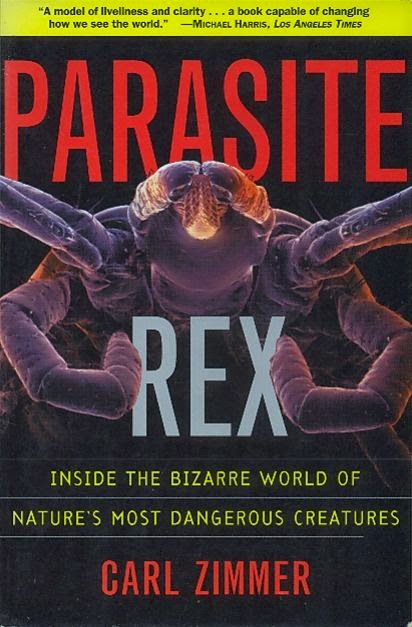
Parasite Rex

Inside the Bizarre World of Nature's Most Dangerous Creatures

It's a disturbing fact that the body of any creature, including our own, is potential habitat. We are a house and the mice want in. Or as the prologue puts it: "a vein is a river."

The life cycle of a parasite can be ingenious, complex, and gruesome, and the book provides some startling examples. Among the 16 pages of b&w photos you'll find one of a crustacean that has devoured the tongue of a fish and taken its place. But what makes this book remarkable is that it goes beyond such sensational examples and addresses broader issues.

Parasites, it seems, have been practising their trade since the dawn of life, and any ecosystem without them is likely to be unhealthy. Parasites may even have been responsible for the development of sex and language.

Then there are social parasites, like the cuckoo. Ultimately we ourselves may be seen as parasites -- with the planet our host.

Behaviour Modification

One of the truly shocking aspects of parasitism is the ability of some organisms to alter the behaviour of their host. Toxoplasma causes rats to be less wary of cats, the parasite’s final host.

Ants that have ingested lancet flukes leave their sisters and spend the night at the top of a blade of grass, the better to be consumed by a grazing mammal.

Sacculina, a parasitic barnacle, penetrates a crab’s leg joint, sends out "roots" through the crab’s entire body, and emerges as a sac on its ventral surface. The crab loses its ability to reproduce, becoming "genetically speaking, a zombie: one of the undead serving a master."


...parasites such as Sacculina...control their hosts, becoming in effect their new brain, and turning them into new creatures. It is as if the host itself is simply a puppet, and the parasite is the hand inside.


Makes one think of Heinlein’s Puppet Masters, and the movie Alien, doesn’t it? The author mentions them too.

Carl Zimmer

I enjoyed Parasite Rex so much that I immediately went out and bought two more of Zimmer’s books. Check out his website, which contains numerous articles he has written, as well as Chapter 1 from this book.

You can also find a link to his blog on Discover’s website, and there a link to a a photo gallery of scientific tattoos, the basis for a cool book coming out this fall called Science Ink.

Zimmer has had a tapeworm named after him.

A Few More Quotes


It’s time to put the parasite alongside the lion.

Castration is a strategy that any number of parasites have hit on independently...

Parasites have been a dominant force, perhaps the dominant force, in the evolution of life.

There are more human intestinal worms than humans.

Wednesday, June 15, 2011

For Love of Insects

Science fiction writers in need of an alien or two have only to peruse this book for inspiration. There's the bombardier beetle, for instance, which is capable of discharging with great accuracy jets of boiling acid from its butt.

Yes, boiling.

Spraying is only one way to deliver a toxic substance. Some millipedes, for example, ooze cyanide from glandular pores. Others creatures, lacking defensive glands, are reflex bleeders – their toxic bodily fluids leak out from easily ruptured cuticle. Additional delivery methods include defensive vomiting and defecating. Yowza!

Larvae of the leaf beetle protect themselves by extruding fecal matter in long strands, which they then attach to themselves until they are completely hidden from view, creating the appearance of a tiny haystack.

Some insects practice seminal gift giving. In one species of moth, males lose 10% of their mass when mating. They transfer not just sperm to females, but also nutrients and protective alkaloids. Copulation takes upward of 9 hours.

Butterflies engage in a strange behaviour called puddling. They drink and expel prodigious amounts of water (eg 600 times their body mass) in order to acquire sodium, which is then transferred to females during mating.

Bolas spiders, which do not make webs, bring down their prey bola-style, using a thread with a drop of glue at the end.

These are only a few of the creatures you'll meet in this wonderful book, which is packed with brilliant colour photos that illustrate the bizarre goings-on of insects and arthropods.

The author, Thomas Eisner, is one of the fathers of chemical ecology. He tells us that probably far less than half of all insect species have been discovered, leaving unknown a vast reservoir of chemical compounds. "Chemical prospecting in the world of insects can still bring real rewards," he writes.

He passed away earlier this year.

Monday, March 21, 2011

Postcards from Mars

The First Photographer on the Red Planet

This is as close to Mars as most of us will get, a coffee table book with photos taken by the two Mars Rovers that arrived there in January of 2004. You may remember the event, especially the landing procedure, which involved bouncing the airbag-encased landers across the Martian surface.

Jim Bell, the book's author, is the lead scientist for the Pancam colour imaging system on the Rovers. He gives an interesting behind-the-scenes account of the mission -- launch preparations, technical problems, communication challenges -- but book's main attraction is the 150 or so photos. Postcards he calls them, but not because of their size. You'll actually need a coffee table to spread out the double-page fold-outs. There are four of them, each almost four feet long.

The two rovers, Spirit and Opportunity, arrived on opposite sides of the planet, Gusev Crater and Meridiani Planum -- not the most exciting places visually or scientifically, but for landing purposes they were a necessary trade-off. Nearly half of spacecraft send to Mars in the last 40 years have failed.

Spirit

Gusev Crater was thought to have once have been a lake, but Spirit found no sedimentary rocks, only a rugged lava plain with "dry, primitive volcanic basalts." It therefore set out for the Columbia Hills, 3-4 km distant, where it discovered evidence of layering in outcrops.

Along the way it overcame a wonky wheel and power problems caused by dust on the solar panels. By utilizing slopes oriented toward the sun, and with the fortuitous intervention of the wind, NASA scientists were able to keep the rover alive.

The panoramas are mostly flat desert-like expanses littered with rocky rubble. The light is dim, and the sky is a paler shade of the rust-coloured terrain.

Opportunity

Meridiani turned out to be very different from Gusev -- darker soils, prominent sand dunes, and weathered outcrops that reminded me of the Canadian Shield. More importantly there were BB-sized hematite "blueberries," and a mineral called jarosite in layered sedimentary deposits -- "key evidence that there was once liquid water on Mars...either on the surface in a lake or shallow sea, or just below the surface in extensive underground aquifers or groundwater systems."

The presence of water, however, does not guarantee an environment hospitable to life. On Mars the abundance of sulfur might have resulted in water too acidic for organic molecules to form.

More Mars

A cool companion to this book is the documentary film, Roving Mars. It recreates the Rovers' journey with a combination of actual images and computer-animated graphics. A delightful bonus is the hour-long episode, "Mars and Beyond," that aired in 1957 on the TV program "Disneyland," and is introduced by Walt himself.

When the book and the film came out in 2006, the two rovers were still functioning, having far exceeded their expected travelling distance of 600 meters and life expectancy of 90 Martian days (aka "sols," 39 minutes longer than Earth days). In 2009 Spirit got mired in soft sand, but Opportunity is still carrying out its mission. Current info on the rovers, including updates from Opportunity, is available at the following sites:

Mars Exploration Rover Mission
NASA - Mars Exploration Rovers

Finally, more info about the book can be found on the author's website, including a few images from the book.

Saturday, May 1, 2010

Your Inner Fish

A Journey into the 3.5-Billion-Year History of the Human Body

Paleontologist Neil Shubin begins with a brief account of his role in discovering an ancient creature intermediate between a fish and a land animal. Its fossils were found on Ellesmere Island in the Canadian Arctic in 2004, and the creature was given the Inuit name Tiktaalik.

Later, Shubin pays another visit to Canada, this time the fossil beds near Parrsboro, Nova Scotia, on the Bay of Fundy. There they found rare fossils of the tritheledont, a reptile whose teeth showed mammalian characteristics.

Shubin uses these events to anchor a description of how our anatomy contains links to more primitive creatures. For example: "Tiktaalik has a shoulder, elbow, and wrist composed of the same bones as an upper arm, forearm, and wrist in a human."

Following are a number of observations that I found interesting.  

Human Embryos

1. They have four gill arches, which ultimately develop into jaws, ears, larynx and throat.

2. They have a notochord, which breaks up and forms the disks that cushion our vertebrae.

3. At an early stage in their development, their elbows and knees face the same direction, as do fish and amphibians.

4. Gonads are initially located high up in the body, as in fish.

Evolution

1. Two factors may have been involved in the evolution of bodies: predation, and the rise in atmospheric oxygen.

2. "The origin of mammals involved not only new patterns of chewing...but new ways of hearing... Bones originally used by reptiles to chew evolved in mammals to assist in hearing."

Genetics

Shubin also describes some of the Dr. Moreau-like tinkering that scientists have done in order to understand how genes work. Some of the genes he mentions are Noggin, Pax 6, and Sonic hedgehog.

1. Genes from the embryo of one animal (e.g. a mouse), when grafted to the embryo of another (e.g. a shark), can perform the same function.  This leads to a conclusion such as: "all appendages, whether they are fins or limbs, are built by similar kinds of genes."

2. "Inject extra amounts of frog Noggin into a frog egg, and the frog will grow extra back structures, sometimes even a second head."

3. Turning on an "eyeless" gene can result in creatures growing eyes virtually anywhere on the body. For example, "they could use the mouse gene to trigger the formation of an extra fly eye anywhere: on the back, on a wing, near the mouth."

Trivia

1. Fish have no necks.

2. Tooth replacement in reptiles continues throughout their entire lives.

3. Some creatures, like single-celled microbes, have no body at all.

4. Some creatures have no anus, they expel waste through their mouth e.g. jellyfish and corals.

Wednesday, September 16, 2009

A Brief History of Time

Stephen Hawking is a writer of cosmological space westerns, the most famous of which is this book, A Brief History of Time. His use of literary devices such as imaginary time and virtual particles makes our universe seem like the world of Bizarro in Superman comics, or an updated version of Alice in Wonderland.

Characters

First of all there’s Newton, a rather nasty fellow who pursued counterfeiters all the way to the gallows. Einstein was much nicer, but he disliked gambling, especially with dice. Heisenberg couldn’t make up his mind about anything, Godel proved nothing was provable, and Feynman said everything was possible. Fortunately most of these guys have a sense of humour, like the comedy team of Alpher, Bethe, and Gamow.

The villains of the book are as odd a bunch as you’ll find this side of a pack of cards. There’s a secret society of Mesons, and a couple of clowns named P-Brane and Glueball, and the weak but chubby Massive Vector Bosons.

Then there’s the Quarks, a slippery bunch named after a passage in James Joyce’s Ulysses, and described by Hawking as “somewhat metaphysical.” Thus did modern literature influence particle physics – not just in the trivial matter of names, but in the very subjectivity of existence.

Or to put it another way, stream-of-consciousness helped pave the way for quantum mechanics.

Plot

This is your basic coming-of-age story.

Quotes

A black hole has no hair.

String theory is rather like plumbing.

The universe is the ultimate free lunch.

The total energy of the universe is exactly zero.

Why do we remember the past but not the future?

An ordinary particle moving forward in time is equivalent to an antiparticle moving backward in time.

Black holes are not really black.

The Author

In my copy of this book, the previous owner had left a newspaper clipping dated 1995. It announced Hawking's second marriage. His first wife was quoted as saying that Hawking “is in the grip of forces that he can’t control.”

Of course, that is literally quite true. In 1963 he was diagnosed with ALS and given no more than two years to live. Yet despite being almost completely paralyzed and no longer able to speak, he's become a world-famous theoretical physicist and cultural icon. He’s addressed NASA, experienced zero-G, and appeared on numerous TV shows, including a famous episode of ST:TNG.

His picture on the book’s cover -- a crumpled body against a backdrop of stars -- sums up the pathos of human existence.

A Brief History of A Brief History

1988 - A Brief History of Time
1996 - The Illustrated A Brief History of Time: Updated and Expanded Edition
1998 - A Brief History of Time: Updated and Expanded 10th Anniversary Edition
2005 - A Briefer History of Time (with Leonard Mlodinow)
2008 - A Brief History of Time: 20th Anniversary Edition

More Cosmological Westerns

Interested readers might try the Shrodinger's Cat trilogy by Robert Anton Wilson, and The Black Hole War: My Battle with Stephen Hawking to Make the World Safe for Quantum Mechanics by Leonard Susskind.

Tuesday, January 20, 2009

Descartes' Secret Notebook

A True Tale of Mathematics, Mysticism, and the Quest to Understand the Universe

Descartes continues to fascinate us not just because he was a titan. He lived in a strange and unruly age, and led the sort of life one would not expect of a philosopher. He was a gentleman soldier and intellectual tourist whose life continues to provide a rich field of speculation for writers three centuries after his death.

The raison d'etre of this new biography is a secret notebook found after Descartes' death. It was written in code because (argues the author) it contained information that Descartes felt would endanger his life should the Inquisition get wind of it.

Leibniz apparently cracked the code but kept the secret to himself. (He was preoccupied by a feud with Newton over calculus.) Not until 1987 was the code deciphered and made public. Descartes had discovered a formula regarding geometric figures that is a property of space itself, and a foundation for the science of topology. A century after his death this formula was rediscovered by the Swiss mathematician Euler.

Descartes' Secret Notebook is smoothly and gracefully written, and its author, Amir Aczel, who is himself a mathematician, concisely explains some of the esoteric aspects of Descartes' work. Best of all are the final three chapters, which describe events after Descartes' death, including the involvement of Leibniz.

Existentialism

Descartes was a Catholic and took great pains not to run afoul of the Church, as Galileo had. Aczel quotes him as writing, "Fear of God is the beginning of wisdom." How ironic then that another Frenchman, 300 years later, would take a very different view. Sartre, an atheist, writes in Nausea, mocking Descartes:


I am, I exist, I think, therefore I am; I am because I think, why do I think? I don't want to think any more, I am because I think that I don't want to be, I think that I...because...ugh! I flee.


Both men lived through times of great upheaval in Europe -- Descartes the Thirty Years War and Sartre WW2, during which he spent nine months as a POW.