Showing posts with label France. Show all posts

Saturday, April 12, 2014

The Enormous Room

In 1917 Edward Estlin Cummings, whose name is better known in lower case, ee cummings, joined a voluntary ambulance corps in France. He and a close friend, William Slater Brown, ran afoul of their American section chief for, among other things, associating with "them dirty Frenchmen."

Unbeknownst to them, they also ran afoul of censors for expressing anti-war sentiments in their letters home, and as a result were incarcerated in a military detention camp for suspected spies. It was an ordeal that Cummings could easily have avoided by saying he hated Germans. This he refused to do, in part because he felt it would be a violation of his friendship with Brown.

Cummings recorded his experiences in this autobiographical novel, named after the pillared high-ceilinged room in which some 60 men were confined. Many he came to regard as "some of the finest people in the world," and despite the brutish conditions, foul food, and bullying officials, he looked back on his time there as one of the happiest in his life.

Cummings of course went on to become one of the most prominent poets of the 20th century, and the energy of his language is evident throughout. He spices every page with French phrases, and takes great joy in deriding the French government, the prison officials, and authority in general. His descriptions of people are particularly fine, and in the latter portion of the book he devotes a chapter each to four he especially liked.

The Wanderer
His wife and children were held in the women's quarters of the camp, save his little son who stayed with him and the other men in the Enormous Room. The Wanderer's quiet stoicism, his deep love for his family, and the child's reckless energy make a moving portrait indeed.

The Zulu
A Polish farmer exceedingly generous with money that he conjured up out of thin air. Though he could not write and spoke only Polish, he was capable of communicating on any subject with the greatest of ease and the finest nuance of meaning, without speaking a word.

Surplice
Religious and hard-working, yet ignorant and vilified by all, he embraced his position at the bottom of the pecking order in the Enormous Room. "To be made a fool of was, to this otherwise completely neglected individual, a mark of distinction; something to take pleasure in; to be proud of."

Jean le Nègre
The most remarkable character in the book: vain, irrepressible, full of laughter, energy, and nonsense. He arrived at the camp after being caught impersonating an English officer, at which he...


...announced that he was a Lord of the Admiralty, that he had committed robberies in Paris to the tune of sees meel-i-own franc, that he was a son of the Lord Mayor of London by the Queen, that he had lost a leg in Algeria, and that the French were cochons.


Cummings suffered a "mental catastrophe" when his friend Brown was removed from the camp. Other prisoners recognized his "disordered mind" and treated him kindly, "kinder than I can possibly say." When informed that he was to be released, he astonished the camp director by saying, "I should rather have gone to prison with my friend."

Final Notes & Links

The Enormous Room is a not-quite-forgotten classic. It's been in print ever since it was first published in 1922 and can be found online in a number of places.

Strangely there appear to have been at least three different editions, but how much they differ I cannot say. The most recent seems to be from Liveright/Norton. It "restores to the work much material that was deleted from the manuscript for the book's 1922 publication and is illustrated with drawings Cummings made while imprisoned in France."

The Poetry Foundation's entry on Cummings
Literary ambulance drivers

Saturday, October 24, 2009

Descartes' Bones

A Skeletal History of the Conflict between Faith and Reason

Descartes is:

a) the father of modern philosophy
b) the intellectual father of modern France
c) the author of one of the most influential books of all time
d) as peripatetic after death as before

Who would have guessed the last point? In 1650 Descartes died in Sweden, where his remains stayed for 16 years until exhumed and returned to France. But upon opening the casket, the skull was discovered missing and the rest of the skeleton to be in poor condition. Many of the bones had dissolved into dust.

The unravelling of this mystery spans several centuries, and sounds as fantastic as a Dan Brown novel. When the skull was finally located, it was covered with graffiti -- a poem in Latin and the signatures of successive owners.

This part of the story reminded me of the bizarre travels of Einstein's brain, and the stuffing and mounting of Jeremy Bentham's body topped off with a wax head, which itself has wandered off on more than one occasion.

But no less fascinating is the role that Descartes' bones continued to play in advancing science. In telling this part of the tale, the author elucidates some aspects of the Enlightenment, drops in on the French Revolution, and spends time with Broca, Cuvier, and other famous figures. Phrenology, the Society of Mutual Autopsy, and the weight of Byron's brain are just some of the odder corners of science visited.


The world's greatest assembly of scientists had reached a conclusion, one that rested not on an ideal of certainty but on the modern notion of probability. They had applied their doubts to the very head that had introduced doubt as a tool for advancing knowledge. And in the end they gave the head a nod.


This is a great book. Check out its website.

Wednesday, January 28, 2009

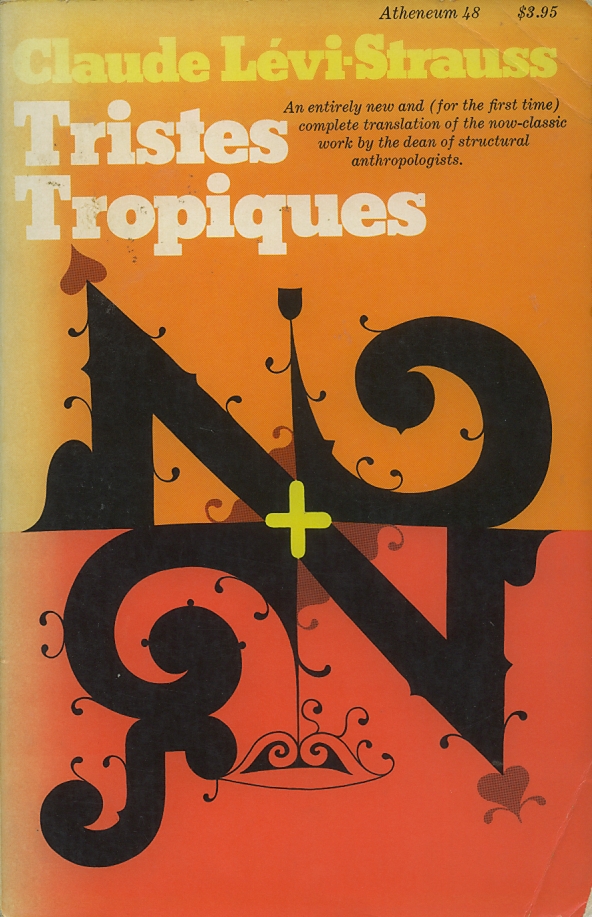
Tristes Tropiques

Part memoir, part travelogue, and part anthropological essay, this is Levi-Strauss's most personal book.

He mentions his debt to Rousseau, his attachment to Marxism, and his rejection of Existentialism. He devotes six pages to describing a sunset, summarizes a play he'd written based on one by Corneille, and describes his escape from France during WW2 (which played out in my mind like a scene from Raiders of the Lost Ark).

The writing is often erudite and abstruse, yet enlivened by arresting phrases (the "nostalgic cannibalism of history"); arresting ideas ("the primary function of written communication is to facilitate slavery"); and arresting images (the moon "an anguished lantern drifting across the sky," cultivated fields like "geographical musings by Paul Kee," and "date merchants with their produce piled up in sticky mounds of pulp and stones suggesting the excreta of some dinosaur").

The bulk of the book, and the most accessible part, describes the time spent by the author among the Bororo and the Nambikwara in South America. Here are poisoned arrows and penis sheaths (foreskin required), brazil nuts big enough to kill if they struck an unlucky head, parasitic fish able to swim up a stream of urine, and an astonishing 4-hour opera performed by a man in a trance.

The book communicates the dizzying intoxication of anthropology, especially in its narcissistic examination of primitive cultures (though it made me wonder to what extent anthropologists themselves, by their prying and poking, contribute to the wreckage of such societies).

Levis-Strauss, himself brooding on the role of anthropology, points out that it is a discipline that only Western society has produced. The anthropologist "is incomprehensible except as an attempt at redemption; he is the symbol of atonement."

Tuesday, January 20, 2009

Descartes' Secret Notebook

A True Tale of Mathematics, Mysticism, and the Quest to Understand the Universe

Descartes continues to fascinate us not just because he was a titan. He lived in a strange and unruly age, and led the sort of life one would not expect of a philosopher. He was a gentleman soldier and intellectual tourist whose life continues to provide a rich field of speculation for writers three centuries after his death.

The raison d'etre of this new biography is a secret notebook found after Descartes' death. It was written in code because (argues the author) it contained information that Descartes felt would endanger his life should the Inquisition get wind of it.

Leibniz apparently cracked the code but kept the secret to himself. (He was preoccupied by a feud with Newton over calculus.) Not until 1987 was the code deciphered and made public. Descartes had discovered a formula regarding geometric figures that is a property of space itself, and a foundation for the science of topology. A century after his death this formula was rediscovered by the Swiss mathematician Euler.

Descartes' Secret Notebook is smoothly and gracefully written, and its author, Amir Aczel, who is himself a mathematician, concisely explains some of the esoteric aspects of Descartes' work. Best of all are the final three chapters, which describe events after Descartes' death, including the involvement of Leibniz.

Existentialism

Descartes was a Catholic and took great pains not to run afoul of the Church, as Galileo had. Aczel quotes him as writing, "Fear of God is the beginning of wisdom." How ironic then that another Frenchman, 300 years later, would take a very different view. Sartre, an atheist, writes in Nausea, mocking Descartes:


I am, I exist, I think, therefore I am; I am because I think, why do I think? I don't want to think any more, I am because I think that I don't want to be, I think that I...because...ugh! I flee.


Both men lived through times of great upheaval in Europe -- Descartes the Thirty Years War and Sartre WW2, during which he spent nine months as a POW.

Tuesday, January 13, 2009

The Erasers

Nine murders have taken place in nine days, all at exactly the same time. Special agent Wallas is sent to investigate the most recent death. He's new at the job and it's a confusing case. He spends a lot of time walking the streets and getting lost. He stops in at several shops to buy an eraser.

Soon the reader is as confused as Wallas. It's difficult to know what's real and what's imagined. Even the identity of certain characters, who are often described in terms of the coats they wear, becomes blurred. The writing is packed with banal detail, often in the form of numbers and measurements, as though this is the only way to pin down what's demonstrably real:


...on a bed of toast, spread with margarine, is arranged a broad filet of herring with silvery-blue skin; to the right, five quarters of tomato, to the left, three slices of hard-boiled egg; set on top, at specific points, three black olives.


Finally Wallas, who is on job probation, begins to doubt himself. At the post office he receives a "pneumatic message" that appears to be incriminating. It seems that he physically resembles the alleged murderer and has the same type of gun that was used in the shooting. When he returns to the scene of the crime, he ends up killing the man whose death he was sent to investigate.

Characters

Roy-Dauzet - Minister of the Interior, who, distrusting his own police force, sends Wallas to take charge of the investigation.

Commissioner Laurent - the local police chief.

Daniel Dupont - a professor who receives a superficial gunshot wound.

Albert Dupont - a wood exporter mistakenly identified in the newspaper as the original victim, later killed in an auto accident.

Dr. Juard - a gynecologist who issues a fake death certificate to protect Daniel Dupont's life.

Marchat - a wood exporter in collusion with Juard and Daniel Dupont who comes to believe that he is the next victim.

Garinati - bungles the murder of Daniel Dupont.

Jean Bonaventure - Garinati's boss, aka Bona.

Fabius - the best sleuth in Europe, adept at disguises, Wallas's immediate superior.

Madame Dupont - Daniel Dupont's estranged wife, from whom Wallas purchases an eraser.

Jean - Daniel Dupont's illegitimate son, who may or may not exist.

Anna Smite - Daniel Dupont's half-deaf housekeeper who thinks Juard killed Dupont.

Juliette Dexter, Emilie Lebermann, and Madame Jean - post office employees.

Andre WS - the addressee of the "pneumatic message," described by post employees as resembling Wallas; the message's sender is indicated by a set of initials, J.B.

Madame Bax - a watcher at a window.

Nameless drunk - keeps turning up at the Cafe des Allies, where Wallas is lodging, to ask meaningless riddles.

Nouveau Roman

The Erasers was first published in 1953 as Les Gommes. At its most superficial, it could be read as a humourless parody of a detective novel, a recursive tale that keeps doubling back on itself. At a deeper level, it's a statement about the nature of reality.

The author, Alain Robbe-Grillet, was a leading figure in the nouveau roman movement. The translation is by Richard Howard.

Tuesday, January 29, 2008

Descartes

The Life and Times of a Genius

One of my favourite biographies is a life of Pepys by Claire Tomalin. Pepys lived in the 17th century and was a child during the English Civil War, of which Tomalin said something quite remarkable: the intellectual revolution accompanying it was so profound that it is difficult to understand how people thought before it occurred.

That remark was much in my mind as I read this new biography of Descartes, who also lived in the 17th century. It was a time when religion and science were closely linked, and science itself based upon the discoveries of the ancient Greeks, filtered through centuries of Scholastic thought.

People believed the sun revolved around the earth, and that angels, humans, and animals were linked in a “great chain of being.” There were four elements in the universe (earth, air, fire, and water), and four humours in the body (blood, phlegm, black bile, and yellow bile), the balancing of which was necessary to maintain good health. Vying with this traditional approach to knowledge was “a heady mixture of notions, beliefs and practices from cabalistic, occult, astrological, alchemical, hermetic and magical sources.”

Into this array of the hidebound and the bizarre stepped Descartes, whose great contribution to science was the assumption that "the natural world can be examined and understood as a system of matter in motion obeying natural laws, without the need for any invocation of supernatural forces or agencies."

He proposed to do this by jettisoning the past and starting anew, basing all science on what could be known for certain – hence his starting point, Cogito ergo sum. He promulgated this approach in his famous Discourse on Method, and applied it in his own investigation of the natural world, which included the grinding of his own lenses and the dissection of cadavers.

His Life

Descartes lived a rather adventurous life for an intellectual barely five feet tall. He spent several years wandering about the continent when it was embroiled in the Thirty Years War (1614-1648), which began as a religious conflict and devastated central Europe. He was, for a period, a mercenary, first joining the Protestant army of the Prince of Orange, and then the Catholic army of Maximilian of Bavaria. He was with the latter at the Battle of the White Mountain (near Prague) where the Protestant forces of Frederick of the Palatinate were routed. [Other sources have also placed him at the infamous siege of La Rochelle, where Cardinal Richelieu starved to death 20,000 Huguenots.]

The author of this bio, A.C. Grayling, has an interesting theory for why Descartes so often turned up in contentious areas in Europe. He may have been a Jesuit intelligence agent. Descartes was educated by Jesuits, who in turn encouraged the Habsburg rulers of the Holy Roman Empire to reclaim Catholic territories lost to Protestant forces during the Reformation.

If true, it may explain why Descartes spent the remaining portion of his life in the Protestant Netherlands. His pro-Habsburg Jesuit interests would not have endeared him to France, which had reasons of its own for opposing Habsburg ambitions. The need for caution was further underlined when in 1633 Galileo was tried for heresy by the Inquisition, and required to remain under house arrest for the remainder of his life. Descartes immediately abandoned plans to publish his masterwork, Le Monde, and changed residences frequently.

Whether or not Descartes was a spy, it was a good time to be in the Netherlands, which was not only wealthy and tolerant, but also enjoying the Dutch Golden Age. Descartes wrote all of his major works there, and shared with Rembrandt the patronage of Christiaan Huygens's father. It was there he met Princess Elizabeth of Bohemia, with whom he struck up a close intellectual relationship.

When he finally did venture back to France, he supped with Thomas Hobbes and met Blaise Pascal, who showed him the calculating machine he had made (“the first ever computer, based on the technology of knitting machines”). Improbably his life came to an end in Sweden, where he was enticed by Queen Christina to serve as her personal tutor.

Grayling points out several ironies here. Princess Elizabeth was the daughter of Frederick, the Elector Palatine, whom Descartes helped to overthrow at the Battle of the White Mountain. Christina of Sweden was her cousin, and daughter of the great Gustavus Adolphus, who brought Sweden into the Thirty Years War on the Protestant side. Christina was instrumental in ending the war, and after Descartes died she abdicated and converted to Catholicism.

His Legacy

Many of Descartes’s scientific notions were wrong. Indeed, some of them sound as unlikely as other crackpot ideas of the time. He believed that the pineal gland was the seat of the soul, that the motion of the planets is explained by vortices in a universal fluid, and that vision results from "pressure on the eye" by that fluid.

Despite these missteps, Descartes is today considered the “Father of Modern Philosophy.” Among other achievements he discovered the law of refraction and created analytic geometry, which is taught in high schools today. His Discourse on Method is one of the seminal texts of the modern world. After four centuries the book is still in print and taught in universities around the world.